Saturday, October 25, 2008

Shedding Some Light on Thomas Welsh. . .

Brigadier General Thomas Welsh
I had the great privilege today to participate in a symposium commemorating the life and forgotten services of Columbia, Pennsylvania's "favorite son," Brigadier General Thomas Welsh. I have a great interest in those Civil War figures who have never fully received their due, including Welsh. What particular draws me to General Welsh is the similarities between him and Brigadier General James Nagle, who I have championed on this blog for the past two years. Welsh and Nagle were natives of Pennsylvania, both served as volunteers in the Mexican-American War (Nagle as a captain, Welsh as a sergeant and then lieutenant), both became leading members of the respective communities, Nagle of Pottsville and Welsh of Columbia, and both answered the nation's call again in 1861. Nagle organized the 48th Pennsylvania, Welsh, the 45th Pennsylvania. Both units served in the 9th Corps, and both Welsh and Nagle would rise to the rank of brigadier general of volunteers. And, sadly, both died way too young. Welsh succumbed to malaria in August 1863 at the age of thirty-nine; Nagle died of heart disease almost exactly three years later, in August 1866, at the age of forty-four. Because of my interest in both Welsh and the 9th Corps, an interest that dates a long ways back, when I was asked earlier this year if I would be interested in participating, I jumped at the chance. I am very glad that I did so.
Mr. Rick Wiggin, a descendant of General Welsh, organized this symposium event, the second annual. In addition to my presentation, the were three others that addressed Welsh's service in the Mexican War (where he fell seriously wounded at Buena Vista, a musket ball shattering his leg), the burning of the Columbia-Wrightsville Bridge on June 28, 1863, and the reaction of the people of Columbia to the memorable, if sometimes overstated event, including that of Welsh's wife, Annie, and, finally, Welsh's legacy to his community and his country.
The symposium started at 1:00 p.m., but I arrived in Columbia an hour or so ahead of schedule so I figured I'd pay my respects to the general, buried in the Mount Bethel Cemetery.
As I searched the graveyard, I, of course, snapped some pictures of other Civil War burials. One grave that caught my attention was that of Major Edward Kelsey, of the 45th PA, mortally wounded at Cold Harbor. Note the very distinctive 9th Corps badge on the stone:


As I continued walking through the cemetery, I came across another interesting grave, that of George W. Derrick, a 43-year-old private in Company B, 45th, who was killed in action at the Crater in July 1864.


At last, I came upon General Welsh's burial site. Welsh survived bullets in two wars, only to fall victim to malaria during the final days of the Vicksburg campaign in the summer of 1863.

After wandering through the cemetery, I made my way to the Columbia Public Library, which sponsored the symposium. It was a great pleasure to meet Mr. Wiggin, and the other presenters. I spoke of Welsh's role at the battle of Antietam, and argued that not only was the battle one of missed opportunities for the Army of the Potomac, but it was also one of missed opportunities for Thomas Welsh as well. He and his men stood on the precipice of greater laurels during the 9th Corps's afternoon attack against Lee's critical right flank, only to have that opportunity vanish when orders were received to fall back just as Welsh's men were reaching the very streets of Sharpsburg itself and just on the verge of a decided victory. Judging from the feedback I received, the talk went over very well with both my fellow presenters and the audience, which numbered well over fifty people. Seeing the great turnout and appreciating Mr. Wiggin's efforts in helping to shed light on Welsh's forgotten service, I am somewhat tempted to organize a similar symposium-type event commemorating General Nagle. Stay tuned.
In addition to the great pleasure it was to participate, I had the opportunity to view many of Thomas Welsh's personal effects, generously displayed by Mr. Rick Abel, an avid collector of Welsh artifacts and memorabilia.

Welsh's epaulettes. . .note the circular "45's" and the eagles, plus the star on the epaulette, each indicating rank.
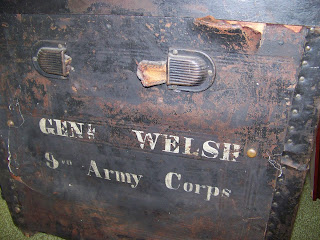
Welsh's personal trunk. This trunk was sent home following Welsh's death, containing the general's personal items.
Last, but certainly not least, I had the honor of holding Welsh's Civil War combat sword. . .a sword he very well may have wielded during the heavy action at South Mountain and Antietam.

Tuesday, October 21, 2008

Lincoln President-Elect: Abraham Lincoln and the Great Secession Winter, 1860-1861, by Harold Holzer

In just two short weeks, Americans will elect their next president, the nation's forty-fourth. No matter the victor, this year's election will no doubt go down as a historic one. But perhaps America's most historic presidential election, and certainly the most significant, occurred 148 years ago, in November 1860.
With threats of secession and the "momentous issue of civil war" at stake, and as the nation headed further toward that "irrepressible conflict," Americans elected Abraham Lincoln, of Illinois. Although he received the lowest percentage of votes in American history (less than 40%), and although his name did not even appear on the ballots in several of the Deep South states, Lincoln prevailed in large part due to the divided Democratic Party--which ran two candidates, Stephen Douglas and John Breckinridge--and yet another contender, John Bell, of the short-lived Constitutional Union Party. Following Lincoln's election, America entered, in the words of Henry Adams, the "Great Secession Winter" of 1860-1861, during which seven states left the Union while the lame-duck president James Buchanan did little, if anything, to stop them. To say, then, that president-elect Lincoln would assume a difficult challenge upon entering the White House in March 1861 would be an exercise in understatement.
Being both fascinated by Abraham Lincoln and having a great interest in American presidential history, I agreed several weeks ago to read and review Lincoln President Elect, by Harold Holzer, one of the nation's foremost Lincoln scholars. With nearly 500 pages of text, this book provides a detailed day-by-day and, in some cases, minute-by-minute account of Abraham Lincoln's actions and decisions from his election in early November 1860 until his inauguration in early March 1861. With a clear and fast-paced style, Holzer takes us through Lincoln's period of "masterly inactivity" as the nation drifted apart and explains Lincoln's stoicism in refusing to agree to or promote any kind of compromise that would address the "grievances" of the South and attempt to save the Union by essentially overturning the decision of the American people in electing Lincoln. We learn of Lincoln's efforts to establish a presidential image, the difficulties he encountered in trying to shape his Cabinet, and how he was continually besieged, even plagued by office-seekers. At the same time, Holzer recounts Lincoln's historic inaugural journey, including his infamous passage through Baltimore, and his drafting of his famed first inaugural address. In summarizing Lincoln's actions during that Great Secession Winter, Holzer writes, "[He] had successfully maintained a masterly inactivity and public silence to prevent the spread of slavery, privately fought a bare-knuckle political battle to bar unprincipled compromise, and brilliantly introduced himself to the press and people of the North with a new look, new images, and a new style of informal oratory along a triumphant voyage to the capital. And then, despite a giant step backward at Baltimore that might have crippled less agile leaders, he had recaptured public confidence while harmonizing a balanced and brilliant cabinet. And," concludes Holzer, "he had crafted one of the nimblest and most eloquent of all inaugural addresses, one that not only reiterated his devotion to the rule of law and invoked the emotional power of national tradition, but maintained that slavery could be maintained without compromising founding principles." [Pg. 458]
In the end, Holzer presents a convincing challenge to the established notion of a wavering, uncommitted, and perhaps even delusional Abraham Lincoln in the wake of his election. At the same time, he further cements himself as an eminent Lincoln scholar. I enjoyed reading Lincoln President Elect and believe that others, with similar interests in Civil War and presidential history, will enjoy it as well. In the seemingly endless catalog of Lincoln titles that has already appeared and will continue to do so over the next year as Americans commemorate the 200th Anniversary of Lincoln's birth, this work will surely rank among the best and most important.

Wednesday, October 15, 2008

$4,000.00 Mark Passed. . .

Just a quick update. . .

A little over six months ago--back on April 5--I launched an effort to restore the 48th PA monument at Antietam by raising money to replace the missing sword from the bronze statue of Brigadier General James Nagle.

I have been most pleased with the progress thus far of this undertaking and have gotten some good press, including a full-page in the current (November) issue of America's Civil War.

Today I received a generous donation that brought the total amount of money raised over the $4,000.00 mark.

This means we need just $2,800.00 to go. I anticipated the fundraising to last over a year, but at this rate it seems we will get there sooner rather than later.

If you are interested in donating, or if you would like to learn more about the project, please visit www.amonumentaltask.blogspot.com

Sunday, September 28, 2008

Getting To Know. . .Eliakim Parker Scammon


I'm willing to bet not many out there in the Civil War community are readily familiar with Union general Eliakim Parker Scammon. . .the cool name notwithstanding. So let's take the time to get to know this rather obscure officer.
* * * * * * * * * * * * * * * * * * * *
Educated at West Point, Colonel Eliakim Scammon seemed to enjoy more success as a scholar in the classroom than as a commander on the field of battle. Born in Whitefield, Maine in 1816, Scammon graduated from the United States Military Academy in 1837, ranking ninth in a class of fifty graduates. Among Scammon’s classmates in the illustrious Class of 1837 were future Civil War Generals Braxton Bragg, Jubal Early, John Pemberton, John Sedgwick, and Joseph Hooker. He entered the artillery upon his graduation, but one year later was transferred to the corps of Topographical Engineers. Scammon served against the Seminoles in Florida, then, as a first lieutenant, saw action in the Mexican-American War as a member of General Winfield Scott’s staff, serving alongside Robert E. Lee and George B. McClellan. Following the signing of the Treaty of Guadalupe-Hidalgo, which ended the war with Mexico in 1848, Scammon performed surveying duties along the northern lakes. In 1855, he was promoted to captain and the following year, was sent to the New Mexico Territory to help map and construct roadways. However, on June 4, 1856, Scammon was dismissed from the service for disobedience of orders and for “Conduct to the Prejudice of Good Order and Military Discipline.” Apparently unconcerned with his dismissal, Scammon began his career in education later that same year when he accepted a professorship at St. Mary’s College in Ohio. After teaching here for two years, Scammon then became president of Cincinnati College, a position he held until the outbreak of the Civil War in 1861.
On June 14, 1861, a little more than five years after being forced out of the army, Scammon was named commander of the 23rd Ohio Volunteers, a unit known to history as the “President’s Regiment,” for in its ranks served a young Rutherford Hayes and a young William McKinley. The 23rd was assigned to what became known as the Kanawha Division, which initially served in the mountains of western Virginia. Scammon must have impressed his superiors, for in the fall of 1861 the forty-five-year-old professor was given brigade command. In the spring of 1862, the Kanawha Division, under the command of General Jacob Cox, was transferred to John Pope’s Army of Virginia, and then, in the early September reorganization of the Army of the Potomac, was attached to the 9th Corps. Scammon’s brigade was heavily engaged at South Mountain on September 14, 1862. During this battle, Lieutenant Colonel Hayes, leading Scammon’s 23rd Ohio, fell grievously wounded, and General Jesse Reno, commanding the 9th Corps, was killed. Command of the Ninth Corps devolved upon General Jacob Cox upon Reno’s death. Succeeding Cox in command of the Kanawha Division was Colonel Scammon, the division’s senior brigadier. Scammon thus held divisional command for less than three days before the battle of Antietam.
Although Scammon held command of the Ninth Corps’s Kanawha Division, his role at the battle of Antietam was minimal as he was left, essentially, without a command. His first brigade, under Colonel Hugh Ewing was attached to Isaac Rodman’s Division, which crossed Snavely’s Ford and supported the advance of Rodman’s two brigades during its attack on the afternoon of September 17. Scammon’s second brigade, under Colonel George Crook, made an aborted attack against the Lower, or Burnside’s Bridge, and later supported General Willcox’s Division in its advance toward Sharpsburg. The two brigades were thus separated. Total casualties in Scammon’s Kanawha Division at Antietam numbered 255, a figure that included 37 killed, 191 wounded, and 27 missing.
Despite his limited role at Antietam, Scammon was promoted to brigadier general of volunteers less than one month later, but was soon detached from the Army of the Potomac with the rest of the Kanawha Division and sent back to the mountains of western Virginia. Here Scammon served as both the commander of the Subdistrict of the Kanawha in the Department of the Ohio, and as the commander of the 1st Brigade in the Kanawha Division. In the early spring of 1863, he was once again given divisional command in this department. On February 3, 1864, Scammon was captured by Confederate guerillas while sleeping onboard on the SS Levi, a steamer that was anchored in the Kanawha River near Red House Shoals, West Virginia. Scammon was held as a prisoner of war for six months until exchanged on August 3, 1864. Upon his exchange, it was evident that Scammon’s health had greatly deteriorated during his months of imprisonment. In an effort to restore his well-being, Scammon was sent to South Carolina where, in October, he took command of the Northern District, Department of the South. Remarkably, a little more than two weeks after his arrival here, the hard-luck Scammon was once again taken prisoner. His time in confinement this time, however, lasted just five days. After his second exchange from a Confederate prison camp, Scammon was sent further south, where he served out the duration of the war as commander of the District of Florida, in the Department of the South.
Eliakim Scammon was mustered out of United States service on August 24, 1865. After the war, Scammon continued to serve his country, but this time in a diplomatic role. In 1866, he was made U.S. Consul to Prince Edward Island in Canada, a position he held for four years. Scammon then settled in New Jersey, where, in 1875, he once again entered the academic world, becoming a professor of mathematics at Seton Hall College. Retiring ten years later, Scammon spent the final years of his life in New York City. On December 7, 1894, ten days shy of his seventy-eighth birthday, Scammon succumbed to cancer. His remains were laid to rest in Long Island’s Cavalry Cemetery.

Friday, September 19, 2008

"His Death Cry. . .Is Still Heard In The Ear of Imagination:" The Death of Sergeant Alexander Prince, Co. B, 48th Pennsylvania

At the Battle of Antietam, the 48th Pennsylvania suffered a loss of 8 men killed and 51 wounded. While most of these losses were sustained on that bloody Wednesday, September 17, 1862, there were at least two men who lost their lives as a result of fighting on the following day. They were nineteen-year-old Private John Robinson, a laborer from Pottsville, and nineteen-year-old Sergeant Alexander Prince, a laborer from St. Clair, both of Company B. 

Prince was shot and killed while trying to succor a wounded man caught between the lines. To be gunned down while in this act of mercy within full view of the regiment naturally left a deep impression upon the soldiers of the 48th. Accounts of the incident were recorded in Captain James Wren's diary, as well as both regimental histories. 

On September 18, 1874, the twelfth anniversary of Prince's death, Oliver Christian Bosbyshell, former major of the 48th, penned the following account, which appeared in Pottsville's Miners' Journal:

* * * * * * * * * * * * * * * * * * * *

Position held by the 48th PA skirmishers at Antietam on September 18, 1862. . .Fence lines the Otto Farm Lane, looking west toward Branch Avenue, where Confederate pickets from A.P. Hill's and D.R. Jones's divisions exchanged shots with the 48th's skirmishers. 


The Story of Alexander Prince, Company B, 48th Pennsylvania
Miners' Journal, September 18, 1874
By Oliver C. Bosbyshell

"Who of the old members of the 48th regiment can ever forget Alex Prince, that noble Sergeant of Company B? He was a grand soldier and the embodiment of all the virtues that go to make up the true man. Handsome in person, tall, well built; a compact rounded figure straight as an arrow, a fine, clean, honest continence with large light lustrous, frank eyes. Foremost in the manner of the duty, strict in the discharge, but kind without fault, a soldier to be proud of, a friend to cherish and his nature to emulate. We read of a being who came to earth and took upon himself the nature of man, who lives a pure, spotless life and died ignominious of death for what that and through the sacrifice of humanity could gain eternal life. He gave his life a ransom with a reverence be it said. Prince gave his life a ransom, but let me recall the incident.

The work of the bloody 17 September 1862 at Antietam closed only with the dark shadows of night. The bridge so tenaciously held and so staunchly assailed, that we wrested from the enemy. A whole afternoon was spent in stubborn fighting on the summit of a shallow hill, yes I write to the boys of the 48th, remember the spot? The 48th under [Lt. Col. Joshua] Sigfried with the 51st under [Col. John] Hartranft determined to hold the line with cold steel before yielding. We picketed the same ground all that night and in the morning of the 18th found us still on the same line. During the day we shifted our position further to the left. The main body of the regiment covered by a corn field. This corn field and the clearing to the left was occupied by our skirmish line. Constant firing was kept up through the whole day and between the opposing skirmishers. Prince occupied a small rifle pit burrowed in the ground in a clearing to the left of the corn field. The regular sharp crack of his rifle evidenced his alertness. The ground between the lines fought over the previous day was strewn with dead men, and here and there a badly wounded soldier lay unable to crawl into either line. Relief could not be extended for so close were the contestants, that the least exposure of the person would result in instant injury.

A wounded soldier lay near Prince's position and his piteous cries for water touched to the heart of our gallant comrade. 'Water! Water! For the love of God water!,' begged the crippled man. Prince's warm nature could not rest at the call for help, this wounded probably dying comrade might be saved, if not whether he wore blue or gray, a fellow being suffering within sight and hearing prompted action and Alex, despite the risk, determined to aid him. He knew full well his own danger in the attempt; his strong buoyant spirit could not bear to remain quiet witness to such suffering; relieve him he must. Removing his canteen from his shoulder and fastening the strap clearly to the point of the bayonet, he pushed it out over the top of the pit to the full extent of his arm. Too short his reach, the sufferer could not be aided without a greater effort. Realizing his task and nobly determined to take it, the prize, the saving of a life. He threw himself over the side of the rifle pit, hug close to the ground, the object of his great love eagerly watching the long forth draft, his very eagerness elegantly urging Prince on. He had almost reached with the life saving water, his nearing grasp when bang, whiz, and the death bearing lead sinks deep into the heart of the poor Alex. A wild spring in the air, an earthly shriek that rises above the din of the battle, and Prince falls. A sacrifice. He died to save his fellow man, can anything be more sublime? Prince by name, a very prince by nature.

When the monument rises to commemorate the men of the 48th and give bright and dearing praises to [Col. George] Gowen [killed in action at Petersburg on April 2, 1865], think in the fullest of Alex Prince who gave a ransom. Greater love has no man than this that a man lay down his life for his friends."

* * * * * * * * * * * * * * * * * * * *
Twenty-one years after writing this account for the Miners' Journal, Bosbyshell published a regimental history of the 48th Pennsylvania. In it, he also discussed Prince's heroic and selfless act, adding that Prince's "death cry as he leaped into the air, and fell to rise no more, is still heard in the ear of imagination."(1)

After being struck down and killed, Sergeant Prince's lifeless body lay in the open. His comrades in the 48th back on the skirmish line--shocked and some no doubt outraged about the manner of his death--"were very ancious [sic] to get his Body," wrote Captain James Wren, but "We dare not go into him as the enemy had range on that ground." Finally, and unable to bear it any longer, several members of Company B crawled forward and were able to bring it back to their line. Captain Wren detailed several men to carry the body back across the Antietam Creek and "had it Buried in the field near the [Burnside] Bridge." The following day, Wren met Sergeant Prince's brother Elbridge Prince, who served in a 9th Corps artillery unit. "He told me he saw his Brother before he was Buried," recorded Wren, "and I am glad he had seen him, even if he was dead. I gave him his pocket book, which contained $1.30 Cents in money & 3 rings & 5 buttons & also the Bible."(2)  While not known for certain, it is likely Prince's body was later removed and reburied  buried as an "Unknown" in the Antietam National Cemetery.


Notes:
(1) Oliver C. Bosbyshell. The 48th In The War. (Philadelphia: The Avil Printing Company, 1895). 82. 
(2) James Wren. Captain James Wren's Civil War Diary: From New Bern to Fredericksburg, edited by John Michael Priest. (New York: Berkeley Books, 1990): 95.

Tuesday, September 9, 2008

Arranging A General's Funeral. . .

This past weekend, I had the great privilege to participate in the "Sparks Around the Campfire" event in Schuylkill County. This four-day-long series of special programs highlighted my native county's Civil War history. By all accounts, the event was an unqualified success, drawing hundreds to the various programs. (You can read more about the success of this event by clicking here ). It was an honor for me to asked to participate, and I have to thank Stu Richards and the members of the planning committee for the invitation. (Read Stu's excellent blog on Schuylkill County Military history).
On Saturday morning, along with fellow Schuylkill County Civil War buff and friend Tom Shay, I led a walking tour of the Presbyterian Cemetery in Pottsville, and despite the rain, we had about 30 people come along. In the afternoon, I delivered a presentation on the life and forgotten service of James Nagle. In the end, I could not have been more pleased. Before the morning program, I was approached by an older man, a native of Pottsville, who had been in the antiques business for years. He had with him a photocopy of one of his Civil War documents, thinking that both Tom and I would be interested. He was absolutely correct. What he had was a copy of the Funeral Arrangements for General James Nagle, of interest to me, certainly, but also a great little piece of history.


The funeral arrangements were prepared on August 23, 1866, just the day after the general's death. Planning the arrangements was Joshua K. Sigfried, former colonel of the 48th Pennsylvania and assisting him was Oliver Christian Bosbyshell, former major of the 48th and the regimental historian. The copy this gentleman from Pottsville had was sent to Henry Krebs, and reads as follows:

Pottsville, Aug. 23, 1866
To Lieut. Henry Krebs.
You are respectfully invited to attend the funeral of the late Brig-General James Nagle, on Saturday Afternoon, next, at 2 o'clock. Please reply

Respectfully Yours,
J.K. Sigfried

N.B. Specially requested to wear uniforms if convenient.

At the bottom of the invitation was a note penned by Bosbyshell:

Gen. Sigfried desires me to state that you are appointed one of his Aides. Please invite all soldiers in your neighborhood to participate in the funeral. See enclosed Programme.

The program included the following:

The following order of Parade will be observed at the Funeral of the late Brig. Gen. James Nagle on,
Saturday, August 25, 1866
The line will be formed at 1 o'clock P.M. in Centre Street, right resting on Market Street, in the following order:
1st Brig. Gen. J.K. Sigfried Commanding and Staff
2d All mounted Officers in uniform
3d Uniformed Military Organizations--according to rank.
4th Soldiers' Central League of Pottsville, consisting of discharged Soldiers in Citizens's Dress, with Fatgue Cap, White Gloves and mourning badge on left arm.

The order of march from the house to the Cemetery will be as follows:

Military Escort
Pall Bearers Hearse Pall Bearers
Horse and Groom
Mourners
Citizens in Carriages
Fire Department
Members of the Boro Council and Boro Officers
Members of the Court and Bar, and County Officers
Citizens of Foot

The line will move over the following route: From hourse to Market Street; down Market to Centre; down Centre to Mahantango; up Mahantango to Clay; down Clay to Howard Avenue; down Howard Avenue to Cemetery.
All soldiers who have uniforms are requested to wear them, and those without to attend in fatigue cap and white gloves.
All soldiers not connected with the Soldiers' Central League, are invited to meet at its room, in Clayton's Hall, at 12 o'clock to join in with it.
The citizens of Pottsville are requested to suspend business between the hours of 1 and 4 o'clock P.M. on Saturday, 25th inst., and that colors and hourse along the route be draped in mourning.
General James Nagle died at the age of 44 on August 22, 1866; his funeral was held on Saturday, August 25.
Lieutenant Henry Krebs was among the thousands that turned out that Saturday to pay their last respects to the general.

I cannot thank the kind gentleman from Pottsville enough for generously providing me with a great piece of Schuylkill County Civil War history.