* * * * * * * * * * * * * * * * * * * * * * * * *
John Newton served in the United States Army for forty-four years, graduating from West Point in 1842 and retiring in 1886. He was a brave and thoroughly competent officer in the American Civil War, and proved to be an excellent division commander. However, Newton’s greatest contributions came in the field of engineering. Entering the army as a second lieutenant in the Corps of Engineers, he made his way through the ranks and when he retired was a brigadier general and the army’s chief engineer. His achievements in engineering were impressive and many, and his performance during the Civil War was solid. Yet, Newton’s scheming in 1863 to rid the Army of the Potomac of its commanding general seriously damaged his wartime career and left a stain on his otherwise exemplary record.
Born on August 25, 1822, in Norfolk, Virginia, John Newton demonstrated in his primary education that he was naturally gifted in mathematics. His father, Thomas Newton, a congressman who served the people of his district for more than three decades in the U.S. House of Representatives, sought to develop John’s talent and was able to secure for him a private tutor. In 1838, at the age of sixteen, John Newton received an appointment to the United States Military Academy. He excelled in his studies there, and in 1842 he graduated from West Point ranked second in a stellar class of fifty-six graduates. James Longstreet, D.H. Hill, William Rosecrans, John Pope, Richard H. Anderson, Lafayette McLaws, Abner Doubleday, George Sykes, and Napoleon J.T. Dana, were but a few of Newton’s fellow graduates in the Academy’s illustrious Class of 1842.
Upon graduation, Newton was commissioned a second lieutenant in the army’s Corps of Engineers. He remained at West Point for the next four years serving first as an assistant to the board of engineers, and then, in 1843, at the age of twenty-one, as a professor of engineering. In 1846, as the United States prepared for war with Mexico, Lieutenant Newton was sent to New England where he was named assistant engineer in the construction of Fort Warren, in Boston Harbor, Massachusetts, and in the construction of Fort Trumbull, in New London, Connecticut. Recognized as one of the army’s brightest and most able engineers, Newton was then transferred to the Great Lakes region where, as superintending engineer, he built Fort Wayne, in Detroit, Michigan, and Forts Porter, Niagara, and Ontario, in New York.
With his work on these projects completed by 1852, John Newton, now thirty years of age, was promoted to the rank of first lieutenant and given various assignments dealing with the surveying of waterways in Maine, Florida, and Georgia, where he also made improvements to Fort Pulaski. In 1856, he was promoted to captain of engineers, and, that same year, was selected to help identify locations along the Gulf of Mexico in Alabama, Mississippi, and Texas, for the construction of defensive fortifications. Newton’s only active field duty of the pre-Civil War years came two year later, in 1858, when he was named chief engineer of the United States Army’s expedition against the Mormons in Utah, under the command of Colonel Albert Sidney Johnston. Returning east shortly after the conclusion of this campaign, Newton then supervised the construction of Fort Delaware. He was completing this assignment when the American Civil War broke out in April 1861.
John Newton was a native Virginian, but there was no question about where his loyalty lay. Although his home state seceded from the Union, Newton, who had by this time been in the army for nearly twenty years, remained true to his uniform, his flag and his country, and was named chief engineer of the Department of Pennsylvania. He held this post for only a few weeks before being named chief engineer of the Department of the Shenandoah, under the command of General Robert Patterson. In August 1861, he was promoted to the rank of major in the engineering corps but later that same month he left this branch of the service to accept command of a brigade of infantry in William B. Franklin’s Division, Army of the Potomac. He received his star as brigadier general the following month, on September 23, 1861.
Although now an infantry commander, Newton was far too valuable as an engineer, and throughout the winter of 1861-1862, he served as assistant engineer in the construction of defenses around Washington. One of his accomplishments during this time was the building of Fort Lyon, named for Nathaniel Lyon, a Union general who fell at the battle of Wilson’s Creek in August 1861. General Newton commanded his brigade during the Army of the Potomac’s march up the Virginia peninsula in the spring of 1862, and turned in commendable performances during the Seven Days’ Battles outside of Richmond, his first true tests as an officer in combat.
General Newton’s next test came at the battle of South Mountain on September 14, 1862. Commanding a brigade in Henry Slocum’s Sixth Corps Division, Newton advanced with his men against the Confederate troops defending Crampton’s Gap. Joseph Bartlett’s Brigade led the attack, but was soon reinforced by Newton’s and Colonel Alfred Torbert’s Brigades, and together they charged, with bayonets fixed, toward the Confederate line, ultimately forcing them from their position. Newton received much praise for his performance during the battle. William B. Franklin, commanding the Sixth Corps, wrote in his Official Report: “While fully concurring in the recommendation offered in behalf of Colonels Bartlett and Torbert. . .I respectfully and earnestly request that Brigadier General Newton may be promoted to the rank of major-general for his conspicuous gallantry and important services during the entire engagement."
General Slocum’s Division arrived on the battlefield of Antietam during the early afternoon hours of September 17, but was not actively engaged in the fighting. However, Brigadier General Newton was brevetted lieutenant colonel in the Regular Army for his actions here, although it was probably due to his services at South Mountain. A month following the battle of Antietam, Newton was given command of the Sixth Corps’s Third Division. His men were held largely in reserve during the battle of Fredericksburg in December 1862, but afterwards General John Newton got involved in a scheme that damaged his career in the Army of the Potomac and tarnished his reputation. In January 1863, Newton traveled to Washington with one of his brigade commanders, John Cochrane. The two men had a private meeting with President Lincoln where they blasted the leadership of army commander Ambrose Burnside, doubted his abilities, and reported on the low morale in the army. Burnside was livid when he learned of this act of insubordination, and demanded the immediate dismissal of Newton, Cochrane, and the other officers who were involved in the scheme, such as William B. Franklin and William Smith. After the smoke cleared, and after Burnside was relieved of command, Newton remained in the Army of the Potomac although he later suffered the consequences of his involvement in this underhanded plot.
John Newton was promoted to major general of volunteers on March 30, 1863. Five weeks later, he led his division in attack against the Confederate position along the base of Marye’s Heights in Fredericksburg during the Chancellorsville Campaign. He was slightly wounded during the storming of the heights, and his men suffered tremendous loss with casualties in his three brigades exceeding 1,000 killed, wounded, and missing, about one-third the division’s total number. Two months later, at Gettysburg, Newton was called upon by General George Gordon Meade to replace General Abner Doubleday as commander of the First Corps. Newton, who was junior in rank to Doubleday, nonetheless assumed corps command during the second day of the battle, and handled his men well for the duration of the conflict. Indeed, for his performance at Gettysburg, he was brevetted a colonel in the Regular Army. Remaining in command of the First Corps throughout the summer and winter of 1863, Newton paid the price for his post-Fredericksburg intrigue on March 24, 1864 when he was left without a command after the First Corps was dissolved with the reorganization of the Army of the Potomac. As if the message was not loud and clear enough, Newton soon discovered that his appointment as major general was withdrawn by the U.S. Senate. A few weeks later, he was sent west.
Reporting to General William Tecumseh Sherman for assignment, Brigadier General Newton, on April 16, 1864, was given command of the Second Division of General Oliver Howard’s Fourth Corps, Army of the Cumberland. Despite the demotion in command, Newton continued to distinguish himself on the field of battle during the Atlanta Campaign, at Dallas, Kennesaw Mountain, and especially at Peach Tree Creek where he was commended by General Sherman. He received his third brevet promotion of the war, this time to brigadier general in the Regular Army, for his performance here. Following the surrender of the city of Atlanta in early September 1864, General Newton was transferred yet again. He was named commander of the District of Key West and Tortugas, in the Department of the Gulf. He remained at this remote Florida outpost for the duration of the American Civil War, being brevetted a major general in March 1865. Commanding the Department of Florida for several weeks during the summer of 1865, Newton was advanced to the rank of lieutenant-colonel in the army’s corps of engineers, and in January 1866 was mustered out of the volunteer service.
John Newton remained in the United States army following the end of the American Civil War, and in the ensuing decades continued to establish himself as one of the country’s best engineers. He oversaw the construction of Fort Hamilton in New York, and, perhaps most noteworthy in his engineering career, he was able to successfully remove large rocks and other obstacles in the Hudson River and in New York Harbor, which allowed for increased and easier navigation. He continued to rise steadily through the army ranks, becoming a colonel in 1879, and then a brigadier general five years later, in 1884. That same year he was named as the army’s chief engineer.
After more than four decades in uniform, General John Newton resigned from the army on August 27, 1886, having reached the mandatory age of retirement at sixty-four. He settled in New York City following his resignation where he served for a time as commissioner of public works. In 1888, he accepted the position of president of the Panama Railroad Company. He also served as president of the Panama Steamship Company, and the Columbian Steamship Line. A lifelong and devout Catholic, Newton received an honorary LL.D. degree from St. Francis Xavier College in 1886, and in his retirement belonged to the National Academy of the Sciences and was an honorary member of the American Society of Civil Engineers.
John Newton died at the age of seventy-two on May 1, 1895, in New York City. The cause of his death was listed as “acute articular rheumatism.” General Newton’s body was taken to the National Cemetery at West Point for burial.
Born on August 25, 1822, in Norfolk, Virginia, John Newton demonstrated in his primary education that he was naturally gifted in mathematics. His father, Thomas Newton, a congressman who served the people of his district for more than three decades in the U.S. House of Representatives, sought to develop John’s talent and was able to secure for him a private tutor. In 1838, at the age of sixteen, John Newton received an appointment to the United States Military Academy. He excelled in his studies there, and in 1842 he graduated from West Point ranked second in a stellar class of fifty-six graduates. James Longstreet, D.H. Hill, William Rosecrans, John Pope, Richard H. Anderson, Lafayette McLaws, Abner Doubleday, George Sykes, and Napoleon J.T. Dana, were but a few of Newton’s fellow graduates in the Academy’s illustrious Class of 1842.
Upon graduation, Newton was commissioned a second lieutenant in the army’s Corps of Engineers. He remained at West Point for the next four years serving first as an assistant to the board of engineers, and then, in 1843, at the age of twenty-one, as a professor of engineering. In 1846, as the United States prepared for war with Mexico, Lieutenant Newton was sent to New England where he was named assistant engineer in the construction of Fort Warren, in Boston Harbor, Massachusetts, and in the construction of Fort Trumbull, in New London, Connecticut. Recognized as one of the army’s brightest and most able engineers, Newton was then transferred to the Great Lakes region where, as superintending engineer, he built Fort Wayne, in Detroit, Michigan, and Forts Porter, Niagara, and Ontario, in New York.
With his work on these projects completed by 1852, John Newton, now thirty years of age, was promoted to the rank of first lieutenant and given various assignments dealing with the surveying of waterways in Maine, Florida, and Georgia, where he also made improvements to Fort Pulaski. In 1856, he was promoted to captain of engineers, and, that same year, was selected to help identify locations along the Gulf of Mexico in Alabama, Mississippi, and Texas, for the construction of defensive fortifications. Newton’s only active field duty of the pre-Civil War years came two year later, in 1858, when he was named chief engineer of the United States Army’s expedition against the Mormons in Utah, under the command of Colonel Albert Sidney Johnston. Returning east shortly after the conclusion of this campaign, Newton then supervised the construction of Fort Delaware. He was completing this assignment when the American Civil War broke out in April 1861.
John Newton was a native Virginian, but there was no question about where his loyalty lay. Although his home state seceded from the Union, Newton, who had by this time been in the army for nearly twenty years, remained true to his uniform, his flag and his country, and was named chief engineer of the Department of Pennsylvania. He held this post for only a few weeks before being named chief engineer of the Department of the Shenandoah, under the command of General Robert Patterson. In August 1861, he was promoted to the rank of major in the engineering corps but later that same month he left this branch of the service to accept command of a brigade of infantry in William B. Franklin’s Division, Army of the Potomac. He received his star as brigadier general the following month, on September 23, 1861.
Although now an infantry commander, Newton was far too valuable as an engineer, and throughout the winter of 1861-1862, he served as assistant engineer in the construction of defenses around Washington. One of his accomplishments during this time was the building of Fort Lyon, named for Nathaniel Lyon, a Union general who fell at the battle of Wilson’s Creek in August 1861. General Newton commanded his brigade during the Army of the Potomac’s march up the Virginia peninsula in the spring of 1862, and turned in commendable performances during the Seven Days’ Battles outside of Richmond, his first true tests as an officer in combat.
General Newton’s next test came at the battle of South Mountain on September 14, 1862. Commanding a brigade in Henry Slocum’s Sixth Corps Division, Newton advanced with his men against the Confederate troops defending Crampton’s Gap. Joseph Bartlett’s Brigade led the attack, but was soon reinforced by Newton’s and Colonel Alfred Torbert’s Brigades, and together they charged, with bayonets fixed, toward the Confederate line, ultimately forcing them from their position. Newton received much praise for his performance during the battle. William B. Franklin, commanding the Sixth Corps, wrote in his Official Report: “While fully concurring in the recommendation offered in behalf of Colonels Bartlett and Torbert. . .I respectfully and earnestly request that Brigadier General Newton may be promoted to the rank of major-general for his conspicuous gallantry and important services during the entire engagement."
General Slocum’s Division arrived on the battlefield of Antietam during the early afternoon hours of September 17, but was not actively engaged in the fighting. However, Brigadier General Newton was brevetted lieutenant colonel in the Regular Army for his actions here, although it was probably due to his services at South Mountain. A month following the battle of Antietam, Newton was given command of the Sixth Corps’s Third Division. His men were held largely in reserve during the battle of Fredericksburg in December 1862, but afterwards General John Newton got involved in a scheme that damaged his career in the Army of the Potomac and tarnished his reputation. In January 1863, Newton traveled to Washington with one of his brigade commanders, John Cochrane. The two men had a private meeting with President Lincoln where they blasted the leadership of army commander Ambrose Burnside, doubted his abilities, and reported on the low morale in the army. Burnside was livid when he learned of this act of insubordination, and demanded the immediate dismissal of Newton, Cochrane, and the other officers who were involved in the scheme, such as William B. Franklin and William Smith. After the smoke cleared, and after Burnside was relieved of command, Newton remained in the Army of the Potomac although he later suffered the consequences of his involvement in this underhanded plot.
John Newton was promoted to major general of volunteers on March 30, 1863. Five weeks later, he led his division in attack against the Confederate position along the base of Marye’s Heights in Fredericksburg during the Chancellorsville Campaign. He was slightly wounded during the storming of the heights, and his men suffered tremendous loss with casualties in his three brigades exceeding 1,000 killed, wounded, and missing, about one-third the division’s total number. Two months later, at Gettysburg, Newton was called upon by General George Gordon Meade to replace General Abner Doubleday as commander of the First Corps. Newton, who was junior in rank to Doubleday, nonetheless assumed corps command during the second day of the battle, and handled his men well for the duration of the conflict. Indeed, for his performance at Gettysburg, he was brevetted a colonel in the Regular Army. Remaining in command of the First Corps throughout the summer and winter of 1863, Newton paid the price for his post-Fredericksburg intrigue on March 24, 1864 when he was left without a command after the First Corps was dissolved with the reorganization of the Army of the Potomac. As if the message was not loud and clear enough, Newton soon discovered that his appointment as major general was withdrawn by the U.S. Senate. A few weeks later, he was sent west.
Reporting to General William Tecumseh Sherman for assignment, Brigadier General Newton, on April 16, 1864, was given command of the Second Division of General Oliver Howard’s Fourth Corps, Army of the Cumberland. Despite the demotion in command, Newton continued to distinguish himself on the field of battle during the Atlanta Campaign, at Dallas, Kennesaw Mountain, and especially at Peach Tree Creek where he was commended by General Sherman. He received his third brevet promotion of the war, this time to brigadier general in the Regular Army, for his performance here. Following the surrender of the city of Atlanta in early September 1864, General Newton was transferred yet again. He was named commander of the District of Key West and Tortugas, in the Department of the Gulf. He remained at this remote Florida outpost for the duration of the American Civil War, being brevetted a major general in March 1865. Commanding the Department of Florida for several weeks during the summer of 1865, Newton was advanced to the rank of lieutenant-colonel in the army’s corps of engineers, and in January 1866 was mustered out of the volunteer service.
John Newton remained in the United States army following the end of the American Civil War, and in the ensuing decades continued to establish himself as one of the country’s best engineers. He oversaw the construction of Fort Hamilton in New York, and, perhaps most noteworthy in his engineering career, he was able to successfully remove large rocks and other obstacles in the Hudson River and in New York Harbor, which allowed for increased and easier navigation. He continued to rise steadily through the army ranks, becoming a colonel in 1879, and then a brigadier general five years later, in 1884. That same year he was named as the army’s chief engineer.
After more than four decades in uniform, General John Newton resigned from the army on August 27, 1886, having reached the mandatory age of retirement at sixty-four. He settled in New York City following his resignation where he served for a time as commissioner of public works. In 1888, he accepted the position of president of the Panama Railroad Company. He also served as president of the Panama Steamship Company, and the Columbian Steamship Line. A lifelong and devout Catholic, Newton received an honorary LL.D. degree from St. Francis Xavier College in 1886, and in his retirement belonged to the National Academy of the Sciences and was an honorary member of the American Society of Civil Engineers.
John Newton died at the age of seventy-two on May 1, 1895, in New York City. The cause of his death was listed as “acute articular rheumatism.” General Newton’s body was taken to the National Cemetery at West Point for burial.
* * * * * * * * * * * * * * * * * * * * * * * * * * * * * *

General Newton's grave at the West Point National Cemetery


 Nicholas Biddle's new headstone
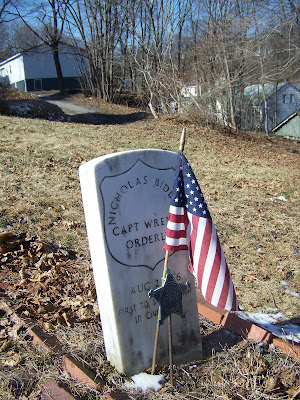 Inscription:
