Friday, April 17, 2009

First Defenders' Day

Tomorrow, April 18, marks the 148th Anniversary of the First Defenders' arrival in Washington. Overlooked, indeed, largely forgotten in the vast annals of Civil War historiography, the First Defenders were the first Northern volunteers to reach Washington following the outbreak of civil war in April 1861. They numbered some 475 strong, composing the ranks of five militia companies, and all of them hailed from Pennsylvania. The Ringgold Light Artillery from Reading had been drilling since January 1861, in response to militia general William Keim's urging that they be prepared should sectional hostilities erupt. Those hostilities did erupt on April 12, when Confederate forces opened fire on Fort Sumter. After a 36 hour-long bombardment, Major Robert Anderson ordered the white flag be raised, and the nation was thus plunged into fratricidal war. The day after the capitulation of Sumter, Lincoln issued a call for 75,000 volunteers, to serve a three-month term of service. Among the first companies to respond were the five First Defender units. In fact, in 1866, former Secretary of War Simon Cameron stated that the very first unit to do so was the National Light Infantry, from Pottsville. On April 17, the National Light Infantry, under the command of Captain Edmund McDonald, left Pottsville, along with the city's other pre-war militia unit, the Washington Artillerists, formed in 1840 by the then eighteen-year-old James Nagle, who rose to the rank of brigadier general in the Civil War. When the two companies departed Pottsville on that "cold, raw, and disagreeable" day, Captain James Wren led the Washington Artillerists. He travelled along with his orderly, sixty-five-year-old Nicholas Biddle, a former slave who escaped bondage some forty years earlier via the Underground Railroad. The Pottsville units arrived in Harrisburg late on the evening of April 17, joining the Ringgold Light Artillery, under Captain James McKnight, which had arrived hours earlier. Later on, the Logan Rifles from Lewistown and the Allen Infantry from Allentown arrived in the Pennsylvania capital.
Early the following morning, April 18, the militia troops were mustered into Federal service by Captain Seneca Simmons, who, one year later, met his death on the fields of Gaines's Mill. After taking the oath, the volunteers boarded train cars and set out for Baltimore. Arriving in the secessionist-leaning Maryland city, the Pennsylvanians were greeted with insults and threats and then, as they marched through the city, to Camden Station, they were pelted with bricks, rocks, bottles, and just about everything else the mob of some 2,500 "hot-blooded secessionists" could get ahold of. Nicholas Biddle was among the first struck; so too would fall a number of the members of the Allen Infantry. These men, all of them painfully wounded, thus shed the first blood of the Civil War. After this rather harrowing ordeal, the men reached Washington around 8:00 p.m. on the night of April 18. They were greeted at the depot by Major Irvin McDowell, who escorted the troops to their quarters. . .in the U.S. Capitol building. Later that night they received their muskets and accoutrements. Their uniforms would be weeks in arriving.
After their three month term of service, which they spent guarding the government buildings, the First Defenders were mustered out. Most of them reenlisted in three-year organizations, mainly the 48th, 49th, 50th, 53rd, and 96th Pennsylvania Infantry and the 7th PA Cavalry. Many of these men were destined to become listed among the 620,000+ war dead.
The First Defenders remain forgotten; not even a footnote. Most accounts of the war have the famed 6th Massachusetts Infantry, which marched through Baltimore on April 19, suffering several fatalities from that same mob, as the first northern volunteers to reach the nation's capital upon the commencement of sectional hostilities. They were not the first, of course. There to greet them when they arrived were the 475 Pennsylvanians who arrived 24 hours earlier.

Monday, March 16, 2009

Soldiers of the 48th: Private Samuel Fryberger, Co. H

One of the greatest things I've discovered after launching this blog in 2006 is how much I have learned about the 48th Pennsylvania. Over the past two-and-a-half years, I have received countless messages from descendants of soldiers who served in the regiment, and each have been more than generous in sending along information about their ancestors; in several cases, they have also sent along photographs that have never before been released or published, and have spent the spent the past century and a half (almost) in family collections.

Several months ago, I received a great deal of information about Private Samuel Fryberger, of Company H, 48th P.V.V.I., from one of his descendants, Ms. Heather Makal, and since it has been a long, long time since I last wrote a Profiles piece, I decided to focus this post on the life of Private Fryberger, one of youngest soldiers who fought in the 48th Pennsylvania.
* * * * * * * * * * * * * * * * * * *

Private Samuel Fryberger
Samuel Fryberger was born on October 28, 1846, in Fountain Springs, but spent much of his childhood in the town of Gordon Plains, where he attended school and where his parents opened a general store. He went to work in the coal mines at a young age, but with the outbreak of civil war in the spring of 1861, young Samuel, at just fourteen years of age, volunteered his services. He enlisted as a private in Company H, organized under the direction of Captain Joseph Gilmour, on August 2, and was formally mustered into service on September 19. Since the age given on the muster roll is 18, it is quite obvious that young Samuel lied about his age in order to enter service. He stood 5'5 1/2" in height, had a Light Complexion, Gray Eyes, and Brown Hair.
Private Fryberger survived the action along the North Carolina coastline in the spring of 1862 as well as the bloodletting at 2nd Bull Run in late August. However, at Antietam, he fell with a grievous gunshot wound to the hip. After recovering from this wound, Fryberger was discharged from the regiment. He returned home in February 1863, and for the next year found work as a shoemaker. By the early spring of 1864, Fryberger returned to the regiment, only to be wounded again at the Wilderness on May 5, 1864. There, a bullet tore into his chest and lodged in his lung. This bullet would remain in his body until his untimely death thirty years later.
Following a lengthy recovery from his Wilderness wound, Fryberger one more volunteered his services, being mustered in as a private in the Veterans' Reserve Corps on January 10, 1865. Seven months later, and with the end of hostilities, he was mustered out of service for the final time. After the war, Samuel Fryberger, not yet twenty years old, but carrying with him two painful wounds, went to work as a conductor on the Mine Hill and Schuylkill Haven Railroad. He worked his way up to the position of engineer before being transferred to the Shamokin Division of the Reading Railroad. He married in 1868 and soon began a family.
In 1893, Fryberger's health took a turn for the worse. He fell ill with ailments associated with his May 1864 gunshot wound to the lung. He died on June 6, 1896, at the age of 49, leaving behind his wife Margaret and several young children. As Fryberger was, perhaps, the youngest member of the 48th Pennsylvania, he also may very well have been the last in the regiment to die of a war-related injury.
(findagrave.com)

Private Fryberger was laid to rest in the "Soldier's Circle" in the Shamokin Cemetery. Buried nearby is Lieutenant Henry "Snapper" Reese, hero of the Petersburg Mine.

Sunday, March 1, 2009

Some Grave Images From Baltimore's Green Mount Cemetery

* * * * * * * * * * * * * * * * * * * * * * * * *
Baltimore's Green Mount Cemetery has long been on my list of must-see places. So when, about a month and a half ago, I discovered that my wife was to have a basket show on the outskirts of the Charm City, I saw it as the perfect opportunity to do some cemetery tramping, and cross one more thing off my life's to-do list. As if I needed further convincing, the March 2009 issue of America's Civil War arrived in the mail a few days later, in which Kim O'Connell has a great little piece on Green Mount. 
Armed with the magazine, as well as a cemetery map and tour book kindly provided to me by Justin McIntyre, a generous intern at Antietam, I set out to see some history.
My wife's basket show did not begin until late in the afternoon yesterday, which meant I did not arrive at Green Mount until 2:30. The day was cloudy and overcast, threatening rain, and the cemetery closes its gates at 4:00. I had but 90 minutes to navigate my way around this massive city of the dead. Truly, the cemetery is enormous, with over 65,000 burials on more than sixty acres. But what an incredible and fascinating place. Green Mount, dedicated in 1839, was one of nation's first rural, or garden cemeteries, a vast park with incredible statuary and monuments. It is the final resting place of hundreds of notable and some infamous Americans, and I regret that I had so short a time to do some exploring. It would take more than a full day to do this place any justice, which means I will no doubt have to return, when I have more time. With only an hour and a half yesterday, I quickly made my way around, following the map, and trying to locate some of the cemetery's most famous residents.

* * * * * * * * * * * * * * * * * * * * * * * * *
Green Mount is the final resting place of hundreds, nay, thousands, of Civil War soldiers, including a host of high ranking officers. Perhaps most notable among these is Confederate general Joseph Eggelston Johnston.


* * * * * * * * * * * * * * * * * * * * * * * * *
General Isaac Ridgeway Trimble is also buried in Green Mount, just a hundred or so yards from Johnston.


* * * * * * * * * * * * * * * * * * * * * * * * *
Other Confederate generals buried in Green Mount include, George Hume "Maryland" Steuart, one-time cavalry commander under Stonewall Jackson and later infantry commander in the Army of Northern Virginia's Second Corps, captured at the Mule Shoe during the battle of Spotsylvania.


* * * * * * * * * * * * * * * * * * * * * * * * *
The remains of General Arnold Elzey, a career army officer with a distinguished combat record in the Mexican-American War, also rest in Green Mount. Elzey served under Jackson in the Shenandoah, was wounded at Port Republic and shot through the head and seriously wounded at the battle of Gaines's Mill. He survived this terrible wound, and was later named as Chief of Artillery for the Army of Tennessee.


* * * * * * * * * * * * * * * * * * * * * * * * *
Just north of Elzey's grave is the final resting place of Confederate Brigadier General Lewis Henry Little. Little served in Mexico as a lieutenant in the 5th U.S. Infantry and was brevetted a captain for gallantry at Monterrey. Promoted to captain shortly after the war, Little resigned from the U.S. army on May 7, 1861, and rose to the rank of brigadier general in the Confederate army. He served under General Sterling Price in the war's Western Theatre. At the battle of Iuka, during which Little served as a divisional commander, he was shot in the head and instantly killed while sitting on his horse, conversing with Price.


* * * * * * * * * * * * * * * * * * * * * * * * *
In addition to the scores of Confederates buried in Green Mount, there are also many Union officers. Among these are General Erastus Bernard Tyler, the fur merchant from Ohio, who was seriously wounded leading his Fifth Corps brigade at Fredericksburg. The cemetery map had his grave nearby Johnston's, but I was unable to locate it. I did, however, find the grave of Union brevet brigadier general Henry C. Bankhead. Bankhead served as an officer on the staff of Major General Don Carlos Buell.


* * * * * * * * * * * * * * * * * * * * * * * * *
While it was a thrill for me to see the graves of so many notable Civil War figures, what I found most incredible was the grave almost immediately behind General Johnston's. There, a tall, ornate stone marks the final resting place of Colonel Thomas Marcus Hulings. Hulings is by no means as famous nor as recognizable as a Johnston, Trimble, or Steuart, but what made the discovery of this grave so incredible to me was that Hulings was a First Defender. As a member of the Logan Rifles from Lewistown, PA, Hulings's company along with the Allen Infantry from Allentown, Ringgold Light Artillery from Reading, and the Washington Artillerists and National Light Infantry from Pottsville, were the first Northern volunteers to arrive in Washington following the outbreak of civil war. In my book on the First Defenders, I made special note of Hulings, who, after his three-month term of service with the Logan Rifles, went on to serve as an officer in the 49th Pennsylvania. As colonel of the 49th, Hulings was killed in action at the battle of the Wilderness.


* * * * * * * * * * * * * * * * * * * * * * * * *
I would venture to guess that the most visited graves in Green Mount are those of the Lincoln Assassination conspirators. I was unable to locate Michael O'Laughlen's grave, but did find that of Samuel Arnold, buried near Generals Elzey and Little. Arnold was not directly involved in the conspiracy to kill Lincoln, but he, along with Booth and his other cohorts, did plan the kidnapping of the president. After that failed, he and O'Laughlen broke off their connection with Booth. However, after the president was killed, Arnold was arrested as being complicit in the larger conspiracy. Sentenced to life along with O'Laughlen, Dr. Samuel Mudd, and Edmund Spangler at Fort Jefferson, Arnold was pardoned by President Andrew Johnson in 1869. He died in September 1906.


Arnold's grave is in the foreground, a simple granite stone on top of which someone placed. . .

. . .a Lincoln penny.

* * * * * * * * * * * * * * * * * * * * * * * * *
And, finally, buried within the impressive stone walls of Green Mount is the body of famed actor Junius Booth. Booth was famous for his portrayals of Shakespearean characters in England before he settled in America, the founder of a legendary acting family which included his sons Junius, Jr., Edwin, and, yes, John Wilkes.

Junius Booth

The Booth family obelisk. . .

It is believed by most, and denied by some, that the remains of John Wilkes Booth lie buried in the Booth family plot, his grave identified by a small unmarked stone.


Three Lincoln pennies decorate the supposed headstone of John Wilkes Booth.

* * * * * * * * * * * * * * * * * * * * * * * * * *
Well, at five minutes to 4:00, I left Green Mount after an incredible (though short) visit to this, a most remarkable place. I will return, hopefully someday soon, when I will have more to time to wander the silent grounds. . .
For more information on Green Mount Cemetery, click here.

Monday, February 23, 2009

Nick Biddle's Grave & An Update On The 48th PA Monument Restoration

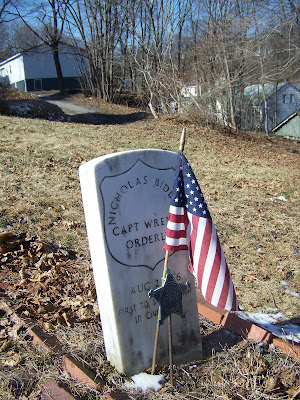
This past Saturday saw me in old Schuylkill County, so while there I, as usual, did some cemetery stomping. I decided to go to the Bethel A.M.E. African-American Cemetery, where First Defender Nicholas Biddle is buried. I was most pleasantly surprised to discover that a new headstone has been placed in tribute to Biddle, to replace the original that was destroyed  many decades ago. I am embarrassed to say that I do not know who led this effort or when the new headstone went up, but to whomever it was, I extend my most heartfelt thanks and gratitude.
Nicholas Biddle's new headstone
Inscription:
"Nicholas Biddle
Captain Wren's Orderly
Aug 2 1876
First to Shed Blood in Civil War"
* * * * * * * * * * * * * * * * * * * * * * * * * * *
I would like also to take this opportunity to thank two donors, both descendants of General James Nagle, who this past week contributed very generously to the effort to replace the missing sword from the general's statue at the Antietam National Battlefield. Their donations, matched on a one-to-one basis by the Western Maryland Interpretative Association, has brought us over the $5,000.00 mark and has taken us that much closer to getting the general's sword back on his side.

Monday, February 9, 2009

48th Pennsylvania Soldiers Buried at Arlington National Cemetery

Mr. Thomas Grund, Senior Vice Commander of the Colonel James D. Brady Camp 63, Sons of Union Veterans, very kindly and very generously sent me a complete listing of 48th Pennsylvania Soldiers buried in National Cemeteries throughout the United States.
The following is a list of those interred at the Arlington National Cemetery:

ARMSTRONG, John: Private, Company G; Wounded 5/12/1864 at Spotsylvania; Died of Wounds on July 1, 1864; Buried in Section 13, Grave #6611.
BETZ, George: Private, Company A; Died June 17, 1864; Buried in Section 13, Grave 6304.
BONER, James: Private, Company I; Wounded in Action, 5/30/1864; Died of Wounds on June 22, 1864; Buried in Section 13, Grave 5828.
CLARK, John: Private, Company I; Died of Wounds Received in Action, 6/8/1864; Buried in Section 27, Grave #978.
DAVIS, Thomas: Private, Company H; Killed at Petersburg, 6/17/1864; Buried in Section 22, Grave #15388.
DAVIS, William: Private, Company H; Wounded at Cold Harbor; Died of Wounds, 9/5/1864; Buried in Section 13, Grave #8702.
EISENHUTH, George T.: Private, Company H; Died, 2/17/1865; Buried in Section 13, Grave #8237.
HECKMAN, Samuel: Private, Company B; Died of Wounds Received in Action, 6/12/1864; Buried in Section 27, Grave #711.
KOPP, Lewis W.: Private, Company H; Died, 10/1/1864; Buried in Section 13, Grave #5552.
MOHAN, Michael: Private, Company C; Wounded at Spotsylvania, 5/12/1864; Died of Wounds, 5/20/1864; Buried in Section 27, Grave #199.
RABER, Jonas Z.: Private, Company D; Died in Washington, 7/1/1864; Buried in Section 13, Grave #6825.
SCHNEIDER, William: Private, Company H; Died of Wounds Received in Action, 9/12/1864; Buried in Section 13, Grave #7750.
SNYDER, Simon: Private, Company A; Wounded at Cold Harbor; Died of Wounds, 6/16/1864; Buried in Section 13, Grave #6292.
WAGNER, Aaron P.: Private, Company D; Wounded at Petersburg, 4/2/1865; Died of Wounds, 4/5/1865; Buried in Section 13, Grave #10485.
WESSLEY, Andrew: Private, Company F; Killed in Action at Petersburg, 6/17/1864; Buried in Section 13, Grave #6275.
WILLONER, Jeremiah: Private, Company I; Wounded at Cold Harbor, 6/3/1864; Died of Wounds, 6/22/1864; Buried in Section 13, Grave #5825.


Mr. Grund also included a list of soldiers from the 48th killed in action at the Second Battle of Bull Run, 8/29/1862. Confederate soldiers buried the dead of this fight on the field, but most were later reinterred, many of them underneath Mrs. Robert E. Lee's one-time Rose Garden. The monument pictured above was placed over the grave of these unknown soldiers; in all some 2,111 remains gathered from the Bull Run battlefield and on the route to the Rappahannock. It is likely that some, if not most, of the 48th's Killed in Action at 2nd Bull Run here rest. Those soldiers are:
BRENNAN, Michael: Private, Company E
FILBERT, Henry A. M.: Captain, Company K
FILBERT, Roland D.: Sergeant, Company K
HATCH, Oliver C.: Sergeant, Company C
KILRAIN, Michael: Private, Company F
LEISER, Charles F.: Private, Company I
LEISER, John H.: Private, Company A
MACKEY, William: Corporal, Company E
MCFEELEY, Hugh: Private, Company E
MILLER, Charles: Private, Company D
MOYER, Samuel: Private, Company E
NAGLE, William: Private, Company H
PETIT, Samuel: Private, Company H
REESE, Lewis M.: Private, Company B
WISER, John: Private, Company C
KELLY, Thomas: Private, Company H
LINK, Hesgian: Private, Company I

Thursday, February 5, 2009

One More For The Blog Roll. . .

I have had the great pleasure to become acquainted with Jared Frederick over the past week. Jared is a history student at Penn State and, like me, is an avid student of the Civil War. Jared is also an illustrator who has had a number of small books published. This summer, Jared will be interning at the Gettysburg National Military Park. He has also just launched a new Civil War blog , and he wrote to me asking if I would link to his site. I agreed. . .but, rather jokingly, only if he did an illustration of General James Nagle. Much to my surprise, about two hours later, he sent one to me. . .I was impressed. (He even included Nagle's Mexican-American War sword).
Anyway, let's all welcome Jared to the Civil War blogosphere. His site is listed as "Gettysburg Intern" in my links' list.
How cool is this?