Thursday, June 19, 2014

The 48th/150th: "Like A Savage Torrent:" The 48th Pennsylvania at Petersburg: June 17-18, 1864

Harpers' Weekly Depiction of Attacks on Petersburg, June 1864


150 Years Ago. . .the ranks of the 48th Pennsylvania had once more been bloodied following a series of assaults at Petersburg.

A week before, Grant had ordered the army south from Cold Harbor and on the morning of June 16, the soldiers of the 48th crossed the James River and arrived in front of Petersburg later that afternoon, in time to watch soldiers of the army's Second Corps launch an unsuccessful attack against the entrenched Confederate line. Sometime around dusk, the regiment was led to the left, marching south along a creek bed until they arrived at a position directly opposite Battery No. 15, which was a well-entrenched angle in the Confederate lines. The opposing lines were very close. Sometime around 10:00 p.m. on the night of June 16, Colonel Henry Pleasants ordered the men of Companies B & G to advance across to the Confederate side of the creek to reconnoiter. Creeping forward in the darkness--regimental historian Joseph Gould later wrote that that night was "dark as pitch"--the two companies came under fire and scampered back. Yet the question remained as to whether they were fired upon by friend or by foe and it fell to two men of Company B, Sergeant Andrew Wren and Private Jacob Wigner, to go forward once more to find out. Once more they slowly crept forward in the darkness. When nearing the line of earthworks, both were grabbed and, by the collars of their uniform coats, pulled inside the Confederate lines. They were both now prisoners of war and both were soon shipped south to Andersonville Prison. It was there, six months later and still in captivity that Wigner, an 18-year-old machinist from Pottsville, died. Wren would remain a prisoner at Andersonville for the next ten months before, finally, being released in late April 1865.

While these two men ventured forth in the darkness only to become prisoners of war, the rest of the regiment settled in for the night, catching whatever sleep they could and knowing that they would most likely be called into action the next day. That next day arrived all too soon.


Map by Hal Jespersen
(http://www.posix.com/CWmaps/


At 3:00 a.m. on the morning of June 17 and in the total darkness, Colonel Henry Pleasants quietly made his way from company to company, informing each of their commanders that they would soon be launching an attack. The men were to charge with bayonets fixed and all caps removed from the guns to prevent against the men from firing. The soldiers were soon stirred awake and, according to Robert Reid of Company G, they quietly attached their bayonets, removed the caps, and even secured their tincups so there would be no rattling. "[T]hen we moved out of the works and crossed the creek. . .After getting the whole regiment over, we silently formed line; then, in utter darkness, moved to the right about one hundred yards, when, in a whisper, the command forward was given."

In his regimental history, Oliver Bosbyshell painted a vivid portrait of the morning's preparations and noted that Pleasants "informed the men of the danger before them, and directed that if any felt disinclined to make the assault, the had permission to remain where they were. There is no record or evidence of any kind that a single man of the regiment took advantage of this offer--not one stayed behind! Tin cups and coffee pots were so secured as to make no rattling sound, and directions were passed along in whispered accents. Bayonets were silently fixed. . .and the regiment moved quietly out of the old rebel works, left in front, with the stealthiness of Indians, over the creek where line of battle was formed, in utter darkness. Moving to the right, for about a hundred yards with panther-like tread, a whispered command 'forward!' was given, and the savage rush began."

The soldiers of the 48th swept across the open ground between the opposing lines; it was still dark and the only noise was that of hundreds of feet tramping down upon the dew-covered grass and dirt. Away off to the right, however, some Union troops opened fire, which drew an immediate response from the Confederate line. The darkness was illuminated with the flash of the Confederate rifles. But still, still, the soldiers of the 48th rushed on. "Directly into this fiery ribbon, belching its leaden hail through the ranks of the charging line, swept the Forty-Eighth," wrote Bosbyshell, while Reid boasted that "We went at them squarely, right into their firing line. Not one of our regiment returned a shot until we reached their works, when there was a short, sharp contest, and the line was ours. I still remember how my heart beat when starting on the charge, but it was forgotten in the glorious rush of the fight."


It was a complete surprise. Within a matter of minutes, the 48th PA crashed into the Confederate lines and captured Battery No. 15. Hundreds of Confederates were very quickly captured.

During the sharp engagement, the Irish-born Sergeant Patrick Monaghan noticed a few Confederate soldiers attempting to flee. He ran amongst them and demanded their surrender. Their hands went up and it was soon noted that one of these Confederate soldiers was attempting to retreat with the flag of the 7th New York Heavy Artillery. The flag had been captured the day before and now Monaghan of the 48th re-captured it and later it would be returned to the New York regiment. For this action, Monaghan received the Medal of Honor.

Robert Reid of the 48th would also receive a Medal of Honor for his actions during this pre-dawn attack on June 17, 1864. Sweeping forward and rushing up and over the Confederate lines, Reid wrestled away the flag of the 44th Tennessee from its regimental color bearer, capturing those colors.

Wrote Bobsyshell: "How the heart beat, and the pulse throbbed during that onslaught! If fear or dread marked the supreme moment of the attack, it was banished completely in the glorious rush of the fight! What a harvest of prisoners--they were captured by the score, disarmed, and sent to the rear."


Robert Reid


Post War Image of Sgt. Patrick Monaghan
(Courtesy of Mr. Richard F. Meaney, III)


The Flag of the 44th Tennessee, Captured By Reid
(http://www.tennessee-scv.org/4455/)


As the skies continued to lighten another Confederate redan about 100 yards further south became visible. Confederate cannons posted there soon erupted into the flank and front of the 48th. Very soon, Colonel Pleasants organized the men for yet another attack and "like a savage torrent" the 48th charged forward. "[T]he regiment fairly tore over those hundred yards and swept through the fort irresistibly. The enemy ran in great disorder by squads and singly to their left and rear." Two Confederate Napoleons fell into the hands of the 48th and the two guns were safely hauled, by hand, to the rear.

Two cannons, two flags and two Medals of Honor, hundreds of prisoners and a good section of the Confederate line; it was a glorious victory for the 48th and for the Ninth Army Corps. All along Burnside's front, the morning attack had achieved much success. Even George Meade, commanding the Army of the Potomac, would recognize the success of the Ninth Corps in a note to Burnside, sent on that June 17: "It affords me great satisfaction to congratulate you and your gallant corps on the assault this morning, knowing the wearied condition of your men from the night march over twenty-two miles, and the continual movement this last night; their persistence and success is highly creditable." These words coming from Meade to Burnside was high praise, indeed.

For the actions of the 48th, Oliver Bosbyshell would later write that the attack on June 17, 1864, at Petersburg, "was probably, in all its results, the most brilliant engagement for the Forty-Eighth of any in which it participated. Praise is due to every officer, from Colonel Pleasants down, and to every many who was in this grand assault, for the splendid record the work here accomplished. .  . ."

Throughout the rest of the day on June 17 the Confederates made several attempts to regain their captured works, but each were turned back. A sometimes lively skirmish fire was kept up throughout the day. The next day, Burnside determined to strike once more, this time with his 1st and 3rd Division leading the way while the 2nd Division--which included the 48th--would advance behind in support. The fighting renewed once more in intensity on June 18 as the soldiers of the Army of the Potomac attempted to drive the Confederates from yet another line of earthworks and trenches very close to the city of Petersburg. Along the Ninth Corps front and though designated as a reserve, the soldiers of the 48th were once more brought to the front. They charged down a ravine and across a railroad cut and they made it closer to the Confederate line than any other Union force. Night settled in and to their front, just a hundred yards or so away, rose Elliott's Salient, held by a brigade of South Carolina soldiers and the gunners of Richard Pegram's Virginia Battery.

One week later, on June 25, the soldiers of the 48th would begin to dig a mine underneath this portion of the Confederate line. . . .

Trenches at Petersburg


* * * * * * * * * * * * * * * * * * * *

The soldiers of the 48th were justly proud of their actions on the Seventeenth and Eighteenth of June; indeed, Bosbyshell later described the attacks on June 17 as the regiment's most brilliant action of the war.
But the price was heavy. . .During its attacks on June 17-18, the 48th Pennsylvania lost 19 men killed or mortally wounded, 42 men wounded, and 4 men missing/captured, for a total casualty count of 65.


Killed/Mortally Wounded: (19)
Private Francis M. Stidham, Company A (MW6/18/1864; Died 7/10/1864)
Private Gilbert Graham, Company C (MW 6/18/1864; Died 4/1/1865)
Private John Major, Company E (KIA 6/17/1864)
Private William Rasons/Reysons, Company E (MY 6/17/1864; Died 6/24/1864)
Private James Reagan, Company E (MW 6/17/1864; Died 6/30/1864)
Private James Mercer, Company E (MW 6/17/1864; Died 5/21/1865)
Private Horace Straub, Company F (KIA 6/17/1864)
Private Isaac Lewis, Company F (KIA 6/17/1864)
Private Simon Devlin, Company F (KIA 6/18/1864)
Lieutenant Curtis C. Pollock, Company G (MW 6/17/1864; Died 6/23/1864)
Private Howard Jones, Company G (MW 6/17/1864; Died 7/13/1864)
Private George Morey, Company H (KIA 6/17/1864)
Private Jefferson W. Beyerle, Company H (KIA 6/17/1864)
Private James Mulholland, Company H (KIA 6/17/1864)
Private Anthony Gallagher, Company H  (KIA 6/17/1864)
Private Thomas Davis, Company H (KIA 6/18/1864)
Lieutenant Joseph Edwards, Company I (MW 6/17/1864; Died 7/2/1864)
Private Nathan Rich, Company K (KIA 6/17/1864)
Private Arthur Gray (KIA 6/18/1864)


Lieutenant Joseph Edwards, Co. I
Mortally Wounded, June 17
(Hoptak Collection)

Lieutenant Curtis Pollock, Co. G
Mortally Wounded, June 17, 1864
(Hoptak Collection)

Private Francis M. Stidham
Killed, June 18, 1864
(Hoptak Collection)


Wounded: (42)
Private Elias Britton, Company A
Private John Holman, Company A
Private John McLean, Company A
Private John Cochran, Company A
Private William Huckey, Company A
Private John Shaffer, Company A
Private Joel Lins, Company A
Private Henry Schreyer, Company A
Private James W. Sterner, Company A
Private William Dreibelbeis, Company A
Private Joseph Dreibelbeis, Company A
Sergeant Robert Campbell, Company B
Corporal James Rider, Company B
Sergeant Henry Weiser, Company C
Lieutenant James K. Helms, Company D
Corporal Jacob Dietrich, Company D
Private Lewis Dietrich, Company D
Private Jacob D. Casper, Company D
Private Joseph Berlinger/Buddinger, Company D
Private Joseph Lindenmuth, Company D
Private Thomas Clemens, Company E
Private R.B. Thompson, Company E
Private Murt Brennan, Company F
Private Patrick Boran, Company F
Corporal Robert Wallace, Company F
Private Edward L. Shissler, Company F
Private Joshua Reed, Company G
Lieutenant David B. Brown, Company H
Private Charles Eberle, Company H
Private Lewis Aurand, Company H
Private Jonathan Dillet, Company H
Private Frank Ringer, Company I
Private William Kramer, Company I
Corporal Benjamin Williams, Company I
Private Christian Seward, Company I
Private Samuel DeFrehn, Company I
Private Jacob Reichwein, Company I
Private Charles Koch, Company I
Sergeant Thomas Irwin, Company K
Private John Gillinger, Company K
Private Oliver Schwartz, Company K
Private David Houser, Company K


Captured/Missing: (4)
Sergeant Andrew Wren, Company B
Private Jacob Wigner, Company B
Private Michael Lavell, Company F
Private William Auchenbach, Company F


Private Elias Britton, Co. A
Wounded
(Hoptak Collection)

Private John Cochran, Co. A
Wounded
(Hoptak Collection)

Lieutenant James K. Helms, Co. D
Severely Wounded
(Patriotic Order Sons of America)


* * * * * * * * * * * * * * * * * * * * * * * * * 

From the Philadelphia Inquirer, June 24, 1864:


Forty-Eighth Regiment Pennsylvania Veteran Volunteers.

Correspondence of the Inquirer.

Near Petersburg, Va., June 19, 1864.

I send herewith a corrected list of killed and wounded in the Forty-Eighth Pennsylvania Veteran Volunteers, in a brilliant charge made by the First Brigade, Second Division, Ninth Army Corps, on the morning of the 17th inst.

During the charge the Forty-Eighth Pennsylvania Veteran Volunteers recaptured the colors of the ---enth New York Regiment, of Second Corps, which had been captured by the enemy the day previously while on a charge. Also, the Rebel colors of the Forty-fourth Tennessee Regiment. The Brigade took 1150 prisoners and two pieces of artillery. The brigade commander, Colonel Curtin, nephew of the Governor, was wounded yesterday. The extent of his wounds I do not know; I hope not mortally; Captain Migel, of his Staff.

Company A—Elias Britten mortally in breast; John. . . slightly; John McLean, thigh; John Cochran leg, slightly; William Huckey, breast grazed; . . .John H. Shaffer, leg; Joel Lind, thigh.

Company B—Sergeant R Campbell, right breast, slight; Corporal James Rider, contusion by shell; Corporal A . . .missing; Jacob Wigner, missing.

Company C—Serg. H. Weiser, thigh, slightly

Company D—Lieut. JK Helms, right leg, severe; Corp Jacob Dietrich hand and hip, severe; L. Deitrich, both. . .severe; JD Casper, right leg, slight; Jos Bertolett breast, severe

Company E—John Major, killed; Wm. Raysons, back. . .Thos Clemens, arm and shoulder, severe; Jas. . .breast, severe; Jas. Mercer thigh severe; Chas. . .both legs, severe; Thos Hall foot, severe; RB . . .pon foot, severe

Company F—HF Straub, killed; Isaac Lewis, killed; Wurt Brennan, foot; Pat Boran, hand; Corporal Robert Wallace, right shoulder; EL Shistler, leg, slight; Mike Lavell, supposed wounded and missing; Wm Auchenbach, supposed wounded and missing

Company G—Lieut CC Pollock, right shoulder, severe; Howard Jones, groin, severe; Joshua Reed, right breast and face, severe

Company H—Lieut DB Brown, contusion by sent ball in right arm; Charles Eberlie, head; George W. Moray, killed; Jackson W. Byerley, Killed; James Mulholland, killed; Lewis Aurand, arm; Jonathan Fillet, foot; Anthony Gallagher, abdomen

Company I—Lieut Joseph Edwards, both hips and body, severely; Frank E. Ringer, wounded; Wm. Kramer, left foot, severe

Company K—Nathan Rich, killed; Sergeant Thomas Irwin, left leg, severe; John Gillinger, leg, slight; OIiver Schwartz hip, slight; David Houser, arm, slight


Killed and Wounded on the 18th inst.

Company A—Henry Schreyer, in hand; Francis M. Stidham, severely in right shoulder; James W. Sterner, arm and grazed in breast; Wm. Dreibelbeis, slightly in leg; Jos. Dreibelebeis, left heel.

Company C—Gilbert Graham, side, slightly

Company D—Jos Lindemuth, leg, severe

Company F—Simon Devlin, killed

Company A—Thomas Davis, killed

Company I—Corporal Ben Williams, ankle, slightly; C. Seward forehead, slight; C.F. De Frehn, shoulder, severely; Joe Reichwein, left foot , slightly; C.R. Koch, knee, severely

Company K—Arthur Gray, killed.

Captain Lantz, of Fiftieth Pa Vols. was killed.

Colonel Christ, of Fiftieth Pa Vols was wounded. He commanded a brigade in the Third Division.


Friday, June 13, 2014

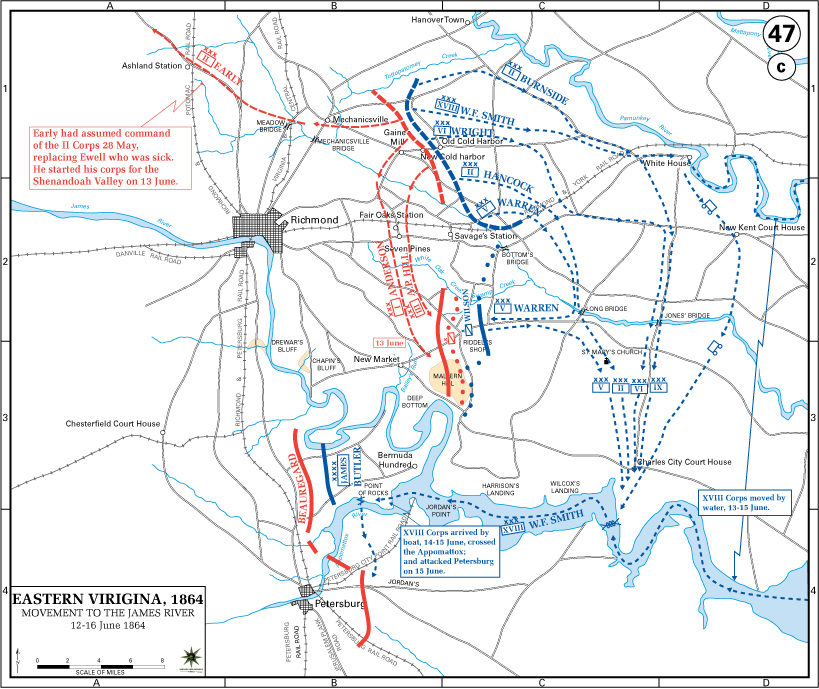
The 48th/150th: Roads South To Petersburg. . .June 12-16, 1864

150 years ago, the Army of the Potomac began its shift southward, marching for the James and, ultimately, to Petersburg beyond. . . .Late on June 12, the 48th Pennsylvania abandoned its position near Cold Harbor, marched through Burhamville and headed for Turnstall's Station and the Chickahominy River beyond. They crossed the Chickahominy on pontoons two days later. On June 16, the regiment crossed the James River "bright and early" and, about 4:00 p.m., arrived in front of the Petersburg defenses. On their way to the front, the tired and dusty Schuylkill County soldiers passed the scene of an earlier engagement, with the dead still covering the fields. For these veteran troops, this ghastly sight was nothing, except for the color of the slain. A number of black U.S.C.T. soldiers had been killed in the assault. "These were the first dead colored troops the boys of the Forty-eighth had seen and their stiff forms eloquently answered the query as to whether the colored troops would fight or not," recorded Oliver Bosbyshell.

The pontoon bridge across the James River consisted of over 100 pontoons and spanned 700 yards across the river. The 48th marches across this bridge on the morning of June 16. [New York Public Library]
 
 
The following two days--June 17-18--the regiment would attack the Confederate defenses at Petersburg and suffer heavily for it. Having already lost well more than 200 soldiers over the past six weeks in its march south from the Rapidan, through the Wilderness, Spotsylvania, across the North Anna, and at Cold Harbor, another 65 were destined to fall. Their attacks would, however, place them very near to yet another Confederate defensive line, nearer to Petersburg, an angle in the trenches known as Elliot's Salient. And it would be on June 23 when Colonel Pleasants overheard one of his soldiers say that if only they could run a mine under it, they could blow that damned fort out of existence.
 
The digging of the Petersburg Mine--the 48th's greatest accomplishment--would commence two days later. .  .


Roads South From Richmond To Petersburg: June 12-June 16, 1864
[http://militaryhistory.about.com/od/civilwarintheeast/a/battle-of-petersburg.htm]

Friday, June 6, 2014

The 48th/150th: Agnes Allison's Sacrifice. . .The Story of the Allison Brothers of Port Carbon

The Allison Brothers
Alexander-John-George-James
(from Schuylkill County in the Civil War)
 
150 years ago. . .In homes throughout Schuylkill County, tears were shed as the families either received the letters of company commanders or read in the newspaper that their son, husband, brother, father had been killed in action in far-away Virginia, near a place called Cold Harbor.
 
But few--very few--throughout the entire nation, perhaps, would shed more tears or mourned as deeply as Mrs. Agnes Allison of Port Carbon, Pennsylvania.
 
On June 3, 1864. . .150 years ago. . .she laid to rest her son, George, who had been mortally wounded at Spotsylvania. On that very same day, as she watched the coffin containing George's body be lowered into the ground within the confines of the Presbyterian Cemetery in Port Carbon, and over a hundred miles away, her son James Allison was killed in action while serving with the 48th Pennsylvania at Cold Harbor.
 
James Allison would be the fourth son Agnes Allison lost in the Civil War.  . . . .


* * * * * * * * * * * * * * * * * * * * *

The small community of Port Carbon, situated along the Schuylkill River two miles northeast of Pottsville in the anthracite rich coal regions of east-central Pennsylvania, boasts a proud Civil War history. Founded in the early 1800s and incorporated as a borough in 1852, Port Carbon grew quickly from a few sparse settlements to a thriving market town of nearly 2,000 inhabitants by 1860. The site of the first lock on Schuylkill Canal, Port Carbon flourished from the shipment of coal extracted from the many mines surrounding the town. The canal and the coalmines offered plenty of work, especially for the thousands of western European immigrants who flocked to Schuylkill County during the antebellum years, seeking a better life. And when the war did break out, many of these immigrants were quick to take up arms in defense of their adopted country, joining and fighting alongside the thousands of Schuylkill County natives who also responded to their country’s call. From Port Carbon and its neighboring coal patches alone came no fewer than 513 volunteers who donned the Union blue from 1861-1865. 

 
Port Carbon Soldiers' Monument
(from http://www.kreilickconservation.com)
To honor the services of these men, Port Carbon, in 1904, erected a tall soldiers’ monument on the summit of Goat Hill, a high eminence that rises above the town. Consisting of a twenty-two-foot zinc pedestal with a bronze, six foot bronze statue of a soldier on top, standing at parade rest, this soldiers’ monument is quite typical of those one can still find standing in hundreds of small towns across the nation, in both the North and the South.


But in Port Carbon there stands another Civil War memorial, one not so typical. Though more modest and much smaller in size, this memorial stands in the Presbyterian Church Cemetery over the grave of Agnes Allison. Known locally as the Mother Allison Memorial, this monument was placed there not to pay tribute to soldiers, but to honor the sacrifice of Agnes Allison, an immigrant from Scotland, who, during the course of the conflict lost four of her sons, all killed in action.


Born in 1807, Agnes was twenty-one-years-old when she married Andrew Allison in Aragask, Scotland, in 1828. Over the next eighteen years, Agnes gave birth to six sons before her husband Andrew’s death in August 1845. A local history of Port Carbon notes that upon her own death in 1883, Agnes Allison had been a resident of the community for thirty years, meaning that she and her sons had emigrated from Scotland and settled in Port Carbon sometime in the early 1850s, after Andrew’s death. Several of Agnes’s sons found work as boatmen on the Schuylkill Canal while another, Alexander, found gainful employment as a blacksmith. With the outbreak of civil war, however, the Allison boys were quick to leave their civilian occupations behind to take up arms in defense of their adopted country.


Twenty-six-year-old Alexander Allison and his older brother James were first to march off to war, as members of two local militia companies that had been raised in response to President Lincoln’s April 15, 1861, call for 75,000 men to serve a ninety-day enlistment. Witnessing no action during this three-month stint, both Alexander and James reenlisted in the summer of 1861, signing up this time to serve for “three years, or the course of the war,” whichever came first. James Allison now entered the ranks of Company M, 1st Pennsylvania Cavalry, while Alexander enlisted as the First Sergeant in Company C, 96th Pennsylvania Infantry. He was joined in the 96th by his brother John, who at age twenty-one, was the youngest of the four Allison boys to serve. The oldest was George Allison who enlisted in February 1862 as a thirty-two-year-old private in Company K, 56th Pennsylvania. The widow Agnes Allison’s anxiety must have been great as she watched four of her six sons answer the call and depart for war.
 
The 96th Pennsylvania Infantry
Recruited largely from Schuylkill County
Alexander and John Allison Served in the 96th PA
(from the Library of Congress)

The first of the Allison brothers to fall were John and Alexander, who were both struck down on May 3, 1863, during the Battle of Salem Church. The two had served side-by-side in the 96th since the summer of 1861 and had survived the worst the war threw at them during the Seven Days’ Battles and at Crampton’s Gaps, where the 96th suffered particularly heavy losses. Alexander Allison was among the wounded at Crampton’s Gap but he had recovered in time to rejoin the regiment for the spring 1863 Chancellorsville campaign. On May 1, 1863, Alexander was promoted to 2nd Lieutenant; his younger brother John, by this time, had worked his way up to corporal. Just two days after Alexander’s promotion, the 96th was again called into action, and again the regiment suffered heavily. Emerging from a woodlot just south of Salem Church, the 96th came under a galling fire from the Alabamians of Cadmus Wilcox’s brigade, sparking a bitter stand-up fight between the two sides. “Volley after volley was fired,” remembered Captain Jacob Haas of the 96th, but the regiment “could not break the rebel position.” Haas remembered seeing the newly-minted Lieutenant Allison repeatedly ordering his men to load and fire, before a bullet slammed into his right side, dropping him to the ground. In the chaos of this battle, Alexander’s younger brother John was also struck down. Noted Haas, “It’s not known whether John Allison was killed before Alex was wounded. But during this heavy fire fight with minnie balls flying in every direction, John was dropped and instantly killed. . . .”


Salem Church
(from nps.gov)

 
Alexander Allison was carried from the field and taken to a hospital at nearby Aquia Creek where he drew his last breath two days later, on May 5, his heart heavy knowing by this time that his younger brother had been killed. It must have been a profound blow for Agnes Allison later that month when word arrived in Port Carbon that two of her sons were now dead. The Miners’ Journal, the leading newspaper of Schuylkill County, took notice of their death, writing that “The death of Lieutenant Allison and his brother is deeply regretted. Their kind dispositions and fine soldiering qualities made many warm friends who mourn their loss.” The editors of the Miners’ Journal also noted that Agnes Allison still had two sons in the service, although at this time, one of them—James Allison—was just then back at home, recovering from what was a grievous injury.

The Grave of Lt. Alexander Allison
Fredericksburg National Cemetery  
(Brother John is most likely buried as an 'unknown' in the same cemetery)
(from findagrave.com)


While Alexander and John Allison had joined the 96th and older brother George served in the 56th Pennsylvania, James Allison enlisted instead in the mounted arm, serving as a private in the 1st Pennsylvania Cavalry. On January 15, 1863, however, James was discharged from the regiment. He had been thrown hard against the pommel of his horse’s saddle, resulting in an injury that required him to use catheters for the next four months. James was thus recovering at home when word of Alexander’s and John’s deaths arrived. Still, their deaths did not deter James from reentering the service. In late February 1864, while the 48th Pennsylvania Infantry was home in Schuylkill County on veteran’s furlough, James, a pre-war boatman on the Schuylkill Canal, signed up once more to fight, this time as a private in Company G of the hard-fighting 48th.


With its ranks replenished, the soldiers of the 48th Pennsylvania Infantry once more departed their Schuylkill County homes in late March 1864, with orders to proceed to Annapolis where their fellow regiments of the 9th Army Corps were just then rendezvousing. Again, for the third time, James Allison was leaving home, no doubt leaving his mother behind with tears filling her eyes. Heavy combat lay ahead for the 48th at the Wilderness in early May but especially a week later at Spotsylvania where, on May 12, the regiment lost 26 men killed or mortally wounded, 92 men wounded, and 11 more missing in action. The price paid by the 48th that bloody Thursday at Spotsylvania was high, but James Allison emerged from this slaughter unscathed.

 
The same could not be said, however, for James’s older brother George, serving in the ranks of the 56th Pennsylvania. Even as James Allison and the men of 48th were attacking Harry Heth’s Confederate division on the Confederate right, George Allison and the 56th Pennsylvania were charging General Charles Field’s Confederate division well-positioned atop Laurel Hill on the opposite end of the line. It was a forlorn effort and the slopes of Laurel Hill were soon awash in a sea of blue and red. The 56th formed part of Edward Fowler’s brigade of Lysander Cutler’s Fifth Corps division. Cutler led his division forward, with two brigades up front, followed by two, including Fowler’s, in support. And while casualties were particularly heavy in the front line, those in the back suffered as well. Confederate general Charles Field acknowledged the bravery of the Federals in this attack, stating that their effort was a “determined” one, but, as he was quick to point out, they were “repulsed with great slaughter.” Thirty-three-year-old George Allison, who, like his brother James, was a boatman before the war laboring along the Schuylkill Canal, was shot down and mortally wounded that day. He clung desperately to life for the next eleven days before passing away on May 23.

 
The remains of George Allison were brought back to Port Carbon for interment. A grief-stricken Agnes Allison buried her oldest son in the graveyard of the Presbyterian Church on June 3. Three of her sons were now gone, leaving only James still in uniform. And even as she buried George, Agnes’s thoughts were no doubt turned to James, fighting in some far off field, over a hundred miles away from home. But what she could not then know—and as if the story of Agnes Allison and her sons were not tragic enough—on June 3, on the very same day George Allison was being laid to rest in Port Carbon and even as Agnes was returning home from the funeral, James Allison was drawing his last breath.


Private James Allison
Company G, 48th PA
 
 
Having survived the storm at Spotsylvania, James Allison and the men of the 48th Pennsylvania next found themselves heavily engaged at the Battle of Cold Harbor. It was during this fight on June 3 that James Allison received a mortal wound, dying just a few hours after being struck down.


The remains of James Allison were later buried in the Richmond National Cemetery; those of Alexander were interred at the Fredericksburg National Cemetery. Confederate soldiers buried the body of John Allison somewhere near Salem Church, though it is likely he was later exhumed and buried as an “Unknown” in the same cemetery as his older brother Alexander. Only the body of George Allison returned home to Port Carbon for burial.
 
The Grave of James Allison, 48th PA
Richmond National Cemetery
(from findagrave.com)
 

It is impossible to imagine the anguish and devastation felt by Agnes Allison, having lost four of her sons in the Civil War. Their deaths left a void in her life and in her heart as she did her best to continue to provide a home and bring up her two remaining sons, Andrew and David.


Peace finally came to Agnes Allison on April 3, 1887, when she passed away at the age of 80.   Her remains were buried next to her son George, already twenty-three years in the grave.


Agnes Allison may have taken some consolation after the war in knowing that the veterans of the local Port Carbon chapter of the Grand Army of the Republic honored the Allison brothers by naming their post after them. Indeed, it was this Allison Brothers Post of the G.A.R. that led the effort to have the soldiers’ monument placed atop Goat Hill in 1904. And it was this same post that three years later led the effort to place a memorial on the grave of Agnes Allison, to pay tribute to her and her great sacrifice.        
 
 
The Mother Allison Memorial in the Presbyterian Cemetery
Port Carbon, Pennsylvania
Agnes and her son George are buried here. . .


The 48th/150th: "He was engaged in a just and holy Cause. . .:" The Death of Alexander Govan

Corporal Alexander Govan
Company G, 48th PA
150 years ago. . .The roads south from Spotsylvania were stained red with the blood of soldiers, both Union and Confederate. Among the tens of thousands who shed their life's blood on these crimson fields were many sons of Schuylkill County from the 48th Pennsylvania regiment. From May 22 until June 4--along the banks of the North Anna River and Totopotomoy Creek and on the plains of Cold Harbor--at least 90 of its soldiers fell either dead or wounded, most of them on June 3 at Cold Harbor. Thus, in just four weeks, since first crossing the Rapidan on May 4, the regiment had been thinned by at least 229 soldiers, including those who first fell during the campaign at the Wilderness and Spotsylvania.
 
But it must be always remembered that these soldiers were not just mere numbers. . .they were human beings, each with their own story to tell, caught up in this most tragic time in American history.

Alexander Govan, for example, was a newlywed. He had just been married on March 20, 1864, just before the regiment departed Schuylkill County once more for the front. Sadly, however, just over two months later, Corporal Govan was shot through the forehead and killed instantly at Cold Harbor, leaving his newlywed bride Sarah a twenty-one-year-old widow who would receive an $8.00/month pension until her own untimely death, which occurred on Christmas Eve, 1879, when she was but 36 years of age. Alex Govan had served with Company G from the outset, having enlisted at the age of eighteen in 1861. By occupation, he was an engineer from Palo Alto. Born in Nova Scotia, Alex was the first of eleven children born to Alexander and Jane Govan. Settling in Pottsville, Alexander, Sr., practiced law. On June 9, 1864, Joshua Sigfried, who had commanded the 48th for so long before accepting a commission in the U.S.C.T., wrote a heartfelt letter to Alex Govan's father in Pottsville:


"Dear Sir--
      In accordance with promise, I am called upon to perform a painful duty; yesterday I learned with sorrow of the death of your son Alexander. He was shot t
 
hrough the head and instantly killed on the 3rd inst. about five miles south of this place, while in battle with the enemy; his body was carefully buried by the members of his Company. I heartily sympathize with you and your family in this sad affliction, allow me to say, while you have lost an affectionate and dutiful son and Mrs. Govan, your daughter-in-law, an endearing husband, the company has lost one of its bravest and best soldiers--one who was ever ready to perform his duty, and who was ever found at his post, whether in camp, upon the march, or in battle--through his ---- good and noble conduct, he had endeared himself to all, both officers and soldiers, and his loss is mourned throughout the command; but let me add while you mourn his loss do not forget that he was engaged in a just and holy Cause and when he fell he fell patriotically at his post, manfully defending the flag-the liberty of our Country. I trust that he rests in that [ineligible] where conflicts never reach."
 
J.K. Sigfried


The Grave of Corporal Govan
Richmond National Cemetery
(from findagrave.com)
 

Wednesday, June 4, 2014

The 48th/150th: "A Regular Inferno:" More Accounts of the 48th Pennsylvania at Cold Harbor, June 3-4, 1864

 
Currier & Ives Depiction of the Battle of Cold Harbor. . .

 "A heavy rain storm during the night made every one most uncomfortable," wrote regimental historian Oliver Bosbyshell of the night of June 2-3, 1864. By the morning, the rain had ended and the soldiers, before forming up into line, attempted to dry their clothing and blankets by their wood fires. Then, the orders came. . .Colonel John Curtin was to lead his brigade into the fight and storm the Confederate lines to his front. The soldiers of the 48th, many with damp clothes and hurriedly swallowing whatever pieces of hardtack may have been left in their haversacks, fell into line of battle, on the far right of Curtin's line; indeed, the regiment was on the extreme right flank of the entire Union army. The attack, boasted Bosbyshell, "was made with great vigor, and the enemy' skirmishers were driven across the creek, and some prisoners were captured. The advance continued over the creek--the enemy was routed out of houses and outbuildings, as well as some breastworks that were within a few yards of the road running to Shady Grove and Cold Harbor." This, as the soldiers of the 48th were about to discover, was the main line of the Confederate army. Harry Heth's Confederates lay to their front and a "rebel battery" that was, said Bosbyshell, "exceedingly annoying." The soldiers readied themselves for the general advance. . .
Captain William Winlack
Company E
. . . .It began at 7:00 a.m. Company E--Captain William Winlack's company--led the way as skirmishers. Swiftly the company swept across a cleared field, with the main body of the regiment following closely behind. "The skirmishers pushed rapidly on through a deep gully, with the regiment in close touch, and as the high ground was reached, the enemy's skirmishers were encountered. Company E's boys went at them with a will, and savagely drove them back on their entrenched lines." Then, the Confederates let loose a staggering volley; a "destructive fire" and many Company E men fell to the ground. They fell back behind the rest of the regiment, still advancing, and this is when "the engagement became general and severe." Advancing to within 80 yards of the Confederate position, the men hastily threw up some entrenchments while continuing to keep up a continuous fire. All the way, the Confederate battery belched forth its shot and shell. "The howling and shrieking of the grape and canister poured into the regiment made up a regular 'inferno,' causing the very flesh to creep with horror!"
The Confederate line was too strong and the casualties too heavy to continue the assault. Orders went out, suspending further offensive operations. The soldiers held on, as best they could, in their new line of defensive works.
Corporal Alexander Govan
Company G
Killed at Cold Harbor
The following morning, June 4, Colonel Pleasants directed Companies G and F to advance. Creeping forward over the scarred landscape, the soldiers of these two companies reached the Confederate earthworks, only to find them deserted. "A number of new-made graves, eight or ten dead battery horses, and a limber chest marked the abandoned line. The advance was continued for a mile beyond--a straggling Johnny was found in a farm house and brought back to the regiment a prisoner. The appearance inside of, and around the position occupied by the rebels, indicated a severe drubbing and evidenced great loss."
Yet the 48th sustained a heavy drubbing as well, particularly in the ranks of Company E, and 150 years ago, as the survivors dug in yet again and secured yet another position, some began burying their dead comrades.

Others wrote letters home, including Lt. Curtis Pollock, of Company G, who wrote the following to his mother, Emily Pollock, in far-away Pottsville. . .


On the Skirmish Lin about 10
miles from Richmond
June 4 1864
 My Dear Ma
          I was very much pleased to receive your letters, the one of the 20th a few days ago and the one of the 27th yesterday. We had another severe engagement yesterday and lost pretty heavily. Alex Govan and James Alison were killed. Both were hit in the head and killed almost instantly. Sergt. C.F. Kuentzler was wounded severely in the arm. John Hutton was struck on the back of the fingers and cut a little. He will be back to the Company today. William Martin was struck in the ankle and bruised pretty badly. The loss in the Regt. is 10 killed and 42 wounded I do not know anything new and have no idea what is going on. The Rebs we 

were fighting yesterday left again last night and we are now out as skirmishers but there are no Rebels in front of us. John Hodgson is well and quite anxious to hear from home. He has not had a letter for some time. [Edward] Flanagan and [John] Humble are all right. I had a ball cut a piece out of the top of my hat yesterday and knocked it about ten feet from me. It is the nearest I have ever had a ball come to me. Hoping you are all well, I remain
Your Affectionate Son
C.C.P.
With Much Love To All
Sadly, Pollock's luck would soon run out. Thirteen days later, he would be struck down and mortally wounded outside Petersburg. 

Tuesday, June 3, 2014

The 48th/150th: Cold Harbor

May turned to June. . .and the slaughter continued.
150 years ago, the soldiers of the 48th Pennsylvania once more found themselves in the midst of heavy battle-action, on a blood-stained field, this time at an obscure Virginia crossroads northeast of Richmond named Cold Harbor. Already during the past month, since crossing the Rapidan on May 4 to its crossing of the Totopotomoy on May 30, the regiment had lost nearly 200 soldiers.
On that June 3, 1864, at Cold Harbor, another 68 were destined to fall. . .
"On To Richmond"
(Harpers Weekly)
Long after the war, Sergeants Alexander Reid and  William Wells, respectively of Companies G & F remembered well the carnage of Cold Harbor:
        Reid: "Skirmishing and artillery firing took place daily, and on the 3rd of June we were very actively engaged at Shady Grove Church. It rained a little the night before, and after a breakfast of coffee and hardtack we dried our blankets at the fire, and at seven o'clock in the morning had formed in line of battle, Company E being deployed as skirmishers to the front. The ground over which we had to advance was a clear field, and at once we were ordered to advance, guide centre, the skirmishers in our front. The crossed the gully which intervened between us and the enemy; we followed closely after; and, as the skirmishers arose on the high ground again, they met those of the enemy, drove them back on their entrenched line of battle and took a few prisoners out of an old log house, who had not had time to get away. Before we got into action we could Winlack's heroes, the skirmishers dropping fast from the destructive fire of the enemy. Company E falling back into line, we were ordered to halt and commence firing, the enemy being about eighty yards to our front, behind a line of breastworks, with a battery. Things soon became lively for all hands.
        "In addition to the heavy infantry firing from the enemy, we were subjected to a galling fire of grape and canister. We threw up a line of breastworks in a very short time, and occupied them the rest of the day. The following morning, June 4th, Companies G and F were ordered by Colonel Pleasants to the enemy's line, which, on reaching, we found evacuated, and saw nothing but some new-made graves, many dead battery horses and a limber chest, left by the enemy. We advanced as skirmishers for a mile beyond, and found nothing but one lonesome straggler in a farm house, and then returned to the regiment."
         Wells: "We had fallen back from Armstrong's Farm, where Major Gilmour had been wounded on May 31st, in accordance with Grant's inevitable movement, 'from right to left,' and on June 2nd, stacked arms in a large open field, near a fine country mansion, standing back some distance from a well-defined country road. Batteries, baggage wagons and ambulances were parked back of, and around, the mansion, while General Officers, probably Grant and Meade, and their staffs, unmounted, stood around. If I remember rightly, a violent storm, accompanied by much lightning and thunder, burst upon us early in the afternoon. In the midst of this, a heavy discharge of shot and shell poured into us from the woods beyond the road, showing that the enemy had followed our line of march, and had opened upon us with the intention of surprising and stampeding the entire combination, troops, batteries, ambulances, wagons, etc., but they were soon undeceived, for, as if by magic, everything became active. The horses had not been detached from the guns, wagons, nor ambulances; therefore, it was the work of a few moments for the latter to move to the rear, and the former to the front. Mounted officers flew over the field from right to left, muskets were unstacked, and the troops were moved rapidly to the front: a rapid transformation from peace to horrid war, as the entire surroundings evidently indicated as much surprise to general officers as to the men. It seemed but a few moments before we were lying along the road, some firing and others, with the small intrenching shovels, bayonets, tincups, anything that could remove dirt, throwing up intrenchments, for the troops had learned their value by sad experience, while our batteries in the rear literally filled the woods with bursting shells. The enemy evidently failed in their object, for they soon gave up their attack, but not before we had a strong work erected. The next day, the 3rd, the entire line was advanced, as the enemy had fallen back to a strong line of works erected during the night. . . .
      ". . . .in no other engagement of the 48th did they expend more ammunition than in this battle; besides, our line was so close to that of the enemy's battery that we were subjected to the bursting of our own shells; so much so, that our batteries were compelled to move their position further to the right, where the fire enfiladed the enemy guns but one had been destroyed, and, to finish the job, a gun was drawn by hand around the right of the 48th and soon dismounted this one. With nightfall the battle ceased. In one company of the 45th Pennsylvania, on our left, all the officers had fallen, a corporal alone being left in command. The 48th in this fight was on the extreme right of the army. Advancing on the 4th, thirty-nine dead horses and the dismounted battery, together with several hundred small arms, were found behind the rebel works; while the dead, wounded and dying, lay thick around. The enemy had fled during the night, evidently in haste, though they had tried to remove their disabled guns by hand. To increase the efficiency of their works, they had placed many of their dead on top, the commander of the battery among them. Our fire must have been very effective, for the trees in the woods behind them showed our firing to have been very low."


Map by Hal Jespersen, www.posix.com/CW
In a letter to editors of Miners' Journal, Colonel Henry Pleasants recorded that, once more, the regiment had been engaged in a heavy fight and that they had suffered severely. He also boasted however, with a bit of exaggeration, that the Confederates to their front had retreated and, "judging from the number of dead and quantity of arms left behind on the field, their loss in our immediate front must have been over one thousand. We exploded one of their caissons; another was left behind, and over thirty artillery horses lie dead in front of the 48th."

In his report, Pleasants also included a list of the killed and wounded, the names of those who fell 150 years ago. . . from June 1-June 3, 1864:

Killed/Mortally Wounded: (16)

*George Betz: Company A (Died June 7, 1864)
*David Williams: Company E
*Sgt. Thomas Tosh: Company E (Died July 7, 1864)
*Daniel Reedy: Company E (Died July 6, 1864)
*James Bradley: Company F
*Edward Pugh: Company F
*William Smith: Company F
*Corporal Alexander Govan: Company G
*James Allison: Company G
*Joseph Alexander: Company H
*John Clark: Company I (Died June 8, 1864)
*William J. Price: Company I
*Benjamin B. Kershner: Company I
*Jeremiah Willouer: Company I (Died June 22, 1864)
*George Dresh: Company I
*Jacob Lauby: Company K


Wounded: (51)  


*William Koch: Company A
*John Hegg: Company A
*Simon Snyder: Company A
*Elias Lins: Company A
*Corp. Monroe Heckman: Company A
*James D. Ash: Company A
*Samuel Eckroth: Company A
*Isreal Britton: Company A
*Sgt. Samuel Strauch: Company B
*Sgt. Robert Campbell: Company B
*1st Lt. Charles Loeser: Company C
*2nd Lt. William Clark: Company C
*Patrick Farrell: Company C
*John Dolan: Company C
*Thomas Boyle: Company C
*Daniel Boyer: Company E
*John Clemens: Company E
*Robert Beverage: Company E
*Patrick Brennan: Company E
*Charles Quinn: Company E
*Albert Cummings: Company E
*Sgt. James Easton: Company F
*Cpl. Robert D. Paden: Company F
*George H. Jones: Company F
*Jacob Kuhns: Company F
*William E. Duffy: Company F
*Cyrus Haines: Company F
*James Hoult: Company F
*Sgt. Charles F. Kuentzler: Company G
*Cpl. John Hatton: Company G
*William Martin: Company G
*John C. Benedict: Company H
*Sgt. Henry Bernsteel: Company H
*Cpl. Henry C. Matthews: Company H
*Cpl. William A. Lloyd: Company H
*Joseph Hayes: Company H
*Anthony O'Donnell: Company H
*James Welsh: Company H
*William Davis: Company H
*Edward Metz: Company H
*1st Sgt. Oliver A.J. Davis: Company I
*Sgt. Jacob Ongstadt: Company I
*Cpl. E.C. Kehl: Company I
*Peter Keller: Company I
*William Owens: Company I
*John H. Cooper: Company I
*William Kramer: Company I
*H.W. Haas: Company K
*Milton Nagle: Company K
*William G. Keiser: Company K
*Thomas Hudson: Company K


* * * * * * * * * * * * * * * * * * * * 

From The Philadelphia Inquirer, June 15, 1864

Correspondence of the Inquirer.

Company A, Forty-Eighth P.V.V.

June 4, 1864

Below I give you the casualties of the Forty-eighth Regiment Pennsylvania Veteran Volunteers, in the engagement on the 3d instant. Our loss thus far in killed and wounded foots up to about two hundred and forty (since Grant’s forward movement to Richmond commenced), including seven commissioned officers. Our gallant Major, Joseph A. Gilmour, was wounded in the left leg, by a sharp-shooter, whilst establishing a skirmish line, and amputation was rendered necessary to save his life. In him our army has lost a most valuable officer. His separation from our regiment is deeply regretted by all. Much to his credit, be it said, he has left it without a single enemy.

Wounded

Lieut. Charles Loeser, Co. C, arm, slight
Lieut. William Clark, C, abdomen, slight
Thomas Boyle, C, contusion by shell
Patrick Farrell, C, left foot
Sergt. Robert Campbell, B, contusion left shoulder
Sergt. James A. Easton, F, contusion right arm
James Hoult, F, left shoulder
James Bradley, F, right leg
George Jones, F, chin
Corporal Cyrus Haines, F, arm
Corporal R. Paden, F, left arm
James Ash, A, on head slight
George Betz, A, face, severely
John Hugg, A, both legs
Simon Snyder, A, left leg
Corporal Monroe Heckman, A, breast, slight
Samuel Eckroth, A, in side, slight
Corporal James Eveland, A, toe, slight
Howard Hass, K, left hand
William Heiser, K, left arm, seriously
H.W. Nagle, K, contusion, right shoulder
Edward Metz, H, head, slight
Sergeant Henry Bensteel, H, arm, slight
Corporal W.A. Lloyd, H, right arm
Anthony O’Donnell, H, right arm
Corporal Henry Matthews, H, head
Joseph S. Haas, H, in groin
James Welsh, H, back
William Davis, H, right arm
Elias L…e, A, left side
Corporal E. Kehl, I, left foot
William Owens, I, left foot
Peter Keller, left foot
J. Willower, I, left side
William Kenner, I, right arm
John Clark, I, head
John Cooper, I, face
William Kramer, I, right arm
Isaac Beltz, I, arm
Sergeant William Kuentzler, G, right arm
William Martin, G, leg
Corporal John Hutton, G, hand
Daniel E. Reedy, E, both legs and breast
Robert Beverage, E, face
John Clemens, E, left leg
Sergeant Thomas Tosh, E, left shoulder
Patrick Brennen, E, left arm
Sergeant Samuel Stouch, B, left side

Killed
Edard E. Pugh, CO. F

--- Smith F
Corporal Alex Govans, G
James A. Allison, G
James Alexander, H
George Dresh, K
----Lauby, I
Benjamin Kershner, I
William Price, I