Thursday, June 4, 2009

A Stroll Through Washington's Congressional Cemetery

* * * * * * * * * * * * * * * * * * * * * * * * * * * * * * * * *
This past Wednesday, friends and fellow rangers Rory Moore and Mannie Gentile and I took a day trip to Washington. We set out to do some cemetery tramping, and I suggested the capital's "other" famous graveyard, the Congressional Cemetery. This is a truly remarkable place. I have only been there once before in my life, and this was many years ago. I remember that at that time, the cemetery was not in the greatest of conditions. However, from the moment we pulled up, I noticed that much has changed. The cemetery is working hard at preserving this historic site. The three of us were greatly impressed by the amount of literature and interpretation available at the cemetery's gatehouse. You can pick up a host of walking tour brochures that highlight the gravesites of many American notables. There is a War of 1812 brochure, as well as brochures for the gravesites of American Indians, Civil War notables, Congressmen, and several others. There is even a cell phone tour where you can dial a number and an extension at a number of historic graves and hear biographical descriptions. To say that we were impressed is an understatement. The employee who greeted us was very friendly and helpful. I cannot recommend this cemetery greatly enough to anyone interested in historic graveyards, or to anyone interested in American history in general.
* * * * * * * * * * * * * * * * * * * * * * * * *
The Congressional Cemetery has a park-like atmosphere. . .and is filled with impressive tombs and incredible statuary.
* * * * * * * * * * * * * * * * * * * * * * * *
There are a host of notable Civil War figures buried within the walls of the Congressional, including. . .
Major General Andrew Atkinson Humphreys,
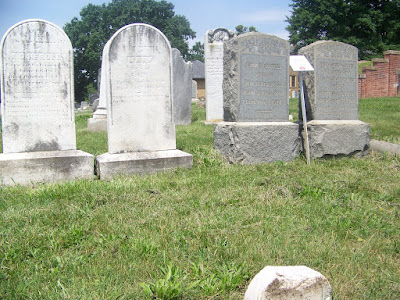
Lincoln Assassination conspirator David Herold, who lies within the family plot,
and Major General Alfred Pleasonton, chief of the Army of the Potomac's Cavalry.
Alfred Pleasonton is buried alongside his father, Stephen Pleasonton, who, as a young clerk during the burning of Washington in August 1814, saved many famous documents from destruction, including the Constitution and Declaration of Independence.
And, of course, the Congressional Cemetery is the final resting place of famed photographer Matthew Brady.
* * * * * * * * * * * * * * * * * * * * *
The Congressional Cemetery dates to 1807, covers more than 30 acres and contains more than 55,000 burials, many dating to the early Nineteenth Century, and many Revolutionary War soldiers.
The engravings on many of the stones is very impressive. . .
* * * * * * * * * * * * * * * * * * * * * * * * * *
There are a countless number of important American political figures, such as. . .
Elbridge Gerry, vice-president under Thomas Jefferson and the only signer of the Declaration of Independence to be buried in Washington,
and John Forsyth, Secretary of State under Presidents Jackson and Van Buren.
* * * * * * * * * * * * * * * * * * * * * * * * * *
Other famous internments include. . . .
Robert Mills, the first Federal architect, who designed the Washington Monument, the Treasury Building and Old Post Office, among many other structures,
John Phillip Sousa, and
J. Edgar Hoover.
* * * * * * * * * * * * * * * * * * * * * * * * * *
The Congressional Cemetery also features a number of cenotaphs to deceased Representatives and Senators, who were buried here before their bodies could be taken home.
Among the many cenotaphs, one can find a veritable who's who of important Congressmen, including Henry Clay and John Calhoun, Andrew P. Butler, Thaddeus Stevens, and Preston Brooks, among many others.
Ranger Mannie imitating Senator Preston "Bully" Brooks and Brooks's cenotaph.
* * * * * * * * * * * * * * * * * * * * * * * * * * *
For more information on the Congressional Cemetery, visit their website at

Monday, May 25, 2009

Photo Gallery: Some Unique Views of the Nagle Statue


* * * * * * * * * * * * * * * * * * * * * * * * *
Last week, Mike Kraus came to Antietam to take some measurements for the replacement sword on the Nagle statue. While up in the lift provided by the NPS, Mike snapped a lot of rather unusual photographs. The following are just a few. Note the level of detail in the uniform; even the top of the kepi has the general's trefoils, though not all four lines as a general would have worn.
* * * * * * * * * * * * * * * * * * * * * * * * * *
* * * * * * * * * * * * * * * * * * * * * * * * * *
* * * * * * * * * * * * * * * * * * * * * * * * *

* * * * * * * * * * * * * * * * * * * * * * * * *

Wednesday, May 20, 2009

Another Step Closer. . .

* * * * * * * * * * * * * * * * * * * * * * * * * * * * * *
I had the great pleasure today to meet Mr. Michael Kraus and his good friend Mr. David Neville, editor of Military Images Magazine. Mike, a Civil War historian and artist, will be sculpting the replacement sword for the General James Nagle statue at Antietam. He was at the park this morning to take some measurements.
* * * * * * * * * * * * * * * * * * * * * * * * * * * * * * * *
The weather was picture-perfect and the morning a fine one, indeed. I am thrilled at the progress of this project. To everyone who has thus far contributed to the restoration project, I cannot thank you enough. We are one step closer to getting the general his sword back!
For anyone wishing to donate, please click here for information on how you can go about contributing. Any dollar amount will help us greatly and will be greatly appreciated.
Me and Mr. Michael Kraus

Tuesday, May 12, 2009

Deadly Week. . .

* * * * * * * * * * * * * * * * * * * * * * * * *
The 48th Pennsylvania suffered its greatest casualties at the Second Battle of Bull Run on August 29, 1862. There, the regiment lost 152 men killed, wounded, captured, or missing. The regiment's second deadliest battle came 145 years ago today at the Battle of Spotsylvania, where more than 130 soldiers fell. With this being the anniversary of the battle, I thought I'd list the 48th's casualties during the first week of the Overland Campaign, including those who fell at both the Wilderness and Spotsylvania.
* * * * * * * * * * * * * * * * * * * * * * * * *
48th Pennsylvania Casualties at The Wilderness & Spotsylvania:
5/5/1864-5/15/1864
Killed/Mortally Wounded (31)

Louis M. Robinhold, Company A, 5/12, Spotsylvania
Isaac Otto, Company A, 5/12, Spotsylvania
John J. Huntzinger, Company A, 5/12, Spotsylvania
Abel C.T. St. Clair, Company A, 5/12, Spotsylvania
Sgt. William Kissinger, Company B, 5/12, Spotsylvania (Died 5/24)
Cpl. David J. Davis, Company B, 5/12, Spotsylvania
Matthew Hume, Company B, 5/12, Spotsylvania
Frederick Knittle, Company B, 5/12, Spotsylvania
Laurentus C. Moyer, Company B, 5/12, Spotsylvania
Daniel Wary, Company B, 5/12, Spotsylvania
John Deitz, Company B, 5/12, Spotsylvania
Daniel Brown, Company C, 5/6, The Wilderness
Michael Mohan, Company C, 5/12, Spotsylvania (Died 5/20)
Jonathan Kauffman, Company D, 5/6, The Wilderness
Lawrence Farrell, Company E, 5/6, The Wilderness
Cpl. John Powell, Company F, 5/12, Spotsylvania (Died 5/26)
Israel Manning, Company F, 5/12, Spotsylvania
David F. Thiel, Company F, 5/6, The Wilderness
John Morrissey, Company F, 5/12, Spotsylvania
Lewis Woods, Company F, 5/12, Spotsylvania
Richard Williams, Company F, 5/12, Spotsylvania
Andrew Wessman, Company F, 5/12, Spotsylvania
Lieutenant Henry C. Jackson, Company G, 5/12, Spotsylvania
James Spencer, Company G, 5/12, Spotsylvania (Died 5/31)
John Armstrong, Company G, 5/12, Spotsylvania (Died 7/1)
William Williams, Company G, 5/12, Spotsylvania
Abraham Benscoter, Company H, 5/12, Spotsylvania
Joseph Chester, Company H, 5/12, Spotsylvania (Died 5/24)
Benjamin McArdel, Company I, 5/6, The Wilderness
Henry J. Ege, Company I, 5/12, Spotsylvania
John W. Henn, Company K, 5/12, Spotsylvania

Wounded (99)

Company A:
*Sgt. Albert C. Huckey, 5/12, Spotsylvania, Arm
*Cpl. Charles Brandenburg, 5/12, Spotsylvania, Knee
*Cpl. Jacob Honsberger, 5/12, Spotsylvania, Head (slight)
*Morgan Leiser, 5/12, Spotsylvania, Arm
*Benjamin F.C. Dreibelbeis, 5/12, Spotsylvania, Arm (slight)
*Charles Hillegas, 5/12, Spotsylvania, Back
Company B:
*Sgt. Thomas B. Williams, 5/12, Spotsylvania, Concussion by Shell
*Gottleib Shauffler, 5/12, Spotsylvania, Wrist
*David Deitz, 5/12, Spotsylvania, Foot
*John Brown, 5/12, Spotsylvania, Head
*Henry Shoppell
Company C:
*2nd Lieutenant William Clark, 5/6, Wilderness, Left Hand (slight)
*Sgt. Jonas Geiger, 5/6, Wilderness, Leg
*William Neely, 5/12, Spotsylvania, Left Leg
*William J. Haines, 5/12, Spotsylvania, Side
*Murt Brennan, 5/12, Spotsylvania
*James Coakley, 5/12, Spotsylvania
Company D:
*2nd Lieutenant H.E. Stichter, 5/12, Spotsylvania, Back (slight)
*Sgt. Henry Rothenberger, 5/12, Spotsylvania, Shoulder
*Cpl. Edward Lenhart, 5/12, Spotsylvania, Arm
*James Deitrick, 5/12, Spotsylvania, Thigh and Hand (severe)
*Botto Otto, 5/12, Spotsylvania, Leg, Arm, and Toe
*Perry L. Strausser, 5/12, Spotsylvania, Right Hand
*George S. Beisel, 5/12, Spotsylvania, Leg
*William F. Moyer, 5/12, Spotsylvania, Shoulder
*John Kohler, 5/12, Spotsylvania, Chin
*Jonas Miller, 5/12, Spotsylvania, Arm
*Joseph Zeigler, 5/12, Spotsylvania, Shoulder
*Patrick Cooligan, 5/12, Spotsylvania, Head (slight)
*Andrew Knittle, 5/12, Spotsylvania, Leg
*Gustavus H. Miller, 5/12, Spotsylvania, Leg
*Henry D. Moyer, 5/12, Spotsylvania, Side
Company E:
*Sgt. John McElrath, 5/12, Spotsylvania, Head
*Cpl. Samuel Clemens, 5/6, Wilderness, Hand (slightly)
*Cpl. William J. Morgan
*James McLaughlin, 5/12, Spotsylvania, Right Army
*George W. Schaeffer, 5/12, Spotsylvania
*David Williams, 5/12, Spotsylvania, Foot (slightly)
*W. Simmons. 5/12, Spotsylvania, Arm
*G.W. James, 5/12, Spotsylvania, Leg
*W.C. James, 5/12, Spotsylvania, Arm
*James Meighan, 5/12, Spotsylvania, Thumb
*Robert Penman, 5/12, Spotsylvania, Arm
Company F:
*Sgt. Richard Hopkins, 5/12, Spotsylvania, Hand (slight)
*William E. Taylor, 5/12, Spotsylvania, Hand
*Anthony Carroll, 5/12, Spotsylvania, Leg
*William S. Wright, 5/12, Spotsylvania
*James Brennan, 5/12, Spotsylvania, Abdomen
*Henry Holsey, 5/12, Spotsylvania, Leg
*William H. Kohler, 5/12, Spotsylvania, Back
*John Eddy, 5/12, Spotsylvania, Head
*Jno. T. Reese, 5/12, Spotsylvania, Arm
*John Crawford, 5/12, Spotsylvania, Head
*A.H. Whitman, 5/12, Spotsylvania, Leg
Company G:
*Sgt. R.M. Jones, Head (slight)
*Cpl. George Farne, Hand
*Patrick Cunningham
*John Becker, 5/6, Wilderness, Foot
*Adam Hendley, 5/6, Wilderness, Neck (slight)
*M. Berger, 5/12, Spotsylvania, Left Arm
*Clay W. Evans, 5/12, Spotsylvania, Hand
*Patrick Grant, 5/12, Spotsylvania, Arm
*William Maurer, 5/12, Spotsylvania, Shoulder
*John Kautter, 5/12, Spotsylvania, Hand
*Patrick Savage, 5/12, Spotsylvania, Arm
Company H:
*Samuel Fryberger, 5/6, Wilderness
*William Donnelly, 5/10, Ny River, Abdomen
*William Huber, 5/12, Spotsylvania, Arm
*Benjamin Koller, 5/12, Spotsylvania, Arm (slight)
*John Klineginna, 5/12, Spotsylvania, Eye
*Daniel Ohmacht, 5/12, Spotsylvania, Arm (slight)
*Albert Davis, 5/12, Spotsylvania, Thigh
*John Stevenson, 5/12, Spotsylvania, Groin
*Michael Melarkee, 5/12, Spotsylvania, Right Shoulder
*Daniel Cooke, 5/12, Spotsylvania, Foot
*John Cruikshank, 5/123, Spotsylvania, Hand
*Michael O’Brien
*Charles Focht
*John Olewine, 5/12, Spotsylvania, Hand
*Joseph Edwards, 5/12, Spotsylvania, Finger
*Thomas Palmer, 5/12, Spotsylvania, Leg
Company I:
*Sgt. Luke Swain, 5/12, Spotsylvania, Concussion of Shell, Arms & Legs
*Sgt. Jacob Ongstadt, 5/12, Spotsylvania, Head (slight)
*Cpl. D. Klase, 5/12, Spotsylvania, Thigh
*Cpl. Wesley Knittle, 5/12, Spotsylvania, Hip
*Charles Lindenmuth, 5/12, Spotsylvania, Face
*Francis Boner, 5/12, Spotsylvania, Leg
*Charles Washington Horn, 5/12, Spotsylvania, Both Legs and Hand
*M. Dooley, 5/12, Spotsylvania, Both Legs
*W. Tyson, 5/12, Spotsylvania, Concussion, Head
*Charles DeLong, 5/12, Spotsylvania, Hip
Company K:
*Cpl. George Weaver, 5/12, Spotsylvania, Breast
*David R. Dress
*Elias Fenstermaker, 5/12, Spotsylvania, Finger
*Thomas Fogarty, 5/12, Spotsylvania, Finger
*Henry Schulze, 5/12, Spotsylvania, Body
*Franklin Ely, 5/12, Spotsylvania, Foot
*Simon Hoffman, 5/12, Spotsylvania, Foot
*Andrew Webber, 5/12, Spotsylvania, Breast

Missing in Action (11)

*George Seibert, Company C
*Edward Ebert, Company D
*John D. Weikel, Company D
*William Gottschall, Company E
*George Kramer, Company F
*Harrison Bright, Company H, Deserted, Returned 6/6/64
*Michael Scott, Company H
*Lewis Aurand, Company H, Deserted, Returned 6/6/64
*James Wentzell, Company H
*W.B. Beyerle, Company I
*W.B. Shearer, Company I

Tuesday, May 5, 2009

"They Gave Us A Volley, And Their Peculiar Yell. . .:" The 48th Pennsylvania at the Wilderness

* * * * * * * * * * * * * * * * * * * * * *
Today, 145 years ago, witnessed the start of the confused, chaotic battle of the Wilderness and the commencement of the very bloody, savage Overland Campaign. Here are several accounts, penned by several participants, of the actions of the 48th Pennsylvania at the Wilderness:
* * * * * * * * * * * * * * * * * * * * *
Sergeant Joseph Gould: “On the way to the Wilderness the regiment crossed the Rapidan River on May 5th, and about two hundred veterans of the regiment were sent to the right of the army and deployed as skirmishers and fought the enemy as such nearly all day, losing some men killed and wounded. About five o’clock in the afternoon they rejoined the regiment, went into line of battle and became engaged just at dark.
“On the 7th but little hard fighting was done as we were moving about all day position. It was hard to determine just how our army was fronting and the lines running. Some troops were marching towards Fredericksburg on the left and others to Chancellorsville on the right. The woods were still burning from the effects of yesterday’s firing, and many of the wounded were burned to death ere they could be removed.”

* * * * * * * * * * * * * * * * * * * * *

Captain Joseph Hoskins:After crossing the Rapidan, a detail of 200 men was made and put under my command: Lieut. Pollock, of G, and Lieut. Eveland, of A; Sergeant Al Huckey, of Company A, with a full complement of non-commissioned officers. The names of all but a few have escaped my memory. I recall Bob Reid and Clay Evans, Sandy Govan, David Thiel, and Adam Hendley. We left the regiment and moved to our right, and in a very short time came into contact with a line of the enemy’s skirmishers; they gave us a volley and their peculiar yell, expecting to start us on the back track; but, instead, we advanced and drove them out of the woods; and, on reaching the open field, we came to a halt. The enemy fell back to a rail fence, some fifty yards to our front, and there we held them until relieved by a Michigan regiment. We then moved to the rear and buried David Thiel, who had been killed in the advance. We then joined the main body of the regiment. Heavy firing was in progress all day, and on the 6th, the 9th Corps. . .was engaged almost the entire day in the Wilderness fight, under infantry fire, losing heavily.”


Captain Joseph Hoskins, Company F
* * * * * * * * * * * * * * * * * * * * *
Major Oliver Christian Bosbyshell: “The Forty-eighth crossed the Rapidan River at Germanna Ford, on the fifth of May, 1864, moving toward the Spotswood Tavern, where a bivouac was had. Very early on the morning of the sixth, the command, with the Second Brigade, in front, moved close to the Old Wilderness Tavern and on out the road to Parker’s Store. A half mile out this road, the Forty-eighth Pennsylvania were deployed as skirmishers to cover the flanks of the column. The enemy’s skirmishers were found about a half mile further on, and gave way before the advancing troops. A small stream was crossed, and three regiments of the Second Brigade formed line, advanced until the enemy was found on the opposite side of an open field, drawn up in considerable force, and supplied with a battery, stationed probably a quarter to a half a mile from the junction of the Parker store and Plank roads. A brisk fire was opened by the enemy from the battery as well as from the small arms of the infantry. The line was moved forward to the edge of the woods and the First Brigade formed to cover the left. The action was becoming quite brisk, and General Potter was preparing to charge the enemy, when he received an order to withdraw his command, move to the left, and attack on the right of General Hancock near the Plank road. This movement was made through a dense wood, almost impenetrable, owing to the tangled underbrush; the new line was formed as quickly as possible on Hancock’s right, and the attack made where it was utterly impossible to see anything from the thickness of the woods. The enemy was posted on the opposite side of a swampy ravine behind entrenchments. Sharp firing at very close range ensued, followed by a savage charge, which brought the boys into the enemy’s rifle pits in some places. Being unable to maintain the advantage gained, the troops fell back. Twice the charge was renewed—considerable ground was gained, but the enemy retained possession of their line.
The firing continued until dark; the brigade remained in the front line and entrenched its position. The Forty-eighth was thrown forward as skirmishers during the night, its line extending over a division front.”

Sunday, April 26, 2009

Major General John Newton

It's been a while since I posted a biographical portrait, so tonight I figured I'd post on a somewhat obscure fellow who spent more than forty years in uniform, Major General John Newton.


* * * * * * * * * * * * * * * * * * * * * * * * *
John Newton served in the United States Army for forty-four years, graduating from West Point in 1842 and retiring in 1886. He was a brave and thoroughly competent officer in the American Civil War, and proved to be an excellent division commander. However, Newton’s greatest contributions came in the field of engineering. Entering the army as a second lieutenant in the Corps of Engineers, he made his way through the ranks and when he retired was a brigadier general and the army’s chief engineer. His achievements in engineering were impressive and many, and his performance during the Civil War was solid. Yet, Newton’s scheming in 1863 to rid the Army of the Potomac of its commanding general seriously damaged his wartime career and left a stain on his otherwise exemplary record.
Born on August 25, 1822, in Norfolk, Virginia, John Newton demonstrated in his primary education that he was naturally gifted in mathematics. His father, Thomas Newton, a congressman who served the people of his district for more than three decades in the U.S. House of Representatives, sought to develop John’s talent and was able to secure for him a private tutor. In 1838, at the age of sixteen, John Newton received an appointment to the United States Military Academy. He excelled in his studies there, and in 1842 he graduated from West Point ranked second in a stellar class of fifty-six graduates. James Longstreet, D.H. Hill, William Rosecrans, John Pope, Richard H. Anderson, Lafayette McLaws, Abner Doubleday, George Sykes, and Napoleon J.T. Dana, were but a few of Newton’s fellow graduates in the Academy’s illustrious Class of 1842.
Upon graduation, Newton was commissioned a second lieutenant in the army’s Corps of Engineers. He remained at West Point for the next four years serving first as an assistant to the board of engineers, and then, in 1843, at the age of twenty-one, as a professor of engineering. In 1846, as the United States prepared for war with Mexico, Lieutenant Newton was sent to New England where he was named assistant engineer in the construction of Fort Warren, in Boston Harbor, Massachusetts, and in the construction of Fort Trumbull, in New London, Connecticut. Recognized as one of the army’s brightest and most able engineers, Newton was then transferred to the Great Lakes region where, as superintending engineer, he built Fort Wayne, in Detroit, Michigan, and Forts Porter, Niagara, and Ontario, in New York.
With his work on these projects completed by 1852, John Newton, now thirty years of age, was promoted to the rank of first lieutenant and given various assignments dealing with the surveying of waterways in Maine, Florida, and Georgia, where he also made improvements to Fort Pulaski. In 1856, he was promoted to captain of engineers, and, that same year, was selected to help identify locations along the Gulf of Mexico in Alabama, Mississippi, and Texas, for the construction of defensive fortifications. Newton’s only active field duty of the pre-Civil War years came two year later, in 1858, when he was named chief engineer of the United States Army’s expedition against the Mormons in Utah, under the command of Colonel Albert Sidney Johnston. Returning east shortly after the conclusion of this campaign, Newton then supervised the construction of Fort Delaware. He was completing this assignment when the American Civil War broke out in April 1861.
John Newton was a native Virginian, but there was no question about where his loyalty lay. Although his home state seceded from the Union, Newton, who had by this time been in the army for nearly twenty years, remained true to his uniform, his flag and his country, and was named chief engineer of the Department of Pennsylvania. He held this post for only a few weeks before being named chief engineer of the Department of the Shenandoah, under the command of General Robert Patterson. In August 1861, he was promoted to the rank of major in the engineering corps but later that same month he left this branch of the service to accept command of a brigade of infantry in William B. Franklin’s Division, Army of the Potomac. He received his star as brigadier general the following month, on September 23, 1861.
Although now an infantry commander, Newton was far too valuable as an engineer, and throughout the winter of 1861-1862, he served as assistant engineer in the construction of defenses around Washington. One of his accomplishments during this time was the building of Fort Lyon, named for Nathaniel Lyon, a Union general who fell at the battle of Wilson’s Creek in August 1861. General Newton commanded his brigade during the Army of the Potomac’s march up the Virginia peninsula in the spring of 1862, and turned in commendable performances during the Seven Days’ Battles outside of Richmond, his first true tests as an officer in combat.
General Newton’s next test came at the battle of South Mountain on September 14, 1862. Commanding a brigade in Henry Slocum’s Sixth Corps Division, Newton advanced with his men against the Confederate troops defending Crampton’s Gap. Joseph Bartlett’s Brigade led the attack, but was soon reinforced by Newton’s and Colonel Alfred Torbert’s Brigades, and together they charged, with bayonets fixed, toward the Confederate line, ultimately forcing them from their position. Newton received much praise for his performance during the battle. William B. Franklin, commanding the Sixth Corps, wrote in his Official Report: “While fully concurring in the recommendation offered in behalf of Colonels Bartlett and Torbert. . .I respectfully and earnestly request that Brigadier General Newton may be promoted to the rank of major-general for his conspicuous gallantry and important services during the entire engagement."
General Slocum’s Division arrived on the battlefield of Antietam during the early afternoon hours of September 17, but was not actively engaged in the fighting. However, Brigadier General Newton was brevetted lieutenant colonel in the Regular Army for his actions here, although it was probably due to his services at South Mountain. A month following the battle of Antietam, Newton was given command of the Sixth Corps’s Third Division. His men were held largely in reserve during the battle of Fredericksburg in December 1862, but afterwards General John Newton got involved in a scheme that damaged his career in the Army of the Potomac and tarnished his reputation. In January 1863, Newton traveled to Washington with one of his brigade commanders, John Cochrane. The two men had a private meeting with President Lincoln where they blasted the leadership of army commander Ambrose Burnside, doubted his abilities, and reported on the low morale in the army. Burnside was livid when he learned of this act of insubordination, and demanded the immediate dismissal of Newton, Cochrane, and the other officers who were involved in the scheme, such as William B. Franklin and William Smith. After the smoke cleared, and after Burnside was relieved of command, Newton remained in the Army of the Potomac although he later suffered the consequences of his involvement in this underhanded plot.
John Newton was promoted to major general of volunteers on March 30, 1863. Five weeks later, he led his division in attack against the Confederate position along the base of Marye’s Heights in Fredericksburg during the Chancellorsville Campaign. He was slightly wounded during the storming of the heights, and his men suffered tremendous loss with casualties in his three brigades exceeding 1,000 killed, wounded, and missing, about one-third the division’s total number. Two months later, at Gettysburg, Newton was called upon by General George Gordon Meade to replace General Abner Doubleday as commander of the First Corps. Newton, who was junior in rank to Doubleday, nonetheless assumed corps command during the second day of the battle, and handled his men well for the duration of the conflict. Indeed, for his performance at Gettysburg, he was brevetted a colonel in the Regular Army. Remaining in command of the First Corps throughout the summer and winter of 1863, Newton paid the price for his post-Fredericksburg intrigue on March 24, 1864 when he was left without a command after the First Corps was dissolved with the reorganization of the Army of the Potomac. As if the message was not loud and clear enough, Newton soon discovered that his appointment as major general was withdrawn by the U.S. Senate. A few weeks later, he was sent west.
Reporting to General William Tecumseh Sherman for assignment, Brigadier General Newton, on April 16, 1864, was given command of the Second Division of General Oliver Howard’s Fourth Corps, Army of the Cumberland. Despite the demotion in command, Newton continued to distinguish himself on the field of battle during the Atlanta Campaign, at Dallas, Kennesaw Mountain, and especially at Peach Tree Creek where he was commended by General Sherman. He received his third brevet promotion of the war, this time to brigadier general in the Regular Army, for his performance here. Following the surrender of the city of Atlanta in early September 1864, General Newton was transferred yet again. He was named commander of the District of Key West and Tortugas, in the Department of the Gulf. He remained at this remote Florida outpost for the duration of the American Civil War, being brevetted a major general in March 1865. Commanding the Department of Florida for several weeks during the summer of 1865, Newton was advanced to the rank of lieutenant-colonel in the army’s corps of engineers, and in January 1866 was mustered out of the volunteer service.
John Newton remained in the United States army following the end of the American Civil War, and in the ensuing decades continued to establish himself as one of the country’s best engineers. He oversaw the construction of Fort Hamilton in New York, and, perhaps most noteworthy in his engineering career, he was able to successfully remove large rocks and other obstacles in the Hudson River and in New York Harbor, which allowed for increased and easier navigation. He continued to rise steadily through the army ranks, becoming a colonel in 1879, and then a brigadier general five years later, in 1884. That same year he was named as the army’s chief engineer.
After more than four decades in uniform, General John Newton resigned from the army on August 27, 1886, having reached the mandatory age of retirement at sixty-four. He settled in New York City following his resignation where he served for a time as commissioner of public works. In 1888, he accepted the position of president of the Panama Railroad Company. He also served as president of the Panama Steamship Company, and the Columbian Steamship Line. A lifelong and devout Catholic, Newton received an honorary LL.D. degree from St. Francis Xavier College in 1886, and in his retirement belonged to the National Academy of the Sciences and was an honorary member of the American Society of Civil Engineers.
John Newton died at the age of seventy-two on May 1, 1895, in New York City. The cause of his death was listed as “acute articular rheumatism.” General Newton’s body was taken to the National Cemetery at West Point for burial.
* * * * * * * * * * * * * * * * * * * * * * * * * * * * * *

General Newton's grave at the West Point National Cemetery