Friday, November 20, 2009

A Stroll Through Reading's Charles Evans Cemetery & Other Places

Gravesite of Charles Evans,
Reading attorney and philanthropist who established the Charles Evans Cemetery in 1846.
* * * * * * * * * * * * * * * * * * * * * * * * * *
I had the great privilege yesterday of spending the morning with Mark Pflum, an expert on all things First Defenders and Berks County Civil War; it is remarkable how much this guy knows. We spent the morning hours wandering about Reading's famed Charles Evans Cemetery, which is rich in history. We focused mainly on the gravesites of Reading's First Defenders, members of the Ringgold Light Artillery, which was one of the first five companies of Northern volunteers to reach Washington upon the outbreak of hostilities in April 1861.
The Ringgold Light Artillery, an elite militia unit, was founded by Captain James McKnight. In May 1861 and upon the recommendation of US General William H. Keim, McKnight was elevated to the rank of major and given command of Battery M, 5th US Artillery.
Grave of Captain James McKnight
The McKnight family plot
* * * * * * * * * * * * * * * * * * * * * * * * * *
Another famous member of the Ringgold Light Artillery was George W. Durell, famed gunner of Durell's Battery, which fought with the Ninth Corps throughout the war.

Grave of Captain George W. Durell
* * * * * * * * * * * * * * * * * * * * * * * * *
First Defender Howard McIlvain was a private in the Ringgold Light Artillery and then a 1st Lieutenant in Durell's Battery. He died in November 1862 at the age of twenty-three.
* * * * * * * * * * * * * * * * * * * * * * * * *

Perhaps the most famous Civil War burial in Charles Evans Cemetery is Major General David McM. Gregg, famed Federal cavalry commander.


Gregg's grave is the far leftUnion Cavalryman David M. Gregg
* * * * * * * * * * * * * * * * * * * * * * * * * *
Buried near General Gregg is Joseph Hiester, Lieutenant Colonel of the Berks County Militia in the Revolution and Governor of Pennsylvania, 1820-1823.
* * * * * * * * * * * * * * * * * * * * * * * * *
Union Brigadier General William H. Keim, who died of typhoid fever in May 1862, also lies buried in the Charles Evans Cemetery.
* * * * * * * * * * * * * * * * * * * * * * * * *
Famed Berk County brewermeister Frederick Lauer was interred in Charles Evans. Although too old to serve, Lauer raised, outfitted, and equipped what became Company H, 104th Pennsylvania volunteers.
Freddy Lauer's Grave
* * * * * * * * * * * * * * * * * * * * * * * * *
Colonel Charles A. Knederer of the 167th PA Drafted Militia was brave; perhaps too brave for his own good. He was killed in action while battling with Longstreet's Confederate troops in early 1863 near Blackwater River.
Close-up of Knederer's grave.
* * * * * * * * * * * * * * * * * * * * * * * * *
Near the grave of Colonel Knederer is that of Union Eleventh Corps Brigadier General Alexander Schimmelfennig, who died in nearby Wernersville in September 1865 from tuberculosis.
* * * * * * * * * * * * * * * * * * * * * * * * *
Scores of Union veterans, including many soldiers who fought in various U.S.C.T. and other all-black units, lie buried in the G.A.R. Plot.


* * * * * * * * * * * * * * * * * * * * * * * * *
Buried also in Charles Evans is Matilda Edwards Strong, who died at a young age in 1851. The daughter of a US Congressman from Illinois, Matilda was frequently in Washington during the 1840s where she met and befriended another Illinois politician, Abraham Lincoln. The two began a relationship and it is even suggested that Lincoln proposed to Matilda, which she rejected. It is also suggested that when Lincoln broke off his engagement to Mary Todd in 1841, Todd blamed Matilda for it.
* * * * * * * * * * * * * * * * * * * * * * * * * *

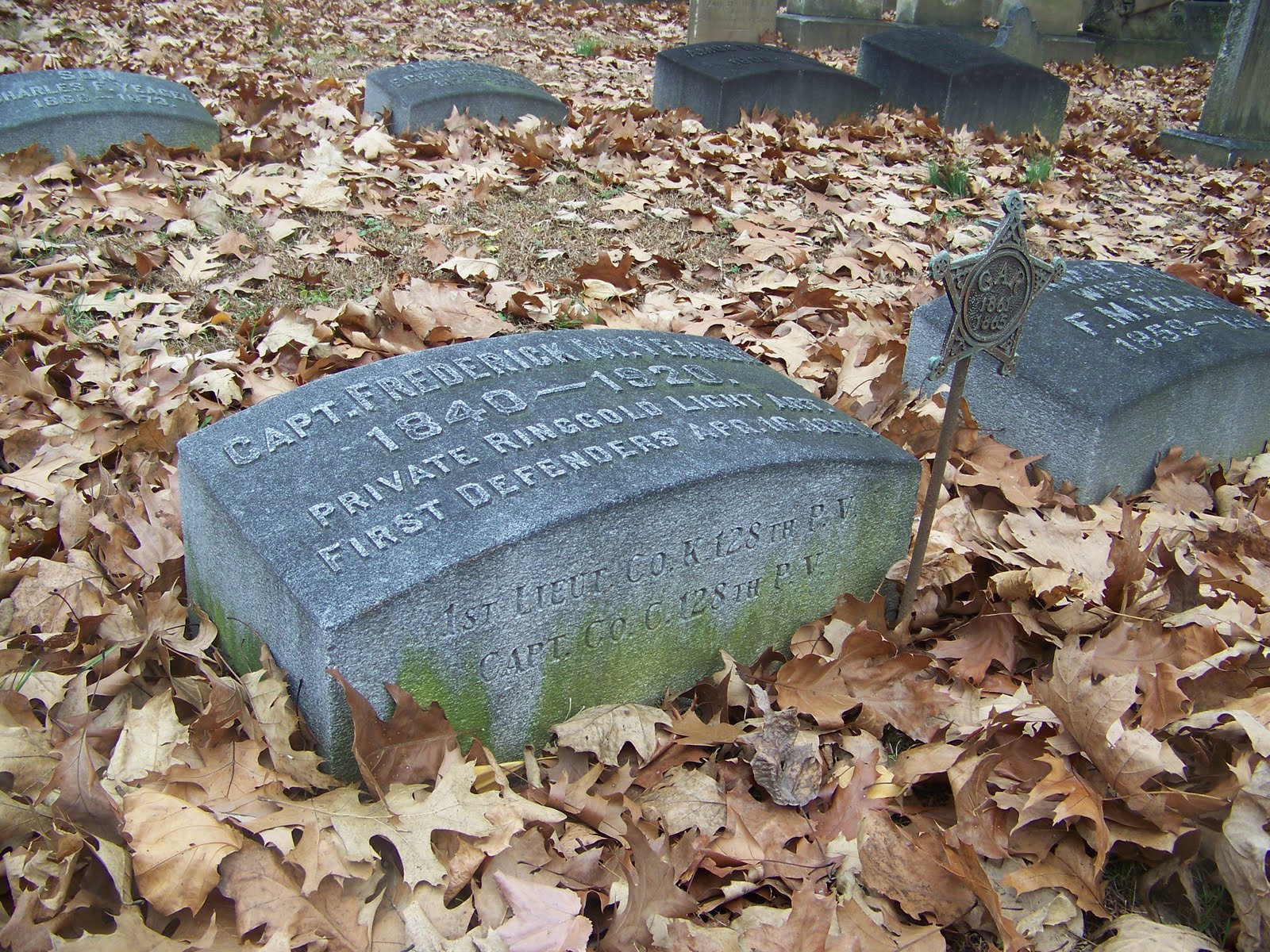
Frederick Yeager was a proud member of the Ringgold Light Artillery and later a captain in the 128th PA. He, too, met Lincoln, on the night of April 18, 1861, when the appreciative president made his way to the Capitol and shook the hands of each First Defender, thanking them for their timely arrival in Washington.
* * * * * * * * * * * * * * * * * * * * * * * * *
After spending several hours in the Charles Evans Cemetery, Mark took me to Penn Commons, a park where stands a monument recognizing the contributions of the Ringgold Light Artillery.


A bronze plaque explains the place of the First Defenders in the annals of Civil War history.
* * * * * * * * * * * * * * * * * * * * * * * * *
In this same park, there is also a pretty impressive monument to William McKinley, commissary sergeant of the 23rd Ohio Infantry. . .oh, and twenty-fifth president of the United States.


* * * * * * * * * * * * * * * * * * * * * * * * * *
48th Pennsylvania Burials
While wandering about the cemeteries, Mark & I discovered the final resting places of several 48th Pennsylvania soldiers. Buried in the GAR Plot (for Posts 16 [McLean] and 76 [Keim]) at Charles Evans are:


Corporal David T. Kreiger, Co. F.
A teamster originally from Girardville, Kreiger served throughout the course of the war.

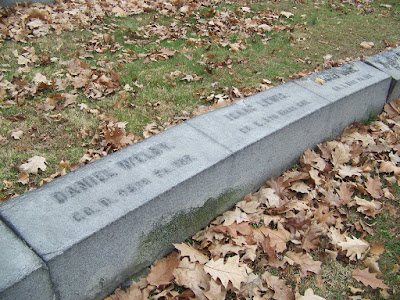
Private Daniel Weldy, Co. D.
Weldy, a chairmaker from Berks County, enlisted in 1861 at the age of forty, reenlisted in 1864, and was mustered out with the regiment in July 1865.

Private Charles Goodman, Co. A.
Goodman was a native of Berks County who enlisted in Port Clinton in 1861. A twenty-six-year-old boatman, Goodman served through the end of his term, being mustered out in October 1864.

Private Albert Fisher, Co. F.
Fisher, a twenty-five-year-old native of Germany entered the 48th in January 1865 as a substitute. He was discharged on a surgeon's certificate in June.


Private Thomas Elliot, Co. C.
A native of Schuylkill County, Elliot enlisted in Pottsville in January 1865 at the age of twenty. The blonde-haired, blue-eyed boatman was discharged with the regiment in July 1865.

* * * * * * * * * * * * * * * * * * * * * * * * *
At the Aulenbach Cemetery, Mark and I discovered two more 48th PA burials:

Sergeant Daniel Moser, Co. H.
Moser was a nineteen-year-old blacksmith from Pottsville when he enlisted in the summer of 1861. He served throughout the war, rising to the rank of sergeant, and was mustered out a "veteran" in 1865.


Private Peter Trump, Co. D.
Trump was a native of Reading who enlisted at the age of twenty in March 1865. He served four months, mustered out in July.

* * * * * * * * * * * * * * * * * * * * * * * * * *

Wednesday, November 18, 2009

Blog Turns Three

The 48th Pennsylvania's Record Banner
* * * * * * * * * * * * * * * * * * * * * * * * *
It is a little hard to believe, but The 48th Pennsylvania Infantry blog turned three years old yesterday. I have had the greatest time keeping this site updated, and I look forward, hopefully, to many more years to come. In the months ahead, I plan on continuing to keep you all updated about my various projects, written or otherwise, which there are quite a few; to present the completion of the Nagle Sword and restoration of the 48th PA monument at Antietam as well as report on the rededication ceremony; and to get back on track, focusing more heavily on the boys of the 48th! I've received so many great new documents, letters, and especially photographs pertaining to the regiment that I can't wait to share.
Thanks to all my readers out there. . .you have made this an incredibly rewarding experience, and I do hope you'll keep coming back.

Wednesday, November 4, 2009

Pottsville's Robert Hampton Ramsey: Brevet Colonel & Assistant Adjutant General to George H. Thomas

Bvt. Col. Robert Ramsey
[Hoptak Collection] 


Throughout the Civil War, Robert Ramsey rose to the rank of colonel, by brevet, and served capably as an officer on the staff of Major General George Henry Thomas, the “Rock of Chickamauga."


* * * * * * * * * * * * * * * * * * * * * * * * * * * * *
Ramsey was born in Pottsville on May 29, 1838. He was educated at the Pottsville Academy and taught school at the Presbyterian Church before entering upon a career as a printer and newspaperman. After working for six years in the officer of the Pottsville Miners’ Journal, Ramsey moved to Philadelphia where he found work first as a printer in the office of Stein & Jones and then as a clerk in the Corn Exchange Bank. He was so employed when civil war erupted in the spring of 1861. Ramsey’s military service began in the summer of 1863, when Robert E. Lee led his Army of Northern Virginia into Pennsylvania. Scores of militia units were organized throughout the Commonwealth in response to this threat, including the 45th PA Militia, which the twenty-five-year-old Ramsey entered as Company H's second lieutenant. Although these Pennsylvania militia units witnessed little, if any action during the Gettysburg Campaign, Ramsey and the 45th PA Militia were sent to Schuylkill County to maintain order during the labor unrest and draft resistance that defined the anthracite coal-rich county in the summer of ’63. While back at this home town of Pottsville, Ramsey was chosen by Brigadier General William D. Whipple, commander of the district, to serve as his assistant adjutant general. When the anticipates threats subsided and a sense of order returned to Schuylkill County, General Whipple was ordered to report to General George H. Thomas and the Army of the Cumberland. Whipple insisted that Ramsey follow him and succeeded in getting the young officer a captain’s commission, to date from December 5, 1863. After much persuasion, Ramsey was ordered west where he ultimately joined Thomas’s headquarters staff. During the 1864 Atlanta Campaign, Ramsey served as Thomas’s acting aide-de-camp and assistant adjutant general. “Though almost constantly exposed to the fire of the enemy, and several times narrowly escaping capture, he passed through the entire campaign uninjured. . . .Captain Ramsey’s bravery, faithfulness, and devotion to duty, during the Atlanta Campaign, so impressed General Thomas that he lodged with the Secretary of War a strong recommendation for his promotion to the rank of major and assistant adjutant-general, which was done, his commission bearing date January 27, 1865. He was afterward commissioned, by brevet, lieutenant-colonel and colonel. He was urged to take a position in the regular army, but always refused, preferring the life of a private citizen.” (1)

Robert Ramsey
[Hoptak Collection] 
* * * * * * * * * * * * * * * * * * * * * * * *
Robert Ramsey was mustered out of the service in July 1866 and he returned to his native Pottsville. He once again entered the newspaper business, becoming a partner in the Miners’ Journal. Later that year, in December, he married Maggie Lindsley of Nashville, Tennessee, whom he no doubt met with serving under Thomas. In February, 1873, Benjamin Bannan, the long-time editor of the Miners’ Journal sold all his interest in the paper to Ramsey and turned the editorial helm over to him. In describing Ramsey, Bannan wrote, “He has been found faithful in every position he has heretofore occupied, and has met the approbation and friendship of all whom he has served. He is fully imbued with the leading principles which have characterized the conduct of the Journal—he is affable, capable, and pushing in business, and is also a fluent writer; but, above all, he is HONEST, and is governed in all his actions by upright principles; and in these degenerate days, when so much corruption abound among public men, and there is so much plundering by office-holders and office-seekers, an honest editor and proprietor of a newspaper is a jewel. . . .” (2)


Ramsey proved an influential editor and won the esteem of his readership. Sadly, however, he began to suffer from a terrible and painful disease, laryngeal phthsis. “It began with a slight affection of the throat, which grew worse, until it affected his voice, and made speaking more and more difficult.” Within several months, Ramsey died of the disease. He sought treatment in Philadelphia to no avail and later traveled to his father-in-law's home in Nashville, “hoping to find relief under milder skies and balmier air.” Ramsey described his life as tortuous and his sufferings as constant and intolerable. “It was only by the greatest effort that he could force himself to swallow enough food to sustain life, and sleep came to him but for two or three hours at night.” By the time he arrived in Nashville in early May 1876, he was very weak and soon became confined to bed. “He expected death, and was fully prepared to meet it. For a week or two before it came, his pain grew easier, and, freed from suffering, but very weak, he lay and waited for the destroyer—to him, the welcome herald of release from a life too full of agony to be endured.”

Finally, on May 31, 1876, the suffering ended and Robert Hampton Ramsey died, just two days after turning thirty-eight years of age. His body was returned to Pottsville, where he was laid to rest in the Presbyterian Cemetery on Tenth and Howard Streets. (3)

Eulogies poured in for the deceased, including the following testimonials from those who knew him best:
“Colonel Robert Hampton Ramsey is no more. . . .That warm and genial heart that was wont to greet us, to sympathize with us, and to encourage us in the battle of life, is stilled in death. . . .He was a man of rare business capacity, indomitable energy, with a heart mellowed by Christian kindness, though bold in conception, courageous in carrying out his plans, yet never infringing on the rights of others, never exalting himself above his less successful competitors, always cheerfully forgiving and even willing to aid those who wronged him, he put the mildest construction upon the action of others, and deported himself in such a kindly and Christian-like manner as to deserve the esteem of all. His line of duty was marked out, and he went forward in it, never swerving to the right or to the left, with the courage and fidelity of a true hero; and whether in the public school, Sabbath school, the church, the army, or in the field of journalism, his talents, his urbanity, his industry, and sterling integrity won for him the highest meed of praise, and, in death, progressive journalism has received a staggering blow. . . .”

Another wrote, “Colonel Ramsey was so young, so full of life, so endowed with energy, that it seemed as if he had many years of work and progress before him. There is left to us, as a consolation, the knowledge that he died content; that his intolerable pain left him some days before he died; that consciousness did not leave him; that the hard-drawn lines of repressed and well-night conquered physical agony were replaced, on his worn face, by a radiance born of his near approach to that God of Love whom he saw by faith, and into whose hands he entrusted his soul with an unfaltering trust. . . .” (4)


* * * * * * * * * * * * * * * * * * * * * * * * *

The Grave of Robert Ramsey
Presbyterian Cemetery, Pottsville, PA
(findagrave.com) 


* * * * * * * * * * * * * * * * * * * * * * * * *


Notes:
(1) Society of the Army of the Cumberland, Tenth Reunion, (Cincinnati: Robert Clarke & Company, 1876), 202-203.
(2) Ibid., 204.
(3) Ibid., 205-206.
(4) Ibid., 206-207.

Thursday, October 29, 2009

The 48th PA at Fort Mahone. . .

My good friend and Schuylkill County Civil War Historian Stu Richards has posted an excellent account of the 48th's last battle at Fort Mahone, Petersburg, on April 2, 1865.

Click here.

Friday, September 11, 2009

Brevet Brigadier General Benjamin Christ Honored


This weekend is Anniversary Weekend at Antietam Battlefield, and while I am looking forward to our full schedule of events, I regret it very much that I will not be able to attend an important ceremony tomorrow in Minersville, commemorating the life and service of Benjamin C. Christ, a valiant soldier from Schuylkill County.
However, I do encourage all who can to attend this event.

From today's Pottsville Republican & Evening Herald:


Civil War General To Be Honored Saturday
by Leslie Richardson (staff writer lrichardson@republicanherald.com)
Published: September 11, 2009

MINERSVILLE - A local Civil War hero will be honored at 2 p.m. Saturday for his contribution to the Union cause.
On his 187th birthday, a Civil War marker will be placed at the gravesite of Brevet Brigadier General Benjamin C. Christ in the First United Methodist Cemetery, Branch Township.
"Carol Kalinich, a neighbor of the cemetery, was really the instigator, if you will, for this whole thing," said Peter Yasenchak, executive director of the Historical Society of Schuylkill County.
"A few months ago, she called me and told me there was a Civil War general buried in the cemetery and no one knows about it."
Yasenchak did some research and took his finding to the Veterans Administration. Later, it was agreed that a Civil War marker should be erected at the gravesite.
"There was no designation on the grave at all," said William Edmunds, president of the cemetery's board of trustees.
"He was a colonel for most of the war, was wounded three times, fought in numerous battles, and no one really knew he was there."
Edmunds said this was probably due to the fact that his remains were buried in an older part of the cemetery in 1869, but were moved when his sister, Elizabeth, bought the family plot in 1870.
Edmunds said Christ most likely lived in Philadelphia with his wife and two children after the war and died there. It seems his children never married and Edmunds said that is the likely reason the gravesite went unadorned.
A cemetery record indicates Christ was interred in the cemetery but the lot designation was left blank.
No one has been interred in the church-owned cemetery since the 1970s. Due to a declining and aging congregation, the cemetery fell into disrepair.
In 2007, Edmunds spearheaded an effort to clean up and maintain the burial ground, and in the process, preserve historical information recorded on the headstones that date back to the 1800s.
According to research done by Deborah Nouzovsky, Minersville, Christ was born in Orwigsburg on Sept. 12, 1822, and later moved to Pottsville and then Minersville.
Christ taught in the Minersville public schools in the 1840s and served as Schuylkill County treasurer in 1848.
In 1854, Christ was president of the Minersville School Board. In 1855, he was elected state representative.
By 1860, he was living in Minersville as an innkeeper.
"Even when you see his military career discussed, you don't see how important he and his family were in the community even before the war," Edmunds said.
Christ enlisted in the Union Army on April 21, 1861, as a lieutenant colonel in Company E, Pennsylvania 5th Infantry Regiment, nine days after Confederate soldiers opened fire on Fort Sumter, Charleston, S.C.
He mustered out of this unit after three months and was commissioned again July 27, 1861, as a field and staff officer, 50th Infantry Regiment, and was promoted to full colonel the same day.
Christ participated in the Battle of Port Royal; commanded the 1st Brigade at Chantilly, assuming temporary command after the death of Isaac Stevens; returned as commander of the 1st Brigade and fought at the battles of South Mountain and Antietam; commanded the 2nd Brigade in the 1st Division at the Battle of Fredericksburg; commanded the 3rd Brigade, 2nd Division in the IX Corps during the siege of Vicksburg; returned to command the 2nd Brigade during the Knoxville Campaign.
In the spring of 1864, Christ took command of the 2nd Brigade in the 3rd Division and fought at the battles of the Wilderness, Spotsylvania and Cold Harbor.
Christ was wounded when the Union army assaulted the Confederate works at Petersburg but returned to command the 1st Brigade, 3rd Division in the IX Corps.
He was promoted to brevet brigadier general on Aug. 1, 1864 and mustered out of Company S, Pennsylvania 50th Infantry on Sept. 30, 1864, six months before General Robert E. Lee surrendered at Appomattox Court House in 1865.
According to a representative of the Veterans Administration, because he was promoted to general shortly before he was discharged, an honor often bestowed on an officer in his last months of active duty, he would have to be distinguished as colonel on the marker, Yasenchak said.
Saturday's ceremony will feature Edmunds, Nouzovsky, Yasenchak, Tom Shay of the Schuylkill County Civil War Round Table, Carol Kalinich, Friends of the Cemetery, the Rev. Nancy Gehres, pastor of First United Methodist Church, Minersville, and a color guard from the Pottsville Joint Veterans Council.
Donations to help maintain the cemetery will be accepted, and applications for membership in the historical society will be available Saturday.

Saturday, August 22, 2009

143 Years Ago Today. . .

. . .General James Nagle, organizer of the 48th Pennsylvania, passed away at the age of forty-four. He died in his home early that Wednesday morning, around 4:00 a.m., surrounded by his family.


The Pottsville Miners' Journal printed the following obituary, as well as an account of the general's funeral, which was held on Saturday, August 25, 1866.

* * * * * * * * * * * * * * * * *

General James Nagle.-Sincere sorrow pervaded this community on Wednesday morning last, when the fact of Gen. Nagle’s death became known. The sad event was not unexpected, for he had suffered for years from disease of the heart and liver, and during the past few weeks it was evident to his friends that he was succumbing to the attacks of adversaries too powerful for medicine to combat successfully. He died on Wednesday morning at 4 o’clock at his residence in this Borough. A brave soldier of two wars; a good citizen; an estimable man, has passed away. While the memory of his worth will remain green in the memories of this community in which so many years of his useful life were spent, his name will be inscribed with honor on the pages of his country’s history.
General Nagle was born in Reading, Pa., on the fifth of April, 1822, and was at the time of his death 44 years, 4 months, and 17 days old. From youth up his tastes were military. In 1842 he organized in Pottsville, where he resided, the Washington Artillery Company. When war was declared against Mexico, he, among the first, tendered the services of his Company, which were accepted. The Company left Pottsville on the 5th of December, 1846, for Pittsburgh, Pa., and was mustered into the United States service as Company B, 1st Pennsylvania Regiment. Gen Nagle, with his Company, was engaged during the entire siege of Vera Cruz, and rendered efficient service. In the Battle of Cerro Gordo he acted as Major of his Regiment. He with his Company and three others of the Regiment, was stationed at Perote Castle, to keep communication with Vera Cruz open, while the army under Gen. Scott, advanced. June 20, 1847, he assisted to route a force of guerillas at Lahoya. October 9, 1847, he fought at Huamantla; on the 12th at Puebla, and on the 19th at Atlixco. In each engagement the enemy was routed with heavy loss. Subsequently he entered the City of Mexico with his Regiment, remained there several weeks, and finally was stationed at San Angel until the close of the war. He was mustered out of the service with his Company at Philadelphia, July 27, 1848. The Company reached Pottsville on the 28th, where it and its commander were received with enthusiasm.
Soon after the return of Gen. Nagle a valuable sword was presented to him by the citizens of this County, as a mark of their appreciation of his services in Mexico.
In 1852 he was elected Sheriff, and subsequently Brigade Inspector and Colonel.
Gen. Nagle was warmly identified with military matters in this County up to the commencement of the Rebellion in 1861, when he was commissioned of the Sixth Pennsylvania (three months) Regiment. He was in the skirmish of Falling Waters. During this term of service he secured the confidence of his superior officers and was complimented by them.
In August, 1861, he organized the Forty-eighth Penna. Regt. for “three years of during the war” of which he was commissioned Colonel. He served with his Regiment at Fortress Monroe, Hatteras Island, and Newbern, and commanded with gallantry, judgment, and discretion, the 1st Brigade, 2nd Division, 9th Army Corps, in the Second Battle of Bull Run. Soon after the battle, he was recommended by Gen. Reno for promotion to Brigadier-General. The appointment was made by President Lincoln. Subsequently, Gen. Nagle was in the battles of Chantilly, South Mountain, and Antietam, and the Brigade greatly distinguished itself. In the carrying of Antietam Bridge which Gen. McClellan. . . . . . . the day, Gen. Nagle’s Brigade performed an important part and was especially complimented.
At Amisville in a skirmish, Gen. Nagle with his Brigade, drove the rebels. In the first battle of Fredericksburg the Brigade fought bravely under its commander and sustained a heavy loss.
Subsequently Gen. Nagle served with his Brigade in Kentucky, until May, 1863, when in consequence of suffering from disease of the heart, which finally caused his death, he was compelled to resign much to the regret of General Sturgess and the troops that Gen. Nagle commanded.
At home rest and absence from the excitements and exposures of the field had a beneficial affect, and his health became so much improved that when Gen. Lee commenced his invasion of Pennsylvania in June, 1863, Gen. Nagle organized the Thirty-ninth Regiment, Pennsylvania Militia, for the emergency an was commissioned Colonel of it. He was mustered in July 6, went to the front, was assigned to command a Brigade, and was mustered out August 3, 1863.
In 1864, Gen. Nagle organized the One Hundred and Ninety-fourth Pennsylvania Regiment, for the Hundred days’ service. He was commissioned Colonel July 31,and ordered to Baltimore. He subsequently commanded all of the troops at Mankin’s Woods-about 8000-and guarded the approaches to the City until the expiration of his term of service. He was mustered out November 5, 1864.
This sums up a military service eventful and honorable.
At the time of his death, Gen. Nagle was President of the Council of this borough.

* * * * * * * * * * * * * * * * * * * *

The Funeral of Gen. James Nagle. The remains of Gen. Nagle were interred in the Presbyterian Cemetery on Saturday afternoon last with military honors.
During the morning the Ringgold Band of Reading, which had volunteered to play on the occasion, the Ashland Veterans, Capt. McLaughlin, and the Cumbola Nagle Guards reached the borough to attend the funeral. At noon Capt. Binder of Philadelphia, a companion-in-arms of Gen. Nagle in the Mexican War, having been in the same Regiment, Gen. Albright of Carbon County, and Major Bertolette of Reading, also arrived to assist in playing the last sad honors to the remains of the dead soldier.
The body was viewed by hundreds before the hour of moving from the late residence of the deceased General. The corpse was attired in citizens’ dress, and rested in a coffin furnished by Mr. John Kalbach, Centre Street opposite the Union Hotel. It was made of walnut covered with black cloth, and the ornamentation was faultless, reflecting great credit on the taste of the maker. A silver plate on the lid bore the General’s name and age. The entire workmanship was the subject of much and just commendation. When the coffin was placed in the hearse it was covered with a silk national flag with a black rosette in each corner. On the top rested the sword which was presented to Gen. Nagle by the citizens of Schuylkill County, after his return from Mexico.
About 3 o’clock the cortege moved from the house in the following order, left in front:
Hydranlian Fire Company
American Hose Company
Humane Hose Company
Good Intent Fire Engine Company
Cumbola Nagle Guards
Washington Artillery Company
Ashland Veterans
Grant Zouaves, Pottsville
Ringgold Band, Reading
Soldiers Central League, Pottsville
Detachment of Soldiers in Mexican War
Who were in Gen. Nagle’s Company, bear-
Ing the old Company flag.
Officiating Clergy
Hearse
Pall Bearers—Gen. Wm. W. Duffield, Gen. Geo. C.
Wynkoop, gen. H. Pleasants, Gen. Albright,
Gen. J.A. Hennessy, Col. J.M. Wetherill
Horse and Groom
Mourners
Mounted Officers in Uniform
Gen. J.K. Sigfried and Staff

The cortege which contained about six hundred persons, moved over the following route: From house to Market Street; down market to Centre; down Centre to Mahantango; up Mahantango to Clay; down Clay to Howard Avenue; down Howard Avenue to the Cemetery.
All places of business were closed during the passage of the funeral train, and many houses along the route were clothed in mourning while flags were suspended at half mast and craped. The streets were filled with silent and mournful spectators. Minute guns were fired from Lawton’s Hill until the cortege reached the Cemetery.
The religious services at the grave were conducted by Rev. Mr. McCool, rev. Mr. Cook and Rev. Mr. Billheimer. Mr. McCool delivered an impressive discourse, in which he dwelt at length upon the life, character, and services of Gen. Nagle. It was listened to attentively by the large concourse of persons present, which must have numbered between two and three thousand.
The last military honors were paid by the Grant Zouaves who fired three vollies over the grave.
The military then returned to Centre Street, where the line was dismissed.
It was one of the largest and most imposing funerals ever seen here, the entire community evincing sincere sorrow at the loss of an estimable citizen, a brave soldier, a patriot, whose career will ever be referred to with pride by our citizens, and whose memory will be cherished while our hills endure.