Thursday, August 21, 2008

Major General Napoleon J.T. Dana

Napoleon Jackson Tecumseh Dana
* * * * * * * * * * * * * * * * * * * * * * *
With his father an officer in the regular army who fought in the War of 1812, his grandfather a veteran of the Revolution, and being as he was named after three of the greatest military leaders of the Nineteenth Century, it seemed only logical that Napoleon Jackson Tecumseh Dana would himself make a career out of the military. A graduate of West Point, Dana was severely wounded during the Mexican-American War, and during the Civil War was struck down with a serious wound at the battle of Antietam, keeping him out of service for the next ten months. Upon his return, Dana was assigned to backwater command posts along the Gulf Coast. Fearless and highly competent as an officer on the field of battle, Dana nonetheless remains as somewhat of an overlooked figure in Civil War history.
Napoleon J.T. Dana was born on April 15, 1822, in Fort Sullivan, Eastport, Maine, where his father, Nathaniel Dana, a West Point graduate and officer in the 1st U.S. Artillery, was then stationed. Sadly, Nathaniel Dana died when his son Napoleon was just eleven years old. While Dana’a paternal grandfather, Captain Luther Dana, served as a naval officer during the Revolution, his maternal grandfather, Woodbury Langdon, served as a member of the Continental Congress alongside his brother John Langdon, who would later become first President pro-tempore of the U.S. Senate as well as governor of New Hampshire.
Five years after his father’s death, at the age of sixteen, Napoleon Dana entered the United States Military Academy at West Point, and four years later, in 1842, graduated twenty-ninth in a class of fifty-six. West Point’s Class of 1842 remains as one of its most illustrious, for in addition to Dana, a number of other soldiers who later gained distinction during the Civil War graduated that year including James Longstreet, Daniel Harvey Hill, William Rosecrans, John Pope, John Newton, George Sykes, Richard H. Anderson, and Abner Doubleday. Upon graduation, Dana was commissioned a second lieutenant in the 7th U.S. Infantry and assigned to garrison duty at Fort Pike, Louisiana, where he spent most of the next three years.
In 1845, with war clouds looming, Dana was sent with his regiment to Texas where they formed part of Zachary Taylor’s Army of Occupation. When hostilities finally erupted, Dana turned in commendable performances during the battles of Fort Brown, Texas, in May 1846, and at Monterrey in September. Promoted to first lieutenant the following February, Dana then traveled south and under General Winfield Scott took part in the siege of Vera Cruz. During the battle of Cerro Gordo on April 18, 1847, while charging the entrenched Mexican position on Telegraph Hill, Lieutenant Dana was struck in the hip and fell gravely wounded. So severe was Dana’s wound that he was left for dead on the field of battle, and lay there for some thirty-six hours until rescued by a burial detail. Brevetted captain for his actions at Cerro Gordo, Dana next served two years on recruiting duty and as Assistant Quartermaster at the rank of captain in Boston. Transferred to Minnesota late in 1848, Dana served for six years at Fort Snelling at Fort Ridgely before resigning from the army on March 1, 1855. Following his resignation, Dana settled in St. Paul and became a banker. Unable to keep away from the military life, Dana also served as brigadier general in the Minnesota State Militia from 1857 until civil war erupted in 1861.
Offering his service to the United States, Dana was commissioned colonel of the 1st Minnesota Volunteers following the promotion of Willis Gorman to brigade command on October 2, 1861. Leading his regiment at the Battle of Ball’s Bluff, Dana assumed command of the Second Brigade of Charles Stone’s Division following the Union fiasco there. On February 3, 1862, Dana was promoted to the rank of brigadier general of volunteers and one month later was given command of the Third Brigade, Second Division, in the Army of the Potomac’s Second Corps. During the Peninsula Campaign and Seven Days’ Battles in the late spring and early summer of 1862, Dana saw action at the battles of Yorktown, Seven Pines, Savage Station, White Oak Swamp, and Malvern Hill, all the while earning a reputation as a solid and dependable officer. Shortly after the latter battle in early July 1862, however, Dana fell ill and sought medical treatment. His doctors determined that he was suffering from a serious case of remittent fever and sent him to Philadelphia, where he spent the next six weeks recovering from his illness. He returned to his command at the outset of the Maryland Campaign.
At the battle of Antietam, Dana’s Brigade suffered heavy loss in the fierce fighting in the West Woods. Sometime around 7:30 on the morning of September 17, Dana’s men crossed the Antietam at Pry’s Ford and marched to the support of the First and Twelfth Corps on the right of the Union line. Second Corps Commander Edwin Sumner arranged his Second Division, under the command of John Sedgwick, into three parallel lines of battle, with Dana’s Brigade constituting the second line. Planning to push this division due west and drive what remained of the Confederate forces to his front through the village of Sharpsburg and toward the Potomac River, Sumner led his men through the East Woods, across the Hagerstown Turnpike, and into the West Woods. Dana’s Brigade, marching some fifty yards in rear of Willis Gorman’s lead brigade, came under artillery fire as they neared the Turnpike but continued to push forward. Dana’s New York, Massachusetts, and Michigan volunteers entered the West Woods at about the same time as Gorman’s Brigade became engaged on the western edge of the woodlot. Just moments after the last of Dana’s troops entered the woods, however, his left flank was struck by the advancing Confederate troops of McLaws’s and J.G. Walker’s Divisions. Struck hard on the flank and in danger of being surrounded, Dana scrambled to meet the oncoming threat and get his men to safety. Being the middle of Sedgwick’s three brigades, however, it was tough for Dana to maneuver his troops. Sometime during the fight, he was struck in the left leg by a musket ball but he remained with his command until they reached the relative safety of the Miller Farm. By this time the pain in his leg had become unbearable. Dana turned command of his brigade over to Colonel Norman Hall of the 7th Michigan before being carried from the field and to a Union field hospital.
Sedgwick’s Division had lost nearly half its number in just thirty minutes of combat in the West Woods. Casualties in Dana’s Third Brigade equaled 900 men killed, wounded, and missing, with the highest loss occurring in the 59th New York and 7th Michigan. Dana was himself cared for in a field hospital for two days in nearby Keedysville before being sent first to Washington and then to Philadelphia to recuperate.
Although promoted to major general of volunteers on November 29, 1862, Dana did not return to duty until July 1863, when, during the Gettysburg Campaign, he commanded the Defenses of Philadelphia and a short time later the Second Division of General Darius Couch’s Department of the Susquehanna. After General Lee’s Army of Northern Virginia was turned back at Gettysburg and retreated across the Potomac, General Dana was sent to the Gulf of Mexico where he saw limited action at Fordoche Bayou and in the expedition that landed at Brazos Santiago and marched to Laredo, Texas. Given divisional command in the 13th Army Corps, Department of the Gulf, in September 1863, Dana subsequently commanded the District of Vicksburg from August 19 to December 8, 1864, when he was named head of the Department of Mississippi. Serving in this capacity until May 14, 1865, Major General Napoleon Dana tendered his resignation from the army two weeks later and returned to civilian life.
In the years following the Civil War, Dana engaged himself in a variety of occupations and endeavors. In 1866, he was named as a general agent for the American-Russian Commercial Company of San Francisco and for the next five years worked for this company in California, Alaska, and Washington, D.C. Dana next entered the railroad business and became superintendent of a number of lines, mainly in Illinois, including the Chicago, Burlington, and Quincy Railroad. In 1885, he was named president of the Montana and Union Railway Company. Retiring from his work on the railroads in the 1890s, General Dana next served as Deputy Commissioner for the United States Department of Pensions. In 1894, in a Special Act of Congress, Dana was commissioned back into the army at the rank of captain and then placed on the retired list so as to enable him to receive a pension.
Napoleon Jackson Tecumseh Dana lived out the final years of his life in peaceful retirement in Portsmouth, New Hampshire. His death, attributed to apoplexy, came on July 15, 1905. The old soldier was laid to rest in Portsmouth’s Harmony Grove Cemetery.

General Dana's Final Resting Place. . .

(www.findagrave.com)

Wednesday, August 6, 2008

Gettysburg Scrapbook: The First Day


I woke this morning a little after six o'clock, and after opening a window in my living room I noticed it rained quite a bit over night. By the time I was up, however, the rain had ended and the weather showed all the promise of a beautiful summer morning. Temps were low, a light breeze was blowing, so I figured I'd do something I don't often do. . .tramp around the Gettysburg battlefield. I've been living here for four years already, but it seems I spent more time on the fields before I moved. During the springs and summers at least, I spend five days a week at the Antietam battlefield, and by the time I get home, well, there just isn't that much time. I thought this morning, then, that I would go out and maybe recapture that almost indescribable feeling I got when I didn't live in Gettysburg, but years back when I traveled here on weekends or while on vacation with my family.
It was a glorious morning, and I had my camera along. So here are just a few images I captured early today while tramping north and west of Gettysburg, on the fields where the three-day battle began. . .

* * * * * * * * * * * * * * * * * * * *
General John Buford's Statue, and, just yards behind. . .
The equestrian statue of General John F. Reynolds.

The McPherson Farm, with the McPherson Woods behind. Reynolds was slain early that Wednesday morning, July 1, 1863, leading his 1st Corps into action.
Another view of the McPherson barn, this time looking north-east from the woodline.
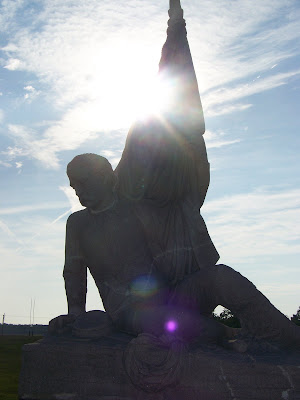
It's soon going to be time for harvest, I suppose. Here is the statue of General Abner Doubleday (you know, the guy who didn't invent baseball) rising above and behind the rows of corn.
And, of course, the famed Lutheran Seminary.
Cannon atop Oak Hill (McPherson barn in far distance, to the right of the barrel).


This picture is looking south-westerly over Gettysburg. . .the heights south of town, where the Army of the Potomac would rally after their reverse on the First Day can be seen beyond.

A rare Whitworth Gun with the Peace Light beyond. . .
Looking north toward Oak Hill from modern-day Howard Avenue, where the 11th Corps would go into position. By the time Howard's men arrived, Rodes's Confederates had already reached Oak Hill and were hammering away on the right flank of the Federal 1st Corps, held by General John Robinson's men. . .two brigades, which, by the way, had seen terrible combat in the Cornfield at Antietam nine and half months earlier.
Another view of Oak Hill (far distance, right. . .you might see the Peace Light). Oak Ridge, where Robinson's men tenaciously held on despite terrible loss before being driven back is to the left. . .This picture was also taken from the perspective of the 11th Corps. Soon after settling into line, Howard's men came under attack from General George Doles's Confederate brigade, which advanced north-to-south, or right-to-left on this picture.
The Monument of the 74th Pennsylvania Volunteers, Schimmelfennig's brigade, 11th Corps.
Francis Barlow (who commanded a New York regiment in the 2nd Corps at Antietam) fell seriously wounded at Gettysburg while in command of a division in the 11th Corps.
A close-up on Barlow's statue has him clutching his kepi as he surveys the ground. . .and Jubal Early's advancing Rebs.

An eagle, with clipped wing, precariously situated atop the small monument to the 27th Pennsylvania along Coster Avenue in town. . .

The 153rd Pennsylvania, recruited from the Lehigh Valley

I could not have asked for a better morning. . .spending two hours on the Gettysburg battlefield on my off-day from work at Antietam.

Wednesday, July 30, 2008

Schuylkill County Civil War Commemoration. . .

As noted earlier this week, I will be participating in a days' long commemoration of my native Schuylkill County's Civil War history, which will take place in Pottsville in early September. More informtaion regarding this upcoming event can be found here.

Hector Tyndale: Fine China & Ceramics Importer, Philantropist, Abolitionist, and Civil War General

* * * * * * * * * * * * * * * * * * * * * * * * * *
Hector Tyndale was a man of high culture and sophistication. As one of Philadelphia’s leading importers of ceramics and glasswork, Tyndale also pursued his interests in literature, philosophy, science, and the fine arts. Actively involved in cultural, business, and civic affairs, he was also among the city’s biggest philanthropists. It may seem just a bit out of character then for a man so refined to also be a fierce warrior and a fearless leader on the field of battle.
Born on March 24, 1821, in Philadelphia, Hector Tyndale was a first-generation American. His father, Robinson Tyndale, had emigrated along with his brother, William, from their native Leighlinbridge, Ireland, to America, where they established Tyndale & Company, an importing firm that specialized in ceramics and glass. Hector joined his father’s company upon graduating from the Philadelphia School, but only after he declined an appointment to the United States Military Academy at West Point. In declining this appointment, Tyndale was respecting the wishes of his mother, a Quaker, who desired that Hector follow in his father’s footsteps and make a career in the importing business. After his father passed away in 1842, Hector established Tyndale & Mitchell, an importing firm he co-founded with his brother-in-law. Over the ensuing decades, this company would become one of the principal purveyors of fine china and glass. In December 1859, Tyndale, one of the founding members of the Republican Party in Philadelphia, volunteered to escort Mary Ann Day Brown, to Charlestown, [West] Virginia, so that she would be able to spend some final time with her husband, the abolitionist John Brown, who was sentenced to be hanged for his momentous raid on Harper’s Ferry. Amidst threats and insults, and even some gunshots, Tyndale then provided care and comfort to the grieving Mrs. Brown as she accompanied her husband’s body for burial in New York, via Philadelphia.
Tyndale was on one his many business trips to Europe when the American Civil War broke out in April 1861. Departing Paris upon hearing of the outbreak of hostilities, Tyndale arrived back in Philadelphia where, on June 28, 1861, he was commissioned major of the 28th Pennsylvania Volunteer Infantry. Promoted to lieutenant-colonel the following spring, Tyndale led his regiment throughout the Shenandoah Valley campaigns of 1862, as well as at the battles of Cedar Mountain and Second Bull Run. At the battle of Antietam, though still a lieutenant-colonel, Tyndale commanded 1st Brigade, 2nd Division, 12th Corps, composed of his own 28th Pennsylvania, as well as the 5th, 7th, and 66th Ohio Regiments.
Tyndale’s Brigade formed into line around 6:30 a.m. on the morning of September 17, 1862, and then advanced from their bivouac on the Hoffman Farm in southerly direction toward the East Woods. Here they encountered North Carolina troops under the command of Colonel D.K. McRae who were sent to the woods that morning to protect the right flank of Alfred Colquitt’s Brigade, which was then sparring with Union troops from the Cornfield. Striking McRae’s front and flank with fury, Tyndale’s men were able to force the Confederates from the East Woods, thereby exposing Colquitt’s right flank. After unleashing a deadly volley into the ranks of Colquitt’s men, Tyndale’s Ohioans and Pennsylvanians charged into the Cornfield, forcing the retreat of the southern troops. Tyndale’s Brigade, strengthened on the left by Henry Stainrook’s Twelfth Corps brigade, then advanced across the Smoketown Road and took a position on the ridgeline opposite the Dunker Church, and just north of where the Visitor Center stands today. Pausing to replenish its ammunition, Tyndale’s brigade afterward repulsed several Confederate attacks before crossing the Hagerstown Turnpike and taking up an advanced position in the West Woods sometime around 10:30 a.m. With no support, and with their ammunition being again exhausted, Tyndale’s men were forced to retire from their advanced position, and, at around noon, retired to the vicinity of the East Woods, their fighting for the day being done. Casualties in Tyndale’s Brigade totaled 376 men killed, wounded, and missing, with seventy-one percent of these losses being sustained in the ranks of Tyndale’s own 28th Pennsylvania.
Hector Tyndale fearlessly led his men into battle that day. At all times at the head of his brigade, he had no less than three horses shout out from underneath him. Ignoring a wound to his hip, Tyndale was later struck down by a ball to the back of his head, which then traveled down his neck until resting somewhere between his jaw and sternum. Knocked unconscious by this blow, he was then dragged to a safe location behind a haystack where he laid awaiting treatment. After the bullet was surgically removed, Tyndale returned to Philadelphia to more fully recover. Two months later, and because of his courage and conspicuous gallantry at Antietam, Tyndale was promoted to brigadier general of volunteers, jumping two grades from his previous rank of lieutenant-colonel.
Not fully recovered by the spring of 1863, Tyndale nonetheless returned to the army although he suffered frequently from pain and numbness in the right side of his body, a condition his doctors attributed to the head wound he received at Antietam. On July 10, 1863, one week after the battle of Gettysburg, Tyndale was assigned brigade command in the 11th Corps. Traveling west with his new command two months later, Tyndale further distinguished himself as a fighting general during the battles for Chattanooga. Assigned divisional command the following February, Tyndale, still in poor health, was assigned a sick leave three months later. Feeling physically unable to return, Tyndale tendered his resignation from the army, which was accepted on August 26, 1864. He returned to Philadelphia and once again engaged himself in his importing business. In March 1865, although no longer in the service, Tyndale was honored with the rank of brevet major general of volunteers.
After the war, Tyndale remained active in civic affairs and continued to prosper from his lucrative business. He liberally gave back to the community, furthering his fine reputation as a philanthropist. In 1868, Tyndale attempted to enter the political world, being nominated by the Republican Party to run for mayor of Philadelphia, but was narrowly defeated by his Democratic opponent.
Tyndale’s Antietam wound continued to plague him during the postwar years. He was still bothered by feelings of numbness, and soon developed a number of nervous system disorders, which his doctors once again blamed on the damage caused to his head during the September 17, 1862, battle. General Tyndale died on March 19, 1880, less than a week before his fifty-ninth birthday. Despite the problems he suffered from his Civil War wound, the cause of death was listed as heart related. His body was taken to Philadelphia’s magnificent Laurel Hill Cemetery for burial. Carved upon his stone is the following epitaph: “Give me light to see and strength to do my duty.”
Hector Tyndale's Grave

Monday, July 28, 2008

"Sparks Around the Campfire: The Story of Schuylkill County in the Civil War."

My friends and fellow Schuylkill County Civil War historians Stu Richards and Tom Shay have been busy putting together a series of talks, tours, and presentations--all of which focusing on the Civil War history of my native Schuylkill County. And I am happy to report that a schedule of events has just been released. For four days in early September (Wednesday, September 3, through Saturday, September 6), at various sites throughout Pottsville, all attention will be on the Civil War history of Schuylkill County. There are a number of programs/presentations lined up and most of the events are free and open to the public. It was an honor for me to asked to participate in the event. On Saturday, September 6, I will be first leading a tour of the Civil War burials in the Presbyterian Cemetery in Pottsville, then delivering a lecture in the afternoon on the life and overlooked service of Pottsville's own General James Nagle, and finally signing books in the evening. It promises to be a busy day, but I am greatly looking forward to it.
Below is the schedule of events. We are hoping to see you all there. . .


* * * * * * * * * * * * * * * * * * * * * * * * * * * * * * * * *


Sparks Around the Campfire: The Story of Schuylkill County in the Civil War

*Patriotic Rally
Wednesday, September 3, 2008—7:00 p.m.—Sovereign Majestic Theater
Admission—5 cents. Call 628-2833
Join us at the Sovereign Majestic Theater and relive the sights and sounds of a Patriotic Rally during the Civil War Era. Speeches, music, lectures and more.

*Civil War Show and Tell
Thursday, September 4, 2008—5:30 p.m.—Historical Society of Schuylkill County
Admission—Donation Accepted. Call 622-7540
Bring your Civil War artifacts for appraisal or to discuss with other Civil War aficionados. The Civil War Exhibit in the Historical Society will be open for tours.
Marty Hupka will be in attendance with several Civil War Era photographs…he is offering a reward of $50.00 for the positive identification of specific people in the photos.

*Meet General Meade, Victor of the Battle of Gettysburg
Anthony Waskie, Philadelphia - Professor of Languages & Member of the Civil War & Emancipation Studies Forum, Temple University
Thursday, September 4, 2008—7:00 p.m.—Historical Society of Schuylkill County
Admission—Donation Accepted. Call 622-7540
Using Meade's own words and extensive background research, Anthony Waskie, speaking as General Meade, will recount the General's career and services to the nation. From his work as an engineer and lighthouse builder, to combat in the Seminole and Mexican Wars, to his assuming command of the Union Army on the eve of the Battle of Gettysburg (where he handed Lee his first defeat), Meade was integral to the survival of the Union. Not only successful in war, Meade also designed Philadelphia's Fairmount Park, founded two schools for orphans of Civil War veterans and helped integrate surviving veterans back into peacetime pursuits.
Participants are encouraged to ask “General Meade” questions about his life and work.

*Torchlight Vignettes
Friday, September 5, 2008—Schuylkill County Council for the Arts
6:00 - 7:30 p.m. – Mingle and Dine
8:00 p.m. – Till? – Torchlight Vignettes
Admission—$8.00. Call 622-2788
Enjoy a Civil War Era evening featuring strolling musicians, choral groups, living historians, food vendors followed by Torchlight Vignettes where various Civil War scenes are brought to life by living historians.

*Grave Tours
Saturday, September 6, 2008—10:00 a.m.-12:00 noon.—Meet at Presbyterian Cemetery (Howard Avenue and 12th Street)
Admission—Free to all
Tour Presbyterian Cemetery led by John Hoptak, Author and US Park Ranger and Tom Shay, Local Historian, to see the final resting place and hear the stories of the lives of Civil War Notables, including Brigadier General James Nagle, Colonel Daniel Nagle, Medal of Honor Winner Colonel Jacob Frick.

*Lectures
Saturday, September 6, 2008—12:00p.m.-1:00p.m.
Admission – Free, Donations Accepted
Barry Berkey - Historian, Weapons Expert - “Weapons of the Civil War”—Historical Society of Schuylkill County
Jim Corrigan - Author, Historian—”Schuylkill County Coal Miners and the Battle of the Crater”—Sovereign Majestic Theater
Danielle Richards - Historian, Educator - “Arrest the Women at Once and Dispose of Them” - The War & Schuylkill County Irish Women—Historical Society of Schuylkill County.

Saturday, September 6, 2008—2:00p.m.-3:00p.m.
Admission – Free, Donations Accepted
Stu Richards - Author, Historian. - “From the Prison Pen, Schuylkill County Soldiers and Civilians in Rebel Prisons.”— Historical Society of Schuylkill County
Mark Major – Historian, Author - “Schuylkill County in the Civil War: A Collection of Highlights, Unique Stories and Random Insights—Sovereign Majestic Theater.

Saturday, September 6, 2008—3:00p.m.-4:00p.m.
Admission – Free, Donations Accepted
John Hoptak - Author, Historian, Park Ranger Antietam battlefield. “Schuylkill County's Veteran War Horse: The Life and Forgotten Service of Brigadier General Nagle.”—Historical Society of Schuylkill County
Tom Shay - Historian, Antietam Battlefield guide. - “The men and the Units from Schuylkill County and the battles they fought in”—Sovereign Majestic Theater.

*Book Signing
Saturday, September 6, 2008—12:00p.m.-4:00p.m.—Historical Society of Schuylkill County
Admission – Free, Donations Accepted. Call 622-7540
The Research Room of the Historical Society will be open for meet and greet and book signings by authors John Hoptak, Jim Corrigan, and Stu Richards.

*Premiere of Movie “The Color Bearers”
Saturday, September 6, 2008—7:00 p.m.—Sovereign Majestic Theater
Admission—$5.00. Call 628-2833
The Color Bearers is an enlightening, entertaining look at American Patriotism’s evolution as embodied by its iconic symbol the American Flag.
While the film explores the familiar themes in that great American Story – Francis Scott Key and the flag planted atop Iwo Jima – it also explores lesser known but no less deserving subjects such as Mary Pickersgill, maker of the Star Spangled Banner that flew over Ft McHenry and inspired the Star Spangled Banner – Sgt William H Carney, the first African American to be awarded the Medal of Honor for his gallant bravery and defense of the flag with the 54th Massachusetts at Fort Wagner, and who later inspired the film “Glory”. Alongside these heroes of America’s past, the program features modern day patriots – common Americans doing uncommon things to honor their flag and their country – such as NY Artist Scott LoBaido who traveled the United States painting one large American Flag mural on one rooftop in each of the fifty states. This he did with no corporate sponsorship, and as he put it –”I’ll get back to New York with about a hundred bucks left to my life.”
We meet a descendent of Sgt William Carney – and also the descendents of two other Civil War Flag-bearing heroes – and hear how the bravery of their gallant ancestors has affected and helped shape their lives today.

* * * * * * * * * * * * * * * * * * * * * * * * * * * * * * * * * * * *

Tuesday, July 22, 2008

J. William Hofmann: Brevet Brigadier General

Brevet Brigadier General J. William Hofmann
* * * * * * * * * * * * * * * * * * * *
I'm continuing this week with posting yet another biographical piece of a rather overlooked Civil War personality, this time it is John William Hofmann. Hofmann served throughout most of the war, and saw action at most of the Eastern Theatre's significant battles. And although he commanded a brigade for a good portion of his time in uniform, Hofmann never advanced above the rank of colonel.
* * * * * * * * * * * * * * * * * * * * * *
During his four years in uniform, John William Hofmann saw action at most of the major battles of the Civil War’s Eastern Theatre, oftentimes, as at Antietam, in brigade command. Although possessing no formal military training, Hofmann’s performances in battle as well as his own personal bravery won him the accolades of his superior officers. Indeed, in a November 1863 letter to Pennsylvania Governor Andrew Curtin, General Lysander Cutler, Hofmann’s immediate superior at the battle of Gettysburg, declared that the native Philadelphian “is, without qualification, one of the best officers, brave, faithful and prompt, and a most excellent disciplinarian.” And General George Meade wrote of Hofmann’s “high character for intelligence, energy, and zeal in the discharge of his duties, and for [his] conspicuous gallantry on the field of battle.”[1] Yet despite his service record and the high esteem in which he was held, Hofmann never advanced above the rank of colonel.
J. William Hofmann, a first-generation American, was born on February 18, 1824, the son of John and Anna Louisa Hofmann, who had emigrated together from Prussia five years earlier. Upon arriving in Philadelphia, the elder Hofmann went into the business of manufacturing socks, stockings, and undergarments. At the age of twenty-one, the future Civil War officer himself entered the business, selling clothing at his Philadelphia store. But Hofmann’s true interest lay in military affairs. In 1840, at the age of 16, he enlisted in the city’s Junior Artillerists, and in 1843 became a member of the famed Washington Grays militia unit. With the outbreak of civil war in April 1861, Hofmann was quick to offer his services to his country. Less than a week after the capitulation of Fort Sumter, Hofmann was mustered into service as a captain in the three-month 23rd Pennsylvania Volunteer Infantry. The 23rd spent most of its time in service in the Shenandoah Valley, serving under General Robert Patterson, but seeing no substantial action.
In the summer of 1861, after having been mustered out of the 23rd Pennsylvania, Hofmann helped raise and organize the 56th Pennsylvania, a three-year unit, and in October he reentered service as the regiment’s lieutenant-colonel. Remaining at Camp Curtin in Harrisburg for the next six months, the 56th then traveled south to Virginia but did not see any major combat until the Second Battle of Bull Run, fought during the final days of August 1862. Here, in their baptism by fire, the men of the 56th sustained heavy losses, including its colonel, Sullivan Meredith, who fell gravely wounded on the first day’s battle. After Meredith’s wounding, command of the regiment devolved upon Hofmann.
With George McClellan’s reorganization of the Army of the Potomac in early September 1862, the 56th Pennsylvania formed part of General Abner Doubleday’s brigade, in John Hatch’s First Corps division. Hofmann continued at the helm of his regiment until the September 14, 1862, battle at South Mountain. As the 56th entered the battle late in the day, Hofmann saw division commander John Hatch being carried to rear, seriously wounded. Command of the division then fell upon Doubleday, who, in turn, handed command of his brigade over to its senior colonel, William Wainwright of the 76th New York. After Wainwright fell wounded just a short time later, Hofmann assumed command of the brigade, which he commanded three days later at Antietam.
Crossing the Antietam Creek on the afternoon of September 16, Hofmann’s brigade took up position on the extreme right of the First Corps line. Early the following morning, as Doubleday’s division advanced south along the Hagerstown Turnpike and engaged Stonewall Jackson’s men in the West Woods and the Cornfield, Hofmann’s men were held in reserve, with orders to support the First Corps artillery. They remained in this position for most of the day, and as a result, suffered little loss. Indeed, total casualties in Hofmann’s brigade at the battle of Antietam numbered just ten men wounded.
Two months following the battle of Antietam, on November 11, 1862, Hofmann reassumed command of the 56th Pennsylvania upon the return of Colonel Wainwright, who had recovered from his South Mountain wound. At the battle of Fredericksburg, Hofmann’s regiment was only lightly engaged, suffering few casualties. In January 1863 Hofmann was at last promoted to the rank of colonel, after having led a regiment and even a brigade at the rank of lieutenant-colonel since August 1862. Again held in reserve at Chancellorsville in May 1863, Hofmann’s shining moment of the war came two months later at Gettysburg. Leading the advance of the First Corps on July 1, Hofmann’s men were the first Union infantry on the field and the first to open fire on the advancing legions of Confederate troops under Generals Heth and Pender. In the desperate fighting near the Railroad Cut, Hofmann’s regiment lost 130 men killed, wounded, and missing, 52% of its total number.
On July 25, 1863, Colonel Hofmann was ordered to his hometown of Philadelphia with orders to help oversee the implementation of the draft in the city, but was back with his regiment in time to participate in the Mine Run Campaign that fall. During the Overland Campaign in the spring of 1864, Hofmann saw action at the battle of the Wilderness, where his regiment again sustained severe loss, and at Spotsylvania. Following the latter battle, Hofmann was again elevated brigade command. Throughout the summer and fall of 1864, Hofmann led his brigade during the North Anna Campaign, and on the initial assaults at Petersburg. At the battle of Weldon Railroad on August 18, Hofmann’s brigade turned in a distinguished performance and by the end of the day had captured three Confederate battle flags. Although brevetted brigadier general of volunteers on August 1, 1864, for “brave, constant, and efficient services in the battles and marches of the campaign,” Hofmann still held the rank of colonel. After seeing further action at Hatcher’s Run and at Pegram’s Fall in the late summer of 1864, Hofmann tendered his resignation from the army on March 7, 1865, and returned to his home in Philadelphia.
Little is known of Hofmann’s post-war career. It is assumed that he returned to his business, which, during his time in the army, was managed by his wife, Margaretta. He did remain active in military affairs, serving for four years as a brigadier general in the Pennsylvania National Guard. Colonel Hofmann died in his seventy-eighth year, on March 5, 1902. He was buried in Philadelphia’s Laurel Hill Cemetery.
[1] Cutler quote printed in Samuel Bates, History of Pennsylvania Volunteers, 1861-1865, Vol. 2 (Harrisburg: B. Singerly State Printer, 1869-1871): 220. Meade testimonial from Samuel Bates, Martial Deeds of Pennsylvania (Philadelphia: T.H. Davis & Co., 1875): 878.
The Grave of J. William Hofmann, in Philadelphia's Laurel Hill Cemetery
(Courtesy of www.findagrave.com)