Monday, December 1, 2008

Soldiers of the 48th: Captain Francis A. Stitzer, Co. K, 48th PA


Francis A. Stitzer, a native of the small town of Cressona in southern Schuylkill County, was twenty years old in the spring of 1861. On April 17, he was painting a minister's home in Pottsville, when word spread through the borough that its two militia companies--the National Light Infantry and Washington Artillery--would be setting off for Harrisburg the following morning. As a member of the Washington Artillery, Stitzer dropped his brush--leaving his job unifinished--traveled back home and early the next morning, boarded the train cars and headed off to the "seat of war."
Arriving in Washington late on April 18, Stitzer was among the first Northern volunteers to reach the capital following President Lincoln's April 15 call-to-arms. The Washington Artillerists were assigned to quarters in the Capitol, and he remembered that he and his comrades "set up barricades. . .using barrels of flour, and behind them we awaited our new rifles." The rifles arrived late that night and the following day, Lincoln himself arrived, along with Secretary of State William Seward, who each shook hands with every one of the 575 or so Pennsylvanians who comprised the First Defenders' companies.
After an uneventful three-months in uniform, Stitzer was mustered out only to reenlist as 1st Sergeant of Company K, 48th Pennsylvania. Mustered into service again on October 21, Stitzer rose through the ranks, eventually reaching the rank of captain, and emerging from the war largely unscathed.
After the war, Stitzer was active in the Pennsylvania National Guard before settling in Cheyenne, Wyoming, in 1887. He was named the state's first adjutant general four years later and from 1912 through 1916, served two terms as mayor of Laramie. The aging Stitzer then relocated to Florida where he became a newspaper publisher.
In 1938, the ninety-eight-year-old veteran attended the ceremonies commemorating the 75th Anniversary of the battle of Gettysburg and, while in Pennsylvania, made a visit to Pottsville where he was serenaded by the fife and drum band.
Stitzer was the last surviving member of the five First Defender companies and wanted to make it to the century mark. In August 1939, he wrote to William A. Reid, secretary of the 48th Regiment Survivor's Association, and son of former Company G sergeant and Medal of Honor recipient Robert A. Reid. "I have entered my one hundreth year," said Stitzer, "but have neither ache nor pain. Friends tell me I must reach the 100th mark and beat Father Time to the century."
But Stitzer did not live to celebrate his 100th birthday; he died on October 16, 1939 at his daughter's home in Denver, Colorado. Following his death, only one other member of the 48th Pennsylvania yet lived. . .Charles Washington Horn, Company I, who died in Bethelehem, PA, in 1941.

Post-War Image of Francis A. Stitzer

Friday, November 21, 2008

A Walk Through York's Prospect Hill Cemetery


* * * * * * * * * * * * * * * * * * * *
Basket business found me in dowtown York this snowy morning. My wife, Laura, is participating in a Food & Beverage show this weekend and I figured I would help her set up. The arena opened to vendors at noon, but I headed off to York early so I could spend some time tramping around the city's famed Prospect Hill Cemetery. At over 325 acres and more than 90,000 burials, Prospect Hill is an enormous "city of the dead." And being wholly fascinated by cemeteries of all shapes and sizes, I braved the elements--it was frigidly cold with snow flurries--and snapped well over 100 pictures of this truly impressive, yet at times eerie graveyard.
* * * * * * * * * * * * * * * * * * * *
Upon entering the cemetery through the main gates, one is met by a vast sea of American flags, each one representing a soldier killed in either Iraq. . .
. . .or Afghanistan.
Lining George Street, which runs parallel to Prospect Hill, are several banners paying tribute to those soldiers from York and its environs who have paid their last full measure of devotion while fighting for our nation and defending our freedoms.
Breathtaking.
* * * * * * * * * * * * * * * * * * * *
Up the hill and just several hundred yards from the main gates is this statue to a Civil War soldier, which was erected in honor and "In Memory of the Defenders of the Union: 1861-1865." Surrounding the soldier statue lie buried scores of fallen Union troops, many of them--in fact, most of them--buried here died while in the York General Hospital from wounds received at Gettysburg.
* * * * * * * * * * * * * * * * * * * *
There are hundreds of Civil War veterans buried throughout Prospect Hill's 325+ acres, including John Henry Denig, recipient of the Medal of Honor for gallantry at the battle of Mobile in August 1864. . .
and many more.
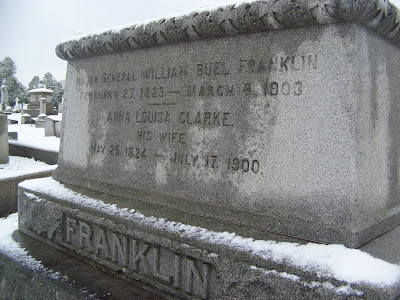
But perhaps Prospect Hill's most famous Civil War burial is Major General William Buel Franklin. Franklin, a premier civil engineer whose Civil War service left much to be desired (especially at the battle of South Mountain on September 14, 1862), died in March 1903. He was one of the longest living, high-ranking Federal officers of the war.
* * * * * * * * * * * * * * * * * * * *
Prospect Hill contains burials dating to the late 18th Century. . .
. . .and there are buried within the cemetery gates, veterans from all of America's wars.
Including the Revolution. . .
. . .and the War of 1812.
* * * * * * * * * * * * * * * * * * * *
Prospect Hill is even the final resting place of one of this nation's Founding Fathers: Philip Livingston, who signed the Declaration of Independence.
* * * * * * * * * * * * * * * * * * * *
The statuary and tombstones of Prospect Hill are incredible. . .

* * * * * * * * * * * * * * * * * * * *
View from atop Prospect Hill, looking over the city of York. . .

* * * * * * * * * * * * * * * * * * * *

Monday, November 10, 2008

Letters Home: George Gowen Wants Out. . .

While doing a bit of organizing this evening, I came across an interesting letter penned by George W. Gowen in early October 1862, just a few weeks after Antietam. At the time of this letter, Gowen, a civil mining engineer before the war, was serving as a lieutenant in Company C. He would soon be promoted to captain, and near the end of the war was the commanding officer of the 48th Pennsylvania. On April 2, 1865, one week before Lee's surrender at Appomattox, Gowen was struck in the face by a Confederate shell and killed instantly during the Army of the Potomac's final assaults on Petersburg. Gowen's body was taken to his native Germantown, Pennsylvania, for burial. It is interesting to note that one of George Washington Gowen's brothers was none other than Benjamin Franklin Gowen, the lead prosecuting attorney of the Molly Maguires.
Gowen led a fascinating life, and established a stellar wartime service record and in future posts I will focus more on Gowen's life and career(s). But for now, here is the contents of the early October, post-Antietam letter, in which he does not have too kind words for his fellow soldiers in the 48th Pennsylvania.
* * * * * * * * * * * * * * * * * * * *
Camp Near Anteitam Creek, Md
October 2nd 1862
Dear John!
I have been intending to write to you every day for a week, but ever since we have been in Camp, I have felt so miserably that I could not get up energy enough to do it. The lime stone water of this region does not agree with the troops and there is a great deal of sickness in Camp. The greater portion of the Army is on this side of the Potomac, yet I do not think it will be very long before a general move across the river will be made.
I passed through the late engagements at South Mountain and Antietam Creek safely--at the latter place our Division carried the stone bridge. Genl. Sturgis is our Division sommander now. We lost Jesse Reno at South Mountain--he was a gallant officer. Wherever the fray was thickest there was Reno to be found. He was always with us on the battle field. The soldiers became very much attached to him. When he fell he was just in rear of our Regiment. I am getting along pretty well, and expect to be made a Captain within a short time. Yet I often feel that I could be situated more pleasantly and have regretted a thousand times that I did not get a position in the Regular Army a year ago. You cannot imagine the difference between the two branches of the service--the four months I spent with Co "C" 1st [U.S.] Artillery were by far the pleasantest of the campaign--there are two or three very fine fellows in my Regiment, but when that is said, all is said. A position on a Staff is my ambition, as it is of most young officers. I notice by the papers that General Cadwalader has been made a Major General and is at present a member of the Court Martial about to convene at Washington. He has not yet been given a command--do you think there could be any prospect of my getting a position on his Staff? . . .
With much love to all
I remain your Affectionate Brother
George

Monday, November 3, 2008

The 48th On Election Day 1864

On November 8, 1864, while in the trenches of Petersburg, the veterans of the 48th Pennsylvania Infantry cast their votes for President of the United States.
The result, at least as far as the regiment was concerned, was easy to project.
When the vote was tallied, 200 soldiers cast their ballot for the incumbent president, Abraham Lincoln, or 87% of those who voted. George McClellan received 30 votes from the ranks of the 48th PA. That year, Abraham Lincoln received nearly 80% of the total soldiers' vote.
Interetingly, in Schuylkill County, where most of the 48th PA was recruited, Lincoln received 7,166 votes as compared to McClellan's 9,244.
* * * * * * * * * * * * * * * * * * * *
Tuesday, November 4, is Election Day. . .
VOTE!

Saturday, October 25, 2008

Shedding Some Light on Thomas Welsh. . .

Brigadier General Thomas Welsh
I had the great privilege today to participate in a symposium commemorating the life and forgotten services of Columbia, Pennsylvania's "favorite son," Brigadier General Thomas Welsh. I have a great interest in those Civil War figures who have never fully received their due, including Welsh. What particular draws me to General Welsh is the similarities between him and Brigadier General James Nagle, who I have championed on this blog for the past two years. Welsh and Nagle were natives of Pennsylvania, both served as volunteers in the Mexican-American War (Nagle as a captain, Welsh as a sergeant and then lieutenant), both became leading members of the respective communities, Nagle of Pottsville and Welsh of Columbia, and both answered the nation's call again in 1861. Nagle organized the 48th Pennsylvania, Welsh, the 45th Pennsylvania. Both units served in the 9th Corps, and both Welsh and Nagle would rise to the rank of brigadier general of volunteers. And, sadly, both died way too young. Welsh succumbed to malaria in August 1863 at the age of thirty-nine; Nagle died of heart disease almost exactly three years later, in August 1866, at the age of forty-four. Because of my interest in both Welsh and the 9th Corps, an interest that dates a long ways back, when I was asked earlier this year if I would be interested in participating, I jumped at the chance. I am very glad that I did so.
Mr. Rick Wiggin, a descendant of General Welsh, organized this symposium event, the second annual. In addition to my presentation, the were three others that addressed Welsh's service in the Mexican War (where he fell seriously wounded at Buena Vista, a musket ball shattering his leg), the burning of the Columbia-Wrightsville Bridge on June 28, 1863, and the reaction of the people of Columbia to the memorable, if sometimes overstated event, including that of Welsh's wife, Annie, and, finally, Welsh's legacy to his community and his country.
The symposium started at 1:00 p.m., but I arrived in Columbia an hour or so ahead of schedule so I figured I'd pay my respects to the general, buried in the Mount Bethel Cemetery.
As I searched the graveyard, I, of course, snapped some pictures of other Civil War burials. One grave that caught my attention was that of Major Edward Kelsey, of the 45th PA, mortally wounded at Cold Harbor. Note the very distinctive 9th Corps badge on the stone:


As I continued walking through the cemetery, I came across another interesting grave, that of George W. Derrick, a 43-year-old private in Company B, 45th, who was killed in action at the Crater in July 1864.


At last, I came upon General Welsh's burial site. Welsh survived bullets in two wars, only to fall victim to malaria during the final days of the Vicksburg campaign in the summer of 1863.

After wandering through the cemetery, I made my way to the Columbia Public Library, which sponsored the symposium. It was a great pleasure to meet Mr. Wiggin, and the other presenters. I spoke of Welsh's role at the battle of Antietam, and argued that not only was the battle one of missed opportunities for the Army of the Potomac, but it was also one of missed opportunities for Thomas Welsh as well. He and his men stood on the precipice of greater laurels during the 9th Corps's afternoon attack against Lee's critical right flank, only to have that opportunity vanish when orders were received to fall back just as Welsh's men were reaching the very streets of Sharpsburg itself and just on the verge of a decided victory. Judging from the feedback I received, the talk went over very well with both my fellow presenters and the audience, which numbered well over fifty people. Seeing the great turnout and appreciating Mr. Wiggin's efforts in helping to shed light on Welsh's forgotten service, I am somewhat tempted to organize a similar symposium-type event commemorating General Nagle. Stay tuned.
In addition to the great pleasure it was to participate, I had the opportunity to view many of Thomas Welsh's personal effects, generously displayed by Mr. Rick Abel, an avid collector of Welsh artifacts and memorabilia.

Welsh's epaulettes. . .note the circular "45's" and the eagles, plus the star on the epaulette, each indicating rank.
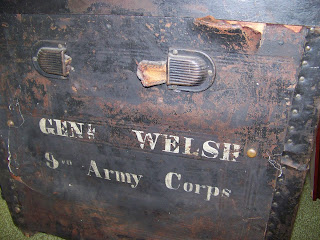
Welsh's personal trunk. This trunk was sent home following Welsh's death, containing the general's personal items.
Last, but certainly not least, I had the honor of holding Welsh's Civil War combat sword. . .a sword he very well may have wielded during the heavy action at South Mountain and Antietam.

Tuesday, October 21, 2008

Lincoln President-Elect: Abraham Lincoln and the Great Secession Winter, 1860-1861, by Harold Holzer

In just two short weeks, Americans will elect their next president, the nation's forty-fourth. No matter the victor, this year's election will no doubt go down as a historic one. But perhaps America's most historic presidential election, and certainly the most significant, occurred 148 years ago, in November 1860.
With threats of secession and the "momentous issue of civil war" at stake, and as the nation headed further toward that "irrepressible conflict," Americans elected Abraham Lincoln, of Illinois. Although he received the lowest percentage of votes in American history (less than 40%), and although his name did not even appear on the ballots in several of the Deep South states, Lincoln prevailed in large part due to the divided Democratic Party--which ran two candidates, Stephen Douglas and John Breckinridge--and yet another contender, John Bell, of the short-lived Constitutional Union Party. Following Lincoln's election, America entered, in the words of Henry Adams, the "Great Secession Winter" of 1860-1861, during which seven states left the Union while the lame-duck president James Buchanan did little, if anything, to stop them. To say, then, that president-elect Lincoln would assume a difficult challenge upon entering the White House in March 1861 would be an exercise in understatement.
Being both fascinated by Abraham Lincoln and having a great interest in American presidential history, I agreed several weeks ago to read and review Lincoln President Elect, by Harold Holzer, one of the nation's foremost Lincoln scholars. With nearly 500 pages of text, this book provides a detailed day-by-day and, in some cases, minute-by-minute account of Abraham Lincoln's actions and decisions from his election in early November 1860 until his inauguration in early March 1861. With a clear and fast-paced style, Holzer takes us through Lincoln's period of "masterly inactivity" as the nation drifted apart and explains Lincoln's stoicism in refusing to agree to or promote any kind of compromise that would address the "grievances" of the South and attempt to save the Union by essentially overturning the decision of the American people in electing Lincoln. We learn of Lincoln's efforts to establish a presidential image, the difficulties he encountered in trying to shape his Cabinet, and how he was continually besieged, even plagued by office-seekers. At the same time, Holzer recounts Lincoln's historic inaugural journey, including his infamous passage through Baltimore, and his drafting of his famed first inaugural address. In summarizing Lincoln's actions during that Great Secession Winter, Holzer writes, "[He] had successfully maintained a masterly inactivity and public silence to prevent the spread of slavery, privately fought a bare-knuckle political battle to bar unprincipled compromise, and brilliantly introduced himself to the press and people of the North with a new look, new images, and a new style of informal oratory along a triumphant voyage to the capital. And then, despite a giant step backward at Baltimore that might have crippled less agile leaders, he had recaptured public confidence while harmonizing a balanced and brilliant cabinet. And," concludes Holzer, "he had crafted one of the nimblest and most eloquent of all inaugural addresses, one that not only reiterated his devotion to the rule of law and invoked the emotional power of national tradition, but maintained that slavery could be maintained without compromising founding principles." [Pg. 458]
In the end, Holzer presents a convincing challenge to the established notion of a wavering, uncommitted, and perhaps even delusional Abraham Lincoln in the wake of his election. At the same time, he further cements himself as an eminent Lincoln scholar. I enjoyed reading Lincoln President Elect and believe that others, with similar interests in Civil War and presidential history, will enjoy it as well. In the seemingly endless catalog of Lincoln titles that has already appeared and will continue to do so over the next year as Americans commemorate the 200th Anniversary of Lincoln's birth, this work will surely rank among the best and most important.