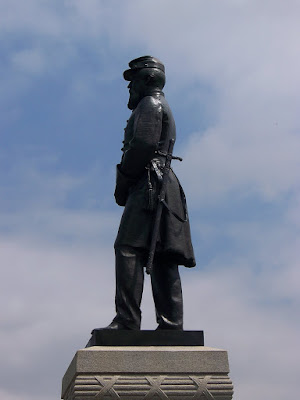
After a two-year-long, nationwide effort, at last, the 48th Pennsylvania Monument at Antietam has been restored. Today, May 29, 2010, witnessed the rededication ceremony. I could not be more pleased with the event; indeed, everything went perfectly. The ceremony lasted a little over half an hour, and an estimated 60-70 persons were in attendance.
I will post photographs (and videos) of today's event in the days ahead, but I thought I would begin by posting the Dedication Address, which I delivered this morning. I had several requests for copies, and figured this would be a good way for all those interested to have a copy.
* * * * * * * * * * * * * * * * *
Dedication Address
John David Hoptak
May 29, 2010
48th Pennsylvania Monument
Antietam National Battlefield
Superintendent Howard, Reverend Schildt, Mr. Kraus, Ladies and Gentlemen: All Honored Guests: It is a great privilege to be here with you this morning as we celebrate the completion of a rewarding effort: at last, the general and his sword are reunited.
I am both humbled by and proud of the support given to this endeavor since first launched in April 2008 and I would be remiss if I did not take a moment to thank those who have lent their support and provided their encouragement. First, I would like to thank Bob Casey and the Western Maryland Interpretative Association for its generous pledge to match all donations. Thanks also to Superintendent Howard, Jane Custer, Antietam’s Chief of Cultural Resources, Pete Warren, monument restoration specialist, and my colleagues in the interpretation division, including Ranger Brian Baracz, for all of their assistance every step of the way. Thanks also to Reverend John Schildt, Dave Maher, and Mike Pasquerette for their participation today. No words of appreciation can truly measure the incredible artistry of Mike Kraus in sculpting the sword, an exact replica of the one presented to Captain James Nagle upon his return from Mexico in 1848, the same one he proudly carried throughout America’s Civil War, and the same one that was replicated in bronze to adorn the side of his statue behind me when this monument was first unveiled 106 years ago. I am confident you will soon agree with me, Mike Kraus did outstanding work. I am confident that even the general himself, no doubt watching from above as we gather here this morning, would be very proud himself. Last, but no means least, I must thank each of you, for without your generous donations, without your great contributions and support, none of this would have been possible. Donations arrived from throughout the United States, from California to Idaho, from Pennsylvania to North Carolina and from right here in Maryland to Florida. Many of the donors are either direct or lateral descendants of General Nagle; many others are descended from soldiers who served under Nagle’s command especially in the 48th Pennsylvania. But regardless of our backgrounds or our ancestry, all of us here gathered are committed to noble cause of preserving our history and honoring the memory of those who served. It is a commitment displayed by your journeying here today and a commitment displayed by your donations to restore this monument.
This monument is a “magnificent tribute to the valor of the Forty-Eighth. . . .It emphasizes the fact that notwithstanding the years that have passed the deeds of these citizen-soldiers are intensified in the minds and hearts of the people. . . .It tells the present generations of the loyalty here displayed, and teaches future generations that we do not forget the sacrifices made by its sons in defending its interests unto death—a lesson to strengthen patriotic love of State and country—an outward and visible sign of great and glorious principles vindicated by the deeds here performed by the men of Pennsylvania in the shedding of their blood.” The man here honored, honors the 48th in turn. Brigadier General James Nagle, “the foremost soldier of old Schuylkill County” who “well deserves this meed of praise bestowed upon him.”
These exact words were spoken here more than a century ago by Colonel Oliver C. Bosbyshell, a veteran of the 48th Pennsylvania, on what was known as “Pennsylvania Day,” when this and twelve other monuments to Pennsylvania units were unveiled and dedicated.
On September 17, 1904—some thirty-six aging and graying veterans of the 48th Pennsylvania Veteran Volunteer Infantry, in company with a host of dignitaries and other attendees, gathered here, on this very same ground, to partake in this dedication and witness the unveiling of their regimental monument.
For many of these veterans, that day witnessed their first return visit to these fields since the battle of Antietam, fought forty-two years to the day earlier.
On that Wednesday, the seventeenth of September 1862—on what was otherwise a beautiful late summer day—the once peaceful and tranquil farming fields surrounding us were transformed into vast, horrific killing fields. In a little more than twelve hours of savage conflict, along the banks of the meandering Antietam Creek, across the narrow farm lanes and country roads, and through standing fields of corn, more than 23,000 Americans, whether in blue or in gray, fell either killed, wounded, or went listed among the missing in action. It was, and remains, the bloodiest single-day battle in all of American history.
Best remembered for this unimaginable loss, Antietam’s greatest legacy was born five days after the guns fell silent here. With Robert E. Lee’s invasion of the north repulsed and with his once seemingly invincible Army of Northern Virginia in retreat following the Union victory here, President Abraham Lincoln gained his long-awaited foundation, or platform, for announcing a proclamation of emancipation.
It was, in words of Horace Greeley, “the beginning of the end of the rebellion, and the beginning of a new life for the nation,” or, to borrow a more famous phrase, it was here that the nation truly witnessed its “new birth of freedom.” At last, the promises and ideals of this American nation, so prevalent at its founding, would apply to all; it was a first step, from this point on, all would be free to enjoy life, liberty, and the pursuit of happiness.
Of course, all of the blessings of this nation, all of the freedoms we have long enjoyed and which we continue to enjoy, have been secured through the bravery and sacrifice of those who have fought and those who have died on the field of battle. And on this particular field of battle, so many thousands fought, and so many thousands died.
Among them were fifty-one members of the 48th Pennsylvania. This monument stands as a silent tribute to those men, and to the hundreds of others who fought in the 48th and who fell on such sanguinary fields as Second Bull Run, Fredericksburg, Knoxville, the Wilderness, Spotsylvania, Cold Harbor, Petersburg, and elsewhere throughout its four- year organization. This was the first monument established by the regiment’s survivors—another came several years later at Petersburg, to commemorate their services there, particularly in their famed tunneling under the Confederate defensive line. Because this was their first, it was only fitting that they chose to honor the soldier who organized and first led the regiment: James Nagle.
Born in 1822, James Nagle never received any formal military training, but from an early age developed an interest in martial endeavors. Perhaps it was the legacy of his own grandfather, Philip Nagle, who served in the Pennsylvania Continental Line under Washington during the Revolution, that inspired him, or perhaps it was his inherent sense of duty to serve his nation. Regardless of the motivation, in 1840, and at just eighteen years of age, he organized the Pottsville Blues, a militia company that in two years changed its branch of service and became the Washington Artillerists. Twenty years later, this company, under a different commander, would march to great fame as one of the first five Northern volunteer companies to reach the United States capital upon the outbreak of sectional hostilities in 1861, arriving in Washington on the night of April 18. Because of this noteworthy feat, the Washington Artillerists, along with four other Pennsylvania companies, became collectively known as the First Defenders, and it was James Nagle who founded this unit.
In 1846, Nagle led the Washington Artillerists off to war in Mexico, where they became Company B, 1st Pennsylvania Volunteers. He served with great merit, such as at Cerro Gordo, where, according to one of his soldiers, he stood “calm and unmoved amid the leaden storm of death,” and on other fields where he earned distinction. With the conclusion of the war, Nagle returned to Pottsville to a hero’s welcome. The grateful citizenry presented him with a beautifully inscribed sword, a sword he would treasure for the rest of his life.
Nagle returned to more peaceful pursuits, raising children and pursuing his vocation as a house and sign painter, and then in 1852 as sheriff of Schuylkill County. All along, however, he maintained his interest and involvement in the Pennsylvania State Militia, rising through the ranks until, just prior to the outbreak of civil war, he was a colonel and brigade inspector.
Such a position, in addition to his reputation, caught the attention of Governor Andrew Curtin, who summoned Nagle to Harrisburg, where he helped to organize the trainloads of volunteers that were then pouring into the state capital. It then led to his appointment of the three-month 6th Pennsylvania Volunteers, which he led in the Shenandoah Valley. With the expiration of this three-month term of service, Nagle returned to Pottsville with authorization to raise a three-year regiment, which he resolved to do from his own Schuylkill County. From the anthracite-laden mine fields in the north to the fertile farming fields in the south, hundreds of volunteers came forth and by the end of summer, these volunteers were organized and were mustered into service as the 48th Pennsylvania Volunteer Infantry.
Nagle led the 48th until the spring of 1862, when he was elevated to brigade command in what became General Jesse Reno’s division of the Ninth Army Corps. His first true test as brigade commander came at 2nd Bull Run. Following this fight, General Reno wrote directly to Abraham Lincoln, recommending Nagle’s promotion to brigadier general. Lincoln endorsed the application with a handwritten note: “Let the appointment be made.”
It was here at Antietam, two days after the battle, the James Nagle’s commission arrived and where he first learned of his promotion to brigadier general.
Nagle went on to lead his brigade Fredericksburg, where he continued to earn the praise of his superiors and the admiration of his subordinates. As testimony to the esteem in which he was held, one of Nagle’s men later wrote that “though inflexibly firm and persistently industrious in the performance and requirement of every camp and field duty, yet such was the kindness of his demeanor, and the tender regard for the health, safety, and comfort of his men, that we considered him rather as a friend and father, than a mere military commander.”
Sadly, failing health, brought on by heart disease, forced his resignation in the spring of 1863 and cut short what was a promising career. Upon accepting his resignation, division commander Sam Sturgis wrote, “By his intelligence, energy, zeal and courage, and quiet, unassuming deportment, General Nagle has endeared himself to this command, and will carry with him the love and respect not only of those gallant troops he had led so often to victory, but of all who have the good fortune to know him.”
Nagle returned to his family in Pottsville, but did not stay idle for long. That same month General Lee embarked upon another northern campaign, this one reaching deep within his native Pennsylvania. He once again sprang into action, organizing the 39th Pennsylvania Militia. The following year, in the summer of 1864, elements of Lee’s army under the command of Jubal Early were once more heading north, passing through this area on their way toward Washington. With Early’s columns threatening, Nagle, for the fourth time in four years, raised and led yet another regiment, this time it was the 194th Pennsylvania, a 100-day unit. At last, in November 1864, Nagle was mustered out of service for the final time. He returned to his home and sought a return to more peaceful endeavors. Sadly, by the summer of 1866, his health had taken a turn for the worse and on August 22, surrounded by his family, General Nagle passed away at only 44 years of age, leaving behind his wife, Elizabeth, and seven children, the youngest of whom was just eleven months old.
But General Nagle also left behind an inspiring legacy. His commitment and dedication went unsurpassed. More than one century ago, when this monument was first dedicated, William Blackwood, the regimental surgeon and Medal of Honor recipient, spoke of this legacy when reflecting upon Nagle’s promotion to general: “At this time,” said Blackwood, “the merited and (for ourselves), the coveted promotion of Colonel Nagle eventuated—he won his star as brigadier general. Never did a soldier win the distinction through a harder road—for his whole time of service this more than brave gentleman and splendid soldier devoted his every energy to the cause for which he left his home and family, and supported by his gallant men, he won imperishable fame.”
Your contributions have helped restore this monument. This monument, and all monuments, serves to remind us, and to teach all the future generations, who will travel here long after we’re gone, to reflect upon the meaning of such a sanguinary battle, that those who fought and those who died on this now hallowed ground, that their service and sacrifice was not in vain. The reuniting of the general and his sword also helps honor and preserve the memory of one so brave and one so dedicated as Brigadier General James Nagle.
I will conclude with a passage from Surgeon Blackwood, spoke here on this very spot on a similar occasion: “Today we celebrate the attainment of General Nagle’s glory—a glory to him and to those who can never forget his leadership—may the bronze and granite which we now dedicate to his memory remain till time shall be no more on this historical field where so many of our Pennsylvania heroes gave their all to the defense of the land they loved—and the flag they adored.”