Tuesday, March 1, 2011

The Union's First Defenders: Sergeant Val Stichter's Diary: Part One: April-May, 1861

Post-War View of First Defender Val Stichter of the Washington Artillerists

* * * * * * * * * * * * *
Valentine Stichter was twenty-seven years old when the American Civil War broke out. He was quick to enlist, and as a member of the Washington Artillerists would be listed among the First Defenders. However, because of "certain circumstances," Stichter did not travel with his company on that fateful April 18 trip to Baltimore and on to D.C. Instead, he was a few days' behind, arriving in the Capital on April 20.

Stichter described his journey to Washington in his diary, as well as noting the day-to-day doings of those first three months in Washington. Stichter's diary appeared first in Heber Thompson's 1910 publication, The First Defenders.

This is the first of two posts, covering the months of April and May 1861.

* * * * * * * * * * * * * * * * * * * *


Left home on April 17th, 1861, with the company. Accompanied them to Reading, but, owing to certain circumstances had to remain over until next day. Satisfactory arrangements being made, advised Captain Wren, of following up next morning. Returned home, arranged matters and next morning telegraphed Captain James Wren, “On our way.”

Several other recruits, after finding out my intentions, desired to accompany me. We received the following transportation:
E.H. Wheeler, Esq.
Pottsville, April 18, 1861


Please pass over the P. & R. R.R. on to Washington City the following recruits, and charge the same to the Commonwealth of Pennsylvania, by order of the Hon. Eli Slifer, Secretary of State:
Valentine Stichter
Franklin Myers
Franklin B. Bannan
George A. Lerch

(Signed) James Nagle
Brigade Inspector for 1st Brig. 6th Div.


We left here on the morning of the 18th for Harrisburg, arriving there at five o’clock, and after a red tape delay of twenty-four hours to get transportation for Washington, D.C. from State officials, we became disgusted and concluded to forward our blue overcoats and baggage by express to Washington, purchase our own tickets and start for the capital, which we did at 1 o’clock P.M.


On approaching Baltimore the newsboys distributed a number of circulars, marked: ‘Extra—Riot in Baltimore with the Mass. 6th Regt.,’ etc. (Startling news for us on our mission). Having three hotels recommended to stop at and not knowing location of either, we chose the Maltby House.


On arrival at the city our cabman was obliged to drive us several squares out of our way, owing to some of the streets being occupied by the city military, called out to suppress the riot. Unpleasantly for us, as we thought afterward, that we had made that selection, for on arrival at the Maltby House and aligning from the cab, one of the first sights that met our eyes was a wounded man being by on a cellar door, a victim of the riot.


Entering the hotel, we found a very large room supported by cast iron columns. The whole floor seemed to be taken up with groups of men discussing the situation and outcome of the riot which had taken place that afternoon, giving vent to their feelings, to wit: ‘Three cheers for Jeff Davis’ ‘Damn the Northern Abolitionists’ ‘We’ll see whether any more of those (oath) will pass through here for Washington.’


We registered our names proper, which was in turn scanned by most of them. The eye of suspicion was cast upon us, our party at supper table noticed, eager to catch on to our mission. After supper enjoyed a smoke, and between nine and ten o’clock retired to bed for pleasant dreams, orders being given landlord to wake us in time to take the 4 o’clock A.M. train south. Fortunately, we thought (through a kind Providence) to enter cars next morning unmolested, but not forgetting that probably the forethought of sending our blue army coats by express from Harrisburg and not visible in our possession on that occasion was the means of saving our lives from an infuriated mob, and our bodies sent home in rough boxes.


* * * * * * * * * * * * * * *

April


18—Left home at 2 o’clock P.M. Arrived at Harrisburg same day.
19—Left Harrisburg at 1 P.M. Arrived at Baltimore at 6 P.M.
20—Left Baltimore at 4 o’clock A.M. Arrived at Capitol at Washington at 6 A.M. Made arrangements in the company. Bought pipe, tobacco, towels, etc.


The U.S. Capitol Building During the Civil War. Stitcher and the First Defenders were initially quartered here upon arrival in Washington.


21—Sunday. On guard from Saturday evening, 7:30 o’clock until Sunday evening at 8 o’clock. Read a chapter in the Bible to comrades in the evening. A certain attack on the Capitol last night; all prepared; squads barricading the inlets and windows with flour, which was seized at Georgetown; 6000 barrels.
22—On guard for 7 hours’ shift.
23—Had a dress parade in the park. Trouble about our cooking arrangements. Moved quarters.
24—More troops arrived from New York, a regiment of 1000. Numbered the muskets today. On 24 hours’ shift guard at upper door. Flour seized by the U.S. Government, amounting to 7000 barrels, making it in all 13,000 barrels, with rice, coffee, and sugar. Visited John Pass at hospital.
25—Paid a visit to patent office and post office. Park parade; cheers given for our company. Gave Massachusetts regiment a serenade with the comb band. Longed to see friends at home. Package of letters arrived; none for me. Brown’s letter contained a few words from home.
26—Had dress parade in the park for three hours. Downtown and bought wearing apparel. Rhode Island and Massachusetts troops arrived; 1600. All well to-day. Seen President Lincoln and lady in Park. New York regiment sworn in.
27—In park, 1600 Pennsylvania troops arrived. Received shoes, blankets, etc.
28—Sunday. Chapter read out of Bible by Captain Wren. Prayer by Frank Myers. President Lincoln visited all the volunteers. Shook hands with him and Secretary Seward. Visited Long Bridge on guard from 7 o’clock last evening. Twenty-four hours’ shift. Preaching in the Senate chamber. Wrote letter home.
29—Parade in park three and a half hours. Squad went downtown to exchange shoes. Another Massachusetts regiment arrived. Report of an attack on the 5th of May.
30—Drill in park. Orders at 1 o’clock to proceed to Fort Washington; in half an hour all prepared for the march and on our way; 1.30 o’clock arrived at Navy Yard; boarded the steamer Philadelphia seized by the Government; passed Alexandria, Palmetto flag floating over the city; the dock was commanded by rebels with two brass six-pounders; prepared for an attack with 32-pound shells on steamer; arrived at Fort Washington 6.30 o’clock; packed in a small house with Logan Guards.


Fort Washington along the Potomac River, courtesy of The Marker Hunter.


May


1—Captain Wren resigned to run for Colonel. Trees all cut down. Mounted guns on water battery. Held an election, of which I was appointed inspector. Wren received 113 voted; opposite, 8.
2—Prepared for quarters in water battery. Put in floors and table. Steamer Kill Van Kull brought to by shot from the fort. Rhode Island troops on board. Moved quarters to water battery. On guard on Fort Heights from 8 P.M. till 8 A.M. Guard house in rifle battery. Quite cold. Very uncomfortable.
3—Great dissatisfaction among the men. Altered the sleeping bunks; made an upper tier. Rain to-day. Received a letter from Brother H.; one enclosed from wife and family; first one; much pleased to hear from home; all well. Meeting held by members about impositions. James Wren went to Washington.
4—Rain all day; remained inside.
5—Sunday. Inspection by Major Haskins at 9 o’clock. Bath in the river. Washed underwear, etc.; fresh shad for dinner.
6—Rain all day. On guard 24 hours. Appointed orderly sergeant for commanding officer of the day; 91 guards on duty to-day and to-night.
7—On guard at 8.30 o’clock. Received canteens and haversacks. Seized a vessel of corn.
8—Received 6 large guns, 24-pounders; lot of grape and canister shot, balls, etc. Provisions for 3 months. Twenty head of cattle engaged in hauling up cannon and mounting same.
9—Received five 8 and 10-inch colombiads for shell. Lot bombs, ammunition. Fresh beef for dinner. Radishes and pies for supper. Carried boards for officers’ quarters. On guard at rifle battery.
10—Rain. Unwell. Colonel H.L. Cake, Captain McDonald, and Messrs. Baber, Mattson, Geo. Patterson, Jas. H. Campbell and others visited here to-day. Got revolver.
11—Hauled up 32-pounders on foot; finished at 2 o’clock. Cleaned up for inspection. Steamer Jas. Guy seized.
12—Sunday. Inspection at 9 o’clock. Army rules read at 10. Received Government uniforms; distributed them. Clothes vermin discovered in camp. Troops passed for Washington.
13—Received 2 barrels eggs and barrel butter of Morris. One barrel eggs of Nichols & Beck. On picket guard. Battle with cattle. Rain.
14—Wrote a letter to family. Cleaned musket. Nothing new to-day.
15—On the main guard 24 hours. Potatoes for supper.
16—Came off guard. Wren’s resignation accepted. Haywood and Huntzinger paid us a visit. All well at home.
17—On police duty.
18—On fatigue duty. L.C. Thompson, W. Patterson and Mr. Garrisgues paid us a visit. Unloaded a steamer with provisions.
19—Sunday. Wrote to wife and father. Inspection at 9 o’clock. On picket guard. Report of Washington’s bones being removed to Kentucky.
20—Rain all day. Packed box with clothes to send home. Living on luxuries, ham, dried beef, pickles, sweitzer cheese, etc.
21—On fatigue duty. Commenced Hardee’s drill. Fired bomb shell up the river from fort. Dragged trees for south side of parapet walls for barricading.
22—Wash day. On picket guard.
23—Came off picket guard. Cleaned my gun.
24—Went on main guard. Appointed orderly sergeant under Captain Perkins. Alexandria taken by the Zouaves. Col. Ellsworth killed. Heavy cannonading through the night. Harper’s Ferry and Arlington Heights taken possession of.
25—Came off main guard. Thirty-five rebel pickets captured near Alexandria. Captain of Pawnee court-martialed from giving false signals.
26—Inspection at 8.30 o’clock. Wrote two letters and received one. All well at home. Weather very warm.
27—On rifle battery guard. On police duty.
28—On fatigue. Shad fishing ended. Fired 11 guns for death of sergeant. Flag at half-mast at fort. Received letter from wife.
29—On long guard. Appointed orderly for officer of the day. D.A. Smith received letter from Brother H. Families well cared for at home.
30—Came off guard. Luxuries arrived for members. Game of ball.
31—Monthly inspection of all the troops in fort. Steamboat loaded with ladies from Alexandria for Piscatawa. Rumored engagement at Alexandria in a few days. Nine ladies arrived here to-day. A ball held in our old quarters by all the officers in the fort with the ladies.

Interior of Fort Washington, courtesy of Civil War Trust.

Thursday, February 24, 2011

The Union's First Defenders: The Washington Artillerists

As mentioned in my previous post on the National Light Infantry, up until the Civil War's Sesquicentennial hits in mid-April, I am going to be focusing (almost exclusively) on Pennsylvania's First Defenders, the first five companies of Union volunteers to reach Washington upon the outbreak of hostilities. Over the next seven to eight weeks, most of the posts on this blog will be histories of these companies, biographies of many of the soldiers who composed their ranks, as well as photographs of the soldiers, newspaper accounts, letters, diaries, and other writings of these First Defenders during the war's first ninety days.

Being a native of Schuylkill County, home to two of these first five companies, I have long been interested in the story of the First Defenders and have sought to bring this story to light. Sadly, these Pennsylvanians are often overlooked when describing the Union response in the wake of Sumter. Other units, most notably the 6th Massachusetts, are often erroneously identified as the first to reach Washington, which is simply not the case. Indeed, when the bloodied 6th arrived on the night of April 19, Pennsylvania's First Defenders were there to greet them in their quarters of the U.S. Capitol Building. They had arrived twenty-four hours earlier. Nor was the 6th the first unit to shed blood at the beginning of the war, as is often related. It was, instead, Pennsylania's First Defenders, several of whom were bloodied while marching through Baltimore on April 18, one day ahead of the Massachusetts men.


* * * * * * * * * * * * * * * * * * * * *

In my previous post, I looked at Pottsville's National Light Infantry, one of two First Defender companies to hail from the Schuylkill County seat. The other was the Washington Artillerists.

Eighteen-year-old James Nagle founded what would become the Washington Artillerists in 1840. Originally, they were called the "Pottsville Blues," but two years later, they switched their branch of service and adopted another name: the Washington Artillerists. Nagle regularly drilled his company, which was composed almost entirely of volunteers younger than twenty years of age.

Upon the outbreak of the Mexican-American War, Captain Nagle tendered the services of his company to the United States. In December 1846, the company marched off to war, led by twenty-four-year-old James Nagle. His younger brother Daniel, at age eighteen, served as the company's drummer. Forming part of General Winfield Scott's army, the Washington Artillerists--officially designated as Company B, 1st Pennsylvania Volunteers, saw action at Vera Cruz, Cerro Gordo, and on several other fields of battle. The men returned home to a hero's welcome on July 28, 1848.

Captain James Nagle in 1848

The organization of the Washington Artillerists was maintained throughout the 1850s, and in January 1861, it participated in the inauguration ceremony of Pennsylvania's Governor Andrew Curtin. By this time, however, the company was commanded by Captain James Wren. Nagle, in 1850, was promoted to the rank of colonel in the state militia system and Wren, an immigrant from Scotland, assumed command of the company.

The Washington Artillerists once more tendered its services to the nation following the outbreak of civil war in April 1861 and the offer was immediately accepted. The company departed Pottsville, along with the National Light Infantry, on the afternoon of April 17. While his former company was thus making its way to Harrisburg, so too was James Nagle, having been summoned to the state capital by Curtin. Nagle was put to work organizing the trainloads of volunteers expected to be arriving in the city. Curtin then commissioned Nagle as colonel of the 6th Pennsylvania Volunteers, a three-month unit that would be mustered out of service in July 1861. However, authorized to raise a regiment of 'three-year' troops, Nagle returned to Pottsville and organized what became the 48th Pennsylvania Infantry. Many of the soldiers of this regiment, especially those who rose to officer's rank, were formerly members of the Washington Artillerists, which had also been mustered out of service in July following its three-month term of service. Among the officers in the 48th were James Wren and Daniel Nagle.

Daniel Nagle, pictured here as colonel of the 173rd Pennsylvania Infantry

The Washington Artillerists arrived in Harrisburg late on the evening of April 17, and the following morning were mustered into service by Captain Seneca Simmons of the 7th U.S. Infantry. Shortly after the swearing-in ceremony, after which these men were United States soldiers, the Washington Artillerists boarded traincars and headed toward Washington. Forced to switch cars in Baltimore, some of the members of the Washington Artillerists were injured by the mob of Confederate supporters who were determined to prevent the Pennsylvanians from marching through their city. Notable among those injured was Nicholas Biddle, the sixty-five-year-old African-American orderly to Captain Wren. Some even argue that Biddle, a black man in uniform, was the very first casualty of the American Civil War.

Nicholas Biddle, in the uniform of the Washington Artillerists

After serving three-months about Washington, the Artillerists were mustered out and began the long journey back to Pottsville. Most of them would re-enlist into the ranks of Schuylkill County's "three-year" regiments, including the 48th Pennsylvania, 96th Pennsylvania, and 7th Pennsylvania Cavalry. One of its privates, William Auman, would fight with Company G, 48th Pennsylvania throughout the Civil War, then remain in the army. . .working his way all the way up to the rank of Brigadier General. In the Spanish-American War, General Auman fought alongside Theodore Roosevelt at San Juan Hill.

The following is the roster of the Washington Artillerists when mustered into Federal service on the morning of April 18, 1861. These men, along with those of the other four First Defender companies, were among the very first volunteers for the United States during the Civil War.

* * * * * * * * * * * * * * * * * * * *
Washington Artillerists

Captain James Wren

James Wren, Commander of the Washington Artillerists

First Lieutenant David A. Smith

2nd Lieutenant Francis B. Wallace
3rd Lieutenant Philip Nagle


Philip Nagle, another of James's brothers, would go on to serve for a brief period of Captain, Co. G, 48th Pennsylvania

1st Sergeant Henry C. Russel


2nd Sergeant Joseph Gilmour

Joseph Gilmour would go on to serve as Major of the 48th PA Infantry. In late May 1864, near Cold Harbor, Virginia, Gilmour was struck down by a Confederate sharpshooter and mortally wounded. His uncle, James Wren, paid for his funeral and for his tombstone.


3rd Sergeant Cyrus Sheetz

Cyrus Sheetz would serve as Captain, Co. G, 48th Pennsylvania

4th Sergeant William McQuade
Quartermaster Sergeant George Gressang


Corporal Delaplain J. Ridgway
Corporal Samuel Russel
Corporal Charles Hinkle
Corporal Reuben Snyder


Privates


William Eagan
William Auman
Henry Alspach
William Bates
G. Wilson Bratton
Joel H. Betz
Henry Brobst
Charles E. Beck

Beck would go on to serve as 1st Lieutenant, Co. C, 15th PA Cavalry

Henry Bobbs
Richard Bartolett
Jeremiah Brandt
David B. Brown
J. Frank Barth
Anthony Burns
Albert Bowen
Alexander S. Bowen
Wiliam Brown
Oliver Bosbyshell

Bosbyshell, seated, would go on to serve as Major of the 48th PA Infantry. Standing on the left (behind the right shoulder of Bosbyshell) is another First Defender, Curtis C. Pollock. As 1st Lt., Co. G, 48th PA, Pollock would fall mortally wounded at Petersburg in June 1864.

Samuel Beard
David Boyer
William W. Clemens
William Cole
John Curry
Thomas Corby

Corby would turn to the Navy after serving as a First Defender. He was on the U.S. Steamship Hatteras when it was sunk by Rafael Semmes's Alabama off Galveston, Texas, on January 11, 1863. He was rescued from the waters and held a captive on the Alabama until later released on parole at Port Royal, Jamaica.

Daniel Christian
Benjamin C. Christian
John Christian
Frederick Christ
William Degan
Phillip Dentzer
Henry Dentzer
Nelson Drank
Francis P. Dewees
Louis Douglass
Henry K. Downing
John Engle
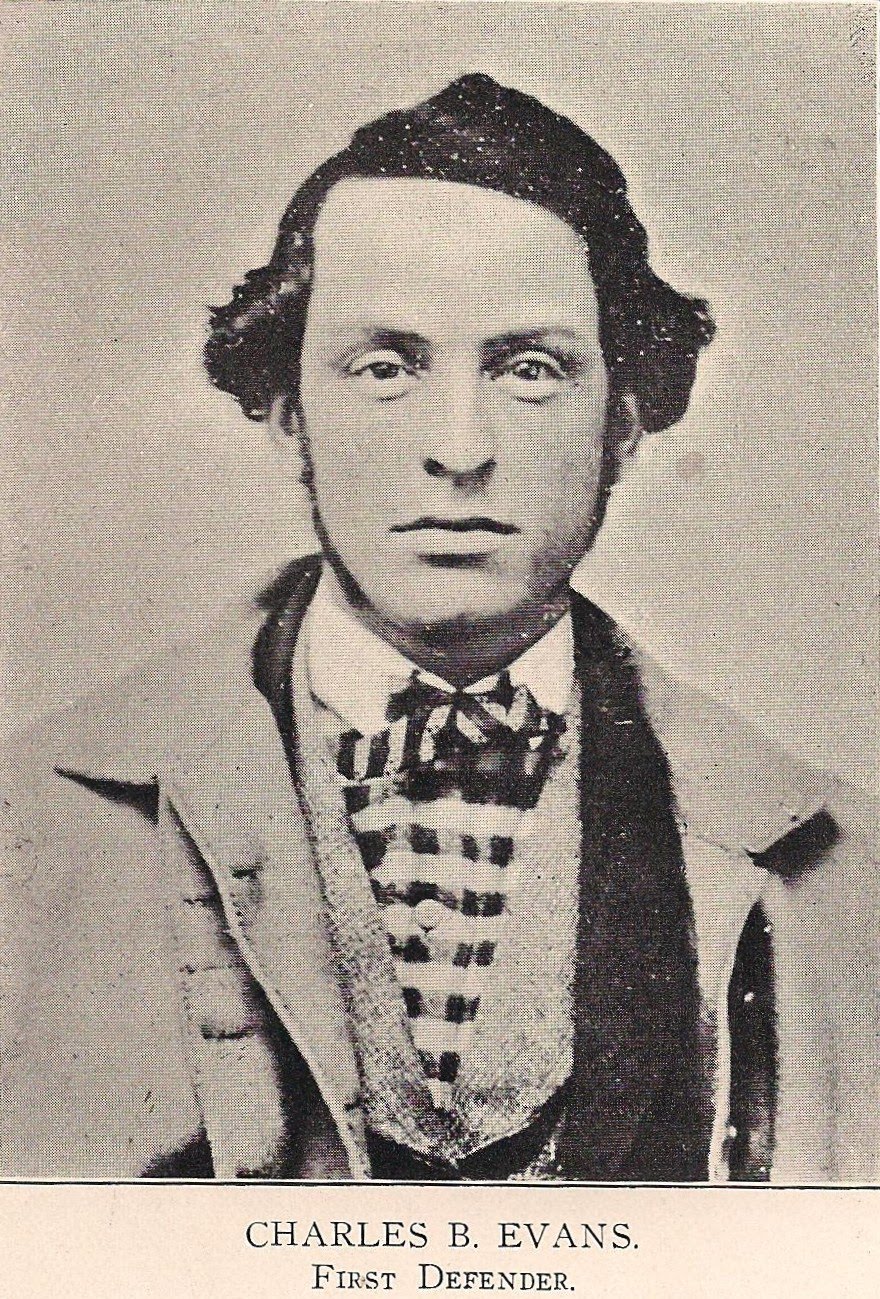
Charles Evans

Evans later served as a Sergeant in Co. G, 48th PA

Joseph Fyant
Peter H. Frailey
William J. Feger
Peter Fisher
Charles A. Glenn
Peter Grow
George H. Hill
James R. Hetherington
William H. Hardell
William Heffner
Alfred Huntzinger
Charles A. Hesser
John Hoffa
Benjamin F. Heffner
George H. Hartman
Thomas F.B. Hammer

Patrick Hanley
Henry H. Hill
Charles Haas
Frank Haas
Richard M. Hodgson
John J. Hetherington
Thomas Irwin
Thomas Jones
Thomas Johnson
Benjamin F. Jones
John Jones
Joseph Kear
Charles P. Loeser
William Lesher
Godfrey Leonard
Edward J. Leib

Leib would go on to serve as Brevet Major of the 5th U.S. Cavalry; he was wounded at Five Forks, VA, on April 2, 1865

Daniel Moser
George Myers
Nelson T. Major
William F. Maize
Charles Maurer
Edward Nagle
John Noble
Charles P. Potts

As a 2nd Lieutenant in command of Co. I, 151st PA, Potts would be captured on July 1, 1863, during the Battle of Gettysburg. He would be held a prisoner of war until March 1865, one month before the end of the war, being confined at Libby Prison for a portion of his captivity.


John Pass
Richard Price
Thomas Petherick, Jr.
Robert F. Potter
Richard Pott
William Ramsey Potts
Theodore H. Patterson
Curtis C. Pollock
Joseph Reed
August Reese
George Rice
William E. Riley
Samuel E. Shoener
James S. Silliman
Robert Smith
Frank A. Stitzer

Stitzer would go on to command Co. K, 48th PA. He was the last surviving veteran of the First Defenders.


Charles Slingluff

Slingluff later served in the 48th PA


Thomas Severn (Fifer)
Isaac Severn
Edward L. Severn
Edwin J. Shippen
Hugh Stevenson

Stevenson later served as 1st Lieutenant, Co. C, 96th PA


Lewis T. Snyder
William Spence
Valentine Stichter


Heber S. Thompson


Thompson later served as Captain, Co. I, 7th PA Cavalry. He was taken prisoner of war at Atlanta on April 20, 1864, and released on parole at Charleston, SC, on December 20, 1864. He would later pen the first history of the First Defenders.


Alba C. Thompson
Ambrose H. Titus
Charles Van Horn
Victor Wernert
John C. Weaver
Eli Williams
Albert G. Whitfield
David Williams

* * * * * * * * * * * * * * * * * * * * *

Tuesday, February 22, 2011

The Union's First Defenders~The National Light Infantry

Throughout the four years of the American Civil War, more than two million soldiers served in Union blue, some for a few weeks, others for the duration.


With the Sesquicentennial upon us—or almost upon us—my attention is now drawn to those first volunteers of the Union: Pennsylvania’s First Defenders.

In the wake of Fort Sumter, President Lincoln issued a call for 75,000 men to serve for a period of three months. Thousands turned out to answer the call, and on April 18, just 72 hours after Lincoln’s call, the first of these thousands reached Washington. Arriving around 7:00 p.m. that evening, were some 475 Pennsylvanians composing the ranks of five militia companies from Schuylkill, Lehigh, Berks, and Mifflin counties, 475 volunteer soldiers who thus go down in the history books as the First Defenders.

Most of these men spent their three month term of service in the defenses of Washington after being more formally organized into the ranks of the 25th Pennsylvania Infantry. When mustered out in July 1861, most would re-enlist in regiments formed that summer, to serve for three years, or the course of the war.


* * * * * * * * * * * * * * * *

Over the next several weeks, as we make our way toward the 150th Anniversary of the Firing on Fort Sumter and the inauguration of America's Civil War, I will be posting histories of these five First Defender companies, along with rosters, photographs, stories, and so on.

Up first, a brief history and the roster of Pottsville's National Light Infantry.

The National Light Infantry was formed in 1831, making it the oldest of the First Defenders companies, although its organization was not regularly maintained in those thirty years prior to the war. However, throughout the 1850s, and with war clouds building, interest in the militia company grew. To many of the soldiers comprising the ranks of the National Light Infantry, the war did indeed seem an "irrepressible conflict," in the words of New York Senator William Seward. Thus, on the evening of April 11, 1861, literally just hours before that first fateful shot hundreds of miles away at Sumter, the officers of the National Light Infantry met in Pottsville and drafted a series of resolutions. One of these resolutions was put forth by Corporal Henry Lutz Cake, who would later serve as colonel of the 96th Pennsylvania Infantry, which read:

On motion of Corporal H.L. Cake that the services of this company be tendered to the Secretary of War and the Governor of Pennsylvania in defense of the Union, and that the company be ready to march at six hours' notice.

The motion accepted, a telegram was sent to Governor Andrew Curtin of Pennsylvania and Secretary of War Simon Cameron, making known the willingness of the National Light Infantry to serve, if needed. With that, the National Light Infantry became the very first company to offer its services to the government at the start of the Civil War. Cameron verified this when in 1866, he wrote the following note:


"I certify that the Pottsville National Light Infantry was the first company of volunteers whose services were offered for the defense of the Capital. A telegram reached the War Department on the 13th, notifying the tender. It was immediately accepted and the company reached Washington on the 18th of April, 1861, with four additional companies from Pennsylvania, and these were the first troops to reach the seat of government at the beginning of the war of the rebellion. ~Simon Cameron."

Their offer accepted, the National Light Infantry departed Pottsville on the afternoon of April 17, 1861, and headed for Harrisburg. With them traveled Pottsville's other militia company, the Washington Artillerists. The two companies, numbering around 230 men, arrived in the state capital that evening and on the following morning, were sworn into Federal service by Captain Seneca Simmons of the 7th U.S. Infantry. Their muster roll report is below, signed by Captain Simmons, who was later killed at Gaines's Mill in June 1862:


Hours after being sworn into U.S. service, the National Light Infantry, along with the Washington Artillerists, Logan Guards of Lewistown, Ringgold Light Artillery of Reading, and Allen Infantry of Allentown, boarded train cars and headed off to Washington. Forced to switch trains in Baltimore, the largely unarmed Pennsylvanians marched through the city and were subjected to the jeers and insults of a large crowd, nearly 2,500 strong, of vehement Confederate supporters. When they reached Camden Station, the mob hurled bricks, stones, bottles, and whatever else they could get their hands on, at the Pennsylvanians. Many of the projectiles hit their mark, thus the first blood shed in America's bloodiest war was shed by Pennsylvania's First Defenders.

At last the weary Pennsylvanians reached Washington around 7:00 p.m. that evening--April 18--and went into quarters in the halls and chambers of the U.S. Capitol Building. So thankful was he of the timely arrival of these Pennsylvanians, that President Lincoln traveled from the White House and shook the hand of each of the 475 men, including, of course, those of the National Light Infantry.

Below is the roster of the National Light Infantry when first sworn into service by Captain Seneca Simmons during the late morning hours of April 18, 1861. These men, along with those who comprised the ranks of the other First Defenders units, were the first of the more than two million soldiers who would volunteer and fight for the Union in the American Civil War.

* * * * * * * * * * * * * * * * * *
The National Light Infantry
Captain Edmund McDonald


Lieutenants
James Russell
Lewis J. Martin


Henry Lutz Cake


Sergeants
Lamar Hay


Abram McIntrye
William F. Huntzinger
George D. Boyer

Quartermaster Sergeant
D. Daniel Downey

Corporals
Ernest Sourbray
Charles C. Russell
Edward Moran
Fred W. Conrad


Privates
Thomas Bull
William Buckley
John Burress
Jacob Bast
B.F. Bartlett
John E. Benedict
John Bodefield
William A. Beidleman
William Baker
William Britton
William Carroll
Patrick Curtin
William A. Christian
J.J. Dampman
John T. Deiner
John Dooley
George DeCoursey
Jeremiah Deitrich
John Donegan
James Donegan
James Evans
John Eppinger
Ernst Ellrich
David Eberle
Amos Forseman
Michael Foren
Edmund Foley
Charles F. Garrett
William F. Garrett
George W. Garber
Uriah Good
Henry Gehring
Levi Gloss
M. Goodyear
James M. Hughes
Thomas G. Houck
Charles F. Hoffman
Herman Hansen
Frank Hanley
David Howard
John Hartman
William H. Hodgson
John M. Howell
William Irving
Joseph Johnson
Enoch Lambert
William Morris Lashore
Anthony Lippman
George A. Lerch
Michael Larkin
Lawrence Mangen
James Marshall
James E. McDonald
Edward McCabe
James P. McGinnes
William Madeira
George W. Mennig
Henry C. Niece
Thomas H. Parker
William Pugh
Henry Quin
John Rauch
Jonas M. Rich
M. Edgar Richards
Charles J. Redkey, Jr.
William R. Roberts
John T. Simpson
Charles J. Shoemaker
Frederick Seltzer
Samuel Stager
James Sammen
F.W. Simpson
James R. Smith
Jacob Shoey
John Stodd
John Schmidt
Alexander Smith
Franklin A. Schoener
Terrence Smith
Emmanuel Saylor
George Schertle
Edward Thomas
Ira E. Troy
Elias Trifoos
C.F. Umbenhower
Mark Walker
Frank Wenrich
Charles Weber
Lewis Weber
William Weller
John P. Womelsdorf
Henry Yerger


* * * * * * * * * * * * * * * * * * * * *

Monday, February 7, 2011

"The Battle of South Mountain" Now Available

It was in early March of last year when I signed a contract with the History Press to write a short, narrative history of the often overlooked Battle of South Mountain for publication as part of its Civil War Sesquicentennial Series.


Eleven months later, I am very pleased to say that that book is now available.


It has been a great, great pleasure working with the History Press, from my first telephone call with Doug Bostick, managing editor of the Sesquicentennial Series, through all the frequent interractions with Adam Ferrell, Jaime Muehl, and everyone else. They have all been extremely helpful and professional, and all have shown a willingness to work with me in bringing this book to print. I do hope I am able to work the History Press again someday.


The book was originally scheduled for release on March 8; then it got bumped up to February 11. Imagine my surprise, then, when this past Friday, February 4, when I was stepping out for a clear-your-head kind of trip down to Gettysburg when I saw the boxes piled up outside my back door.


I could not be more pleased with the finished product. The book looks great and my only hope is that I have met the expectations placed in me to write this history. The Battle of South Mountain is a tough one to explain and I am sure that despite my best efforts and despite the dozens of times I read through the manuscript, that there will inevitably be some mistakes/errors. But now that the book is done I can only hope that I have succeeded in my goal of helping to bring to light the history of this often forgotten battle, waged on September 14, 1862, just three days before Antietam, and further our understanding of the Maryland Campaign.


To everyone who helped me along the way. . .from Eric Wittenberg, who first put me in touch with Doug Bostick, and Mannie Gentile, who once again did an excellent job developing the maps for this book. . . .from my Park Service colleagues Brian Baracz and Christopher Gwinn who read the entire manuscript and offered very helpful suggestions and pointed out my errors, to Dr. Thomas Clemens, Scott Hartwig, and Ted Alexander who were each of great assistance, as were Isaac Forman, Dave Maher, Dan Vermilya, and James Rosebrock. . .to all of you, and to so many others, I say thanks. Your support, your assistance was all very much appreciated.


The Battle of South Mountain can be purchased either through its publisher at http://www.historypress.net/ or through any of the major online book retailers. It will also soon be available at various bookstores in the area. I also have some book signing events lined up for ther year ahead, if you wanted to come on out and say hello.


The book runs 224 pages, with over 50 illustrations and eight maps. It retails for $21.99.


I would love to know your thoughts on the book; if you enjoyed it, post a review on amazon; if you didn't. . .well, you can always send me your thoughts via email ;)

Friday, January 14, 2011

South Mountain Book Set For March Release


I am very pleased to say that my history of the long-overlooked September 14, 1862, Battle of South Mountain is tentatively set for release on March 8.

What I sought to accomplish with this work was to provide a good narrative accounting of this important battle, examining the events that led up to it, focusing extensively on the fighting at the three main gaps (Crampton's, Fox's, and Turner's/Frosttown), and analyzing its consequences and significance to the overall Maryland Campaign.

The book will form part of the History Press' Civil War Sesquicentennial Series. I was first put in touch with the series editor, Doug Bostick, through my friend Eric Wittenberg, to whom I would like to extend my thanks. Last year, Eric's excellent book on the Battle of Brandy Station was published as part of the same series. It was an honor to be asked to write this book, and I can only hope my work meets the faith they both put in me for this project. It has been a great pleasure to work with Doug and with everyone at the History Press, who at every step were very encouraging and diligent. It was a great experience working with this company, and I do hope I may get to work with them again one day.

So, mark your calendars for March 8 (or thereabouts). The book will be heading off to the printer today. . .January 14.

Click here to become a fan and follow this book on Facebook.

Monday, December 20, 2010

December 20, 1860 & The Reasons For South Carolina's Secession

South Carolina Ordinance of Secession
Passed December 20, 1860
* * * * * * * * * * * * * * * *
This date marks an important one in commemorating and reflecting upon the Sesquicentennial of the American Civil War. 150 years ago today, South Carolina declared it was no longer a part of the United States, a declaration made just six weeks after the election of Republican Abraham Lincoln as the nation's Sixteenth President. Sitting President James Buchanan believed secession was illegal and unconstitutional, but also believed that same Constitution prohibited him from taking any action to bring the state back under the fold of the Union. Six more states followed South Carolina's lead even before Lincoln took the Oath of Office, on March 4, 1861. No president had thus inherited a more difficult task.

The secession of South Carolina was the culmination of decades' long sectional strife and tension, at the root of which was slavery. I have no patience for those who deny slavery as the principal cause of secession, since one need only examine all the national debates and tensions in the years leading up to South Carolina's departure from the Union. From the debate in the Philadelphia's Carpenter's Hall in the Summer of 1787 over the three-fifth clause, to the Missouri Compromise of 1820, the annexation of Texas, the Mexican War & Wilmot Proviso, the admission of California into statehood in 1850, the Fugitive Slave Act, the Kansas-Nebraska Act, Bleeding Kansas, the Ostend Manifesto, Dred Scott, John Brown's Raid on Harpers Ferry, and finally the presidential election of 1860, it is clear the nation faced serious challenges in its first eighty years. And those challenges and all the national crises listed above had one thing in common. . .at the root of them all was the issue of slavery and its expansion. Neither do I have patience for those who claim slavery was a dying instituion; quite the contrary: in the 1840, there was just over two million enslaved persons in the United States; twenty years later, there was four million.

Considering all that transpired before the secession of South Carolina and claiming it had nothing to do with slavery is just plain wrong and essentially ignores the first eighty years of America's history.
Now, this is not to be confused over why a particular soldier--whether North or South--fought. Motivations behind an individual's enlistment should not be lumped into a discussion of why a state decided to leave the United States.

While the secession of South Carolina was the culmination of decades' long tensions over the issue of slavery and its expansion into new lands and territories, it was also the spark that lit the powder keg of the Civil War, a devastating war and one of the most tragic episodes in American history. For this reason, today we should by no means celebrate the secession of South Carolina. We should simply reflect upon what it meant to a nation and its peoples.

As the old saying goes, don't take my word for it. . .Four days after South Carolina adopted its Ordinance of Secession, it then explained why in its Declaration of the Immediate Causes Which Induce and Justify the Secession of South Carolina from the Federal Union, which read in part:

The ends for which the Constitution was framed are declared by itself to be "to form a more perfect union, establish justice, insure domestic tranquility, provide for the common defence, promote the general welfare, and secure the blessings of liberty to ourselves and our posterity."
These ends it endeavored to accomplish by a Federal Government, in which each State was recognized as an equal, and had separate control over its own institutions.
[Slavery] The right of property in slaves was recognized by giving to free persons distinct political rights, by giving them the right to represent, and burthening them with direct taxes for three-fifths of their slaves; by authorizing the importation of slaves for twenty years; and by stipulating for the rendition of fugitives from labor.
We affirm that these ends for which this Government was instituted have been defeated, and the Government itself has been made destructive of them by the action of the non-slaveholding States. Those States have assumed the right of deciding upon the propriety of our domestic institutions
[Slavery]; and have denied the rights of property [Slaves] established in fifteen of the States and recognized by the Constitution; they have denounced as sinful the institution of slavery; they have permitted open establishment among them of societies, whose avowed object is to disturb the peace and to eloign the property [Slaves] of the citizens of other States. They have encouraged and assisted thousands of our slaves to leave their homes; and those who remain, have been incited by emissaries, books and pictures to servile insurrection.
For twenty-five years this agitation has been steadily increasing, until it has now secured to its aid the power of the common Government. Observing the forms of the Constitution, a sectional party
[Lincoln's Republican Party] has found within that Article establishing the Executive Department, the means of subverting the Constitution itself. A geographical line has been drawn across the Union, and all the States north of that line have united in the election of a man to the high office of President of the United States, whose opinions and purposes are hostile to slavery. He is to be entrusted with the administration of the common Government, because he has declared that that "Government cannot endure permanently half slave, half free," and that the public mind must rest in the belief that slavery is in the course of ultimate extinction.
This sectional combination for the submersion of the
Constitution, has been aided in some of the States by elevating to citizenship, persons who, by the supreme law of the land, are incapable of becoming citizens; and their votes have been used to inaugurate a new policy, hostile to the South, and destructive of its beliefs and safety.
On the 4th day of March next, this party will take possession of the Government. It has announced that the South shall be excluded from the common territory, that the judicial tribunals shall be made sectional, and that a war must be waged against slavery until it shall cease throughout the United States.
The guaranties of the
Constitution will then no longer exist; the equal rights of the States will be lost. The slaveholding States will no longer have the power of self-government, or self-protection, and the Federal Government will have become their enemy.
Sectional interest and animosity will deepen the irritation, and all hope of remedy is rendered vain, by the fact that public opinion at the North has invested a great political error with the sanction of more erroneous religious belief.
We, therefore, the People of South Carolina, by our delegates in Convention assembled, appealing to the Supreme Judge of the world for the rectitude of our intentions, have solemnly declared that the Union heretofore existing between this State and the other States of North America, is dissolved, and that the State of South Carolina has resumed her position among the nations of the world, as a separate and independent State; with full power to levy war, conclude peace, contract alliances, establish commerce, and to do all other acts and things which independent States may of right do.
December 24, 1860

The bold-print and thoughts in brackets in the above are mine, but it cannot be stated any more clearly. The leaders of the South Carolina secession movement made it known the reasons for secession and it had everything to do with slavery.

And for this reason as well, this is not a day to celebrate.