Wednesday, November 29, 2006

The 48th Pennsylvania Day-By-Day: At Camp Hamilton, Fortress Monroe, September 26-November 11, 1861

Sometime around 6:00 a.m. on September 26, 1861, the 48th Pennsylvania Volunteer Infantry arrived at Fortress Monroe, Virginia, and settled into Camp Hamilton, where they would spend the next six weeks. Most of this time was spent in training and drill. Sergeant Joseph Gould wrote that “strict attention was given to squad, company and regimental drills,” while Corporal Curtis C. Pollock, in a letter written to his mother just days after the regiment’s arrival at Camp Hamilton, said “We have commenced drilling and have about six drills per day.” Continuing, Pollock wrote, "I have just come in from a regimental drill and in about half an hour will have to go out on company drill. We are kept busy pretty much all the time," concluded the young corporal from Pottsville, “and have not much chance to run around.”
Commanding Fortress Monroe during these early days of the Civil War was General John E. Wool. Born in 1784, Wool was a veteran of the War of 1812 as well as the Mexican-American War, and, by the start of the Civil War, was one of the oldest generals in the army. Despite his age, Wool frequently visited the camp of the 48th Pennsylvania, and “his venerable appearance. . .won the respect of the boys.” Meanwhile, General Joseph Mansfield, in command of Camp Hamilton, would too make regular visits to Colonel Nagle and his Schuylkill County volunteers.
Dress parades and grand reviews of the troops stationed near Fortress Monroe soon became quite common. But despite all the training, drilling, and marching, the soldiers of the 48th “enjoyed every minute we spent of this place.” “We were pleasantly situated, having plenty of army rations and luxuries in lavish abundance. Fish, oysters, clams and crabs could be had with little effort, and despite a few rain-storms, accompanied by wind, which blew our tents down, and obliged some of us to sleep in a few inches of water, we were comfortable and happy.” Oliver Bosbyshell remembered that on October 9, the regimental sutler, Isaac Lippman, arrived in camp, while on Sunday, October 13, the first religious service for the regiment was held. “These Sunday services became general, and at least a fourth of the regiment, many times a greater number, attended.” On October 22, after nearly one month in service, the soldiers finally received “the necessary clothing and camp equipage,” and were armed with Harper’s Ferry muskets. “Our first uniforms,” remembered Gould, “were of very ordinary quality, and it took but a few weeks of service to develop the weak spots in their make-up.”
A reminder of the dangers of life in camp and in the field came in late October when a soldier from Colonel Benjamin Christ’s 50th Pennsylvania succumbed to disease. Corporal Pollock recorded the event in a letter dated October 30, 1861: “On Monday afternoon the Captain told us he wanted us all to go to the funeral, we wondered who was to be buried as no one in our camp had died. The Captain marched us down to the fort and we found out that one of Col. Christs men had died on board of one of the vess[els] but they would not let any of his comrades come on shore to bury him so we were called on to do it. there were eight of us shot over his grave the first time for me.”
Around this same time, the volunteers of the 48th learned of the Union disaster at the battle of Ball’s Bluff. “I saw an account of a fight at Balls Bluff,” wrote Pollock, “and think that whoever ordered that movement without furnishing the necessary arrangements to recross the river in case of defeat should be court-martialed or severly dealt with. These fellows make too many mistakes and it will soon be time to put a stop to them.”
On November 10, 1861, after spending the past six weeks at Camp Hamilton, the 48th Pennsylvania received orders assigning the regiment to Hatteras Inlet, North Carolina, to relieve the 20th Indiana Volunteer Infantry. “. . .it cannot be said that a very large degree of enthusiasm was manifested over this assignment,” wrote Bosbyshell. Nevertheless, on November 11, the tents were struck and all equipment packed up and placed aboard the steamer S.R. Spaulding. The regiment bade farewell to Camp Hamilton and marched to the wharf near Fortress Monroe where they boarded the Spaulding. As the sun was setting that evening, the Spaulding set sail for the shores of North Carolina.
Unlike the steamship Georgia, which carried the regiment from Baltimore to Fortress Monroe in late September, the S.R. Spaulding was “a fine ship, only two years old, delightfully fitted out with the best appliances and most comfortable conveniences. Very agreeable was her graceful motion as she steamed out of [Hampton] Roads into the broad bosom of the Atlantic.”
At 8:00 a.m. on the morning of November 12, 1861, the 48th Pennsylvania arrived at Hatteras. . .

Saturday, November 25, 2006

Soldiers of the 48th: Private Henry Ege, Company I

Private Henry J. Ege
Company I, 48th Pennsylvania
[Courtesy of Mr. Ronn Palm]
I grew up in the small town of Orwigsburg, in southern Schuylkill County, Pennsylvania. Having an avid interest in all things Civil War from an early, early age, I would oftentimes walk among the tombstones of the town's three cemeteries, searching for the graves of Civil War soldiers, and especially those who served in the 48th Pennsylvania Volunteers. There are a number buried in my home town, but one that always particularly resonated with me was the grave of Henry Ege in Saint Paul's Lutheran Cemetery. 

Looking into the records, I discovered the story of this young man whose life was cut far too short on the field of battle.  


He was born on June 12, 1845, and named after his dad, Henry, Sr., a carpet weaver. His mother, Hannah, would give birth to at least four other children. When America's Civil War broke out in the spring of 1861, Henry J. Ege, was still only fifteen years of age, and was thus too young to enlist. In February 1864, however, and with the end of conflict still nowhere in sight, new recruits were needed and Ege, now eighteen, was quick to enlist. On February 23, the young laborer who stood 5’5 ½ with blue eyes and brown hair, was mustered into service as a private in Company I, 48th Pennsylvania Volunteer Infantry. The next month, Ege, along with the reenlisted veterans of the 48th as well as the other new recruits, boarded train cars in Pottsville, setting out for Annapolis, Maryland, where the Union Ninth Army Corps was then assembling.


On April 13, 1864, Henry Ege wrote the following letter to his mom and dad in Orwigsburg from the regiment's camp at Annapolis:


Dear Parents
I take my pen in hand to let you know that we are all well at present time and hoping that these few lines may find you enjoying the same state of happiness. I have not much news to tell you this time. I am out of money and would like if you would send me about five dollars as soon as you receive this letter. I would not have written for some money but we don’t know when we will get paid, a person feels lost if he has no money out here. General Burnside and Gen. U.S. Grant were here today, they are very fine looking Generals. The rest of the Orwigsburg boys are all well. I have no more news for this time. I had a letter from my school master C.H. Meredith. No more at present. Excuse bad writing for I had a bad pen.
Answer Soon
From Your Son
Henry J. Ege


Just over a month later, the Ege family in Orwigsburg would receive another letter, one likely written by one of Company I's commissioned officers, notifying them that their son had given his life on the field of battle. It was at a place called Spotsylvania Court House in Virginia. There, during horrific slaughter on May 12, 1864, the 48th had suffered especially heavy losses. Private 
Ege was shot through the head and killed instantly. The eager eighteen-year-old volunteer was in the army less than three months. 


When the guns fell silent and the smoke cleared from the fields near Spotsylvania, members of the 48th Pennsylvania buried Ege on the battlefield along with at least twenty more of his comrades who had also been killed in action on that terrible day. To indicate the spot where Ege’s remains were buried, the soldiers of the 48th placed a marker, one that would replaced a year later with the one seen in the photograph to the right, placed there by Union soldiers in an effort to better mark the many battlefield burials. Later, the remains of these and other soldiers were laid to rest in the Fredericksburg National Cemetery. 


But not Ege's.  


Sometime between 1865 and 1867, Henry Ege, Sr., and likely a few others, traveled to far-away Spotsylvania to retrieve his son's remains, which were then brought home to Orwigsburg for burial in the Ege family plot in Saint Paul's Lutheran Cemetery, where they continue in their silent repose. 


The Grave of Henry Ege
Saint Paul's Lutheran Cemetery
Orwigsburg, PA


(Ege letter courtesy of the Frantz Family, Orwigsburg; grave  marker photograph courtesy of Mr. Al Morgan)

Wednesday, November 22, 2006

The 48th Pennsylvania Day-by-Day: From Harrisburg to Fortress Monroe: September 24-26, 1861:

Fortress Monroe, Virginia
(Library of Congress; E. Sachse & Co. Lithographer)


August-September, 1861: The 48th Pennsylvania Volunteer Infantry is recruited from throughout Schuylkill County and organized at Camp Curtin in Harrisburg.
September 24, 1861: After being mustered into service and presented with its flags, the 48th Pennsylvania left Harrisburg on the boxcars of the Northern Central Railroad and headed for Baltimore, Maryland. The journey of the 48th came to a halt for over ten hours when, within ten miles of Baltimore, the train stopped
. . .there was a wreck on the tracks ahead. Some in the regiment speculated that it was the result of some “fiendish attempt” on the part of secessionists to derail the train. The long halt meant that regiment would not arrive in Baltimore until the morning of
September 25, 1861: After marching two miles through Baltimore, from the train depot to the wharf, the 48th embarked upon the steamship Georgia and set sail down the Chesapeake Bay, heading for Fortress Monroe, Virginia. “The trip down the Chesapeake Bay was accomplished safely and really enjoyed by all, notwithstanding the fact that the Georgia was a precarious old craft, likely to fall to pieces.” Lieutenant Bosbyshell of Company G later remembered that the “captain [of the steamship] wisely crept along close in to shore, not knowing what moment the timbers of the old hulk would separate. He was all anxiety, and his constant call admonishing to ‘trim ship’ kept the boys moving. The night moved slowly away, the somnolent regiment unmindful of the danger, although ever and anon through its weary hours the cry of ‘trim ship’ caused a shifting of position. Finally on the morning of
September 26, 1861: The 48th Pennsylvania arrived at Fortress Monroe. After passing around the high walls of the fort, using a long and narrow road and bridge that connected the fort with Hampton, the regiment arrived at Camp Hamilton. “Here,” recorded Sergeant Joseph Gould, “we settled down into a soldier’s life as naturally and contentedly as though we were old veterans.”

But the volunteer soldiers of the 48th were by no means veterans. Just a few days after being mustered into service, the regiment now found itself encamped on what was the enemy territory of Virginia, although the United States would control Fortress Monroe throughout the war. It was necessary to post guards outside of camp and some members of the regiment proved negligent of this very important duty. “One dark, blustery night,” General Joseph Mansfield, who was in command of Camp Hamilton, slipped past Private Jake Haines and entered the camp of the 48th undetected. Concerned for the safety and welfare of the troops, Mansfield notified the officer-of-the-guard that he was able to walk right past the guard and ordered the inattentive soldier be reprimanded in the morning. The following morning Colonel Nagle did, indeed, reprimand Private Haines but he did so “in the low squeaking voice which the Colonel sometimes adopted.” After the Colonel left, Private Haines, whom Oliver Bosbyshell described as “deaf as a post,” turned to one of his comrades and asked: “What did he say?”

The 48th Pennsylvania remained at Camp Hamilton, Fortress Monroe, until November 11, 1861, when they set sail for Hatteras Inlet, North Carolina. . .

Tuesday, November 21, 2006

INCIDENTS & ANECDOTES: "Song for the 48th P.V.V."

In November 1861, the 48th Pennsylvania was ordered to Hatteras Inlet, North Carolina, and there spent the first winter of the war. As the winter passed into spring 1862, the 48th remained in North Carolina, attached to General Ambrose Burnside's Expeditionary Force that helped secure the eastern part of the Tarheel State for the Union.
Early in 1862, David Hamilton, a private in Company E, composed a few songs and poems for the regiment. At age 44, Hamilton was among the older members of the 48th Pennsylvania, and was a farmer before enlisting in December 1861. He was listed as "Sick, in the Hospital" on 12/5/1862; unfortunately, I have not been able to discover what ultimately became of Private Hamilton. His "Song for the 48th P.V.V.," however, is transcribed below. Keep in mind he wrote this in the early spring of 1862 while stationed in North Carolina. I will add Hamilton's other pieces in the future.
"Song for the 48th P.V.V."
By David Hamilton, Private, Company E

The stars they do twinkle the moon is in the shade
The pickets on Hatteras feel no way dismayed
The sea does surround us on this sandy isle
Though the night may seem dreary, the morning will smile
Then let us be brave our country to save
Let us put down rebellion or welcome a grave

To put down rebellion we do take delight
We will put down the rebels and do what is right
Secession is strong but their pluck we will try
For our Star Spangled Banner they cannot defy
Then let us be brave our country to save
Let us put down rebellion or welcome a grave

We fought them at Hatteras and soon made them run
We whipped them at Roanoke until they gave in
We beat them at Newbern and made them to cry
Then they burned down the bridge and away they did fly
Then let us be brave our country to save
Let us put down rebellion or welcome a grave

Burnside's expedition clearing its way
Wherever they go they are causing dismay
In terror the rebels prepare for the fly
For our Star Spangled Banner they cannot defy
Then let us be brave our country to save
Let us put down rebellion or welcome a grave

Fort Macon is taken we do understand
Four hundred new prisoners new in our hand
We hope such good success will always attend
The arms of all those whom the Union defend
Then let us be brave our country to save
Let us put down rebellion or welcome a grave

May heaven inspire us our armor to wield
And fire us with courage when led to the field
Our freedom is sanctioned by power that is high
Four our Star Spangled Banner will conquer or die
Then let us be brave our country to save
Let us put down rebellion or welcome a grave

And if in the conflict we chance to fall
Never mind brother soldier it is but a call
To take us away to a land that is blessed
Where our Star Spangled Banner forever will rest
Then let us be brave our country to save
Let us put down rebellion or welcome a grave

The time is at hand when Jeff Davis must yield
He must either surrender or fly from the field
We hope some brave soldier will soon cut him down
Then his country with laurels his memory will crown
Then let us be brave our country to save
Let us put down rebellion or welcome a grave

From the ladies we love we are parted afar
But when we return at the end of the war
In our arms will enfold them and true to them prove
All that's charming we'll keep for the lady we love
Then let us be brave our country to save
Let us put down rebellion or welcome a grave

Monday, November 20, 2006

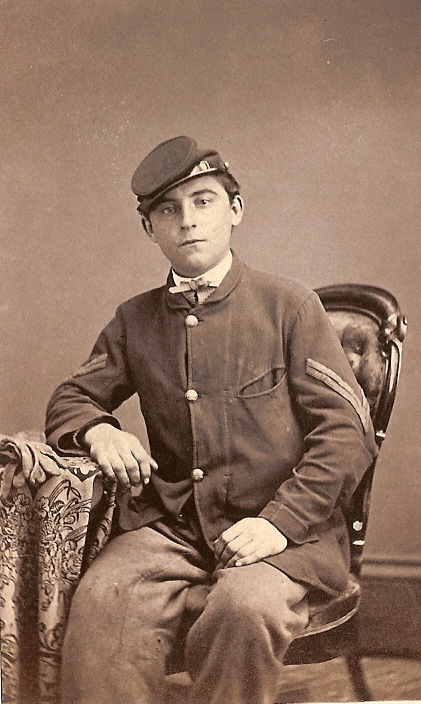
Soldiers of the 48th: Corporal John Humble, Company G


Over my years of researching the 48th Pennsylvania, I have collected quite a number of CDVs of soldiers who served in the regiment. One of my favorites is that of Corporal John Humble, of Company G. With a pose that somewhat betrays his name, Humble appears very proud to be serving in Union blue. His uniform is wrinkled and dirty, showing the effects of war, but this did not deter the young soldier from striking a proud and determined pose.
John Humble was 24 years old when he enlisted in Company G, 48th Pennsylvania. The company muster roll has him standing at 5'5 1/2", with blue eyes, dark hair, and a florid complexion. Before the war, Humble labored as a moulder in Pottsville. He served throughout the course of the war, rising to the rank of corporal, and seeing action with the regiment at 2nd Bull Run, Antietam, Fredericksburg, Spotsylvania, and Petersburg. He was mustered out with the regiment on July 17, 1865.

Sunday, November 19, 2006

PROFILES: General James Nagle (1)


The following biographical sketch of James Nagle appeared in Memorial to the Patriotism of Schuylkill County, by Francis Wallace (Pottsville: Benjamin Bannan, 1865): Pages 501-504.

“General Nagle was born in Reading, Pa., on the 5th of April, 1822. Even when a youth his tastes were military. In 1842 he organized in Pottsville, where he resided, the Washington Artillery Company. When war was declared against Mexico, he, among the first, tendered the services of his Company. They were accepted. The Company left Pottsville, December 5, 1846, for Pittsburgh, Pa., and was mustered into the United States service as Company B, 1st Pennsylvania Regiment. The Regiment was among the first troops to land at Vera Cruz. The Company was one of the four that first approached the city within a few hundred yards under cover of darkness, to clear away the chapperal to enable a naval battery to be planted. Gen. Nagle was engaged during the entire siege, and rendered efficient service. At the Battle of Cerro Gordo he acted as Major with the Regiment to Perote Castle, where he was stationed with three other companies under command of the Colonel to keep communication between Vera Cruz and Puebla open, while the army under Gen. Scott, was advancing. June 20, 1847, he and his company were engaged at Lahoya in assisting Gen. Cadwallader through the Pass with reinforcements and large trains of stores and money. The Pass was strongly fortified by guerillas, but they were routed. October 9, 1847, he and his company were engaged at Huamantla; on the 12th at Puebla, and on the 19th at Atlixco. In each engagement the enemy was routed with heavy loss. Subsequently he advanced with his Regiment to the City of Mexico; remained there several weeks, and was finally stationed at San Angel until the close of the war. The company was mustered out of the service at Philadelphia, July 27, 1848, and reached Pottsville on the 28th, where it experienced an enthusiastic reception.
At a meeting of the citizens of Pottsville, the following among other resolutions, was adopted:
Resolved, That while we rejoice in the glorious termination of the late struggle with Mexico, we acknowledge the brave and gallant conduct of the officers and men composing the volunteers from Schuylkill County, under the command of Capt. James Nagle, who answered to the call of duty, regardless of the privations and sufferings incident to a long campaign in an enemy’s country, thousands of miles from their homes.
Soon after his return, he was presented with a handsome sword by the citizens of Schuylkill County, for his gallant services in Mexico. In the Autumn of 1852, he was elected Sheriff of the County, and subsequently to Brigade Inspector and Colonel. He kept up the organization of the Washington Artillerists, until the commencement of the Rebellion in 1861, when the Company, under the command of Capt. James Wren, was one of the first five companies to reach Washington for its defense.
Captain Nagle was commissioned Colonel of the Sixth Pennsylvania Regiment by Gov. Curtin, for three months. His Regiment served in the Brigade of Col. Geo. H. Thomas, Gen. Patterson’s Department. Col. Nagle was engaged with his Regiment in the skirmish at Falling Waters. He crossed the Potomac four times, and advanced beyond Martinsburg and Charleston, Va. At the termination of his term of service Col. Nagle was highly complimented by Gen. Patterson, and received a complimentary order (No. 16) from his Brigade Commander, Col. Thomas.
In a fortnight after his return from the three months’ service, Col. Nagle organized the 48th Pennsylvania Regiment for ‘three years or the war.’ He was commissioned Colonel of it by Gov. Curtin. He was ordered to Fortress Monroe, and shortly after his arrival there, was sent by Gen. Wool to Hatteras Island, after Gen. Williams had been relieved. He was in command of the post four months. After the capture of Roanoke Island, he, with a portion of his Regiment, accompanied Gen. Burnside’s fleet, and was present at the capture of Newbern, N.C. Immediately after the battle of Newbern, he was assigned by Major General Jesse L. Reno to the command of the 1st Brigade, 2nd Division, 9th Army Corps. The Corps soon joined Gen. Pope. Gen. Nagle was engaged with his Brigade in the Second Battle of Bull Run. In an assault upon the enemy, made in dense woods, where it was impossible to remain mounted, he led his Brigade on foot. His horse was captured after receiving eight wounds.
Soon after the battle Gen. Reno recommended him to the President for promotion to Brigadier-General. Gen Reno’s letter was as follows:
Headquarters, 9th Army Corps
Near Washington, Sept. 7th, 1862
To His Excellency, the President of the United States:
Sir:-I have the honor to recommend Col. James Nagle, 48th Regt. Pa. Vols., for promotion as Brigadier General. Col. Nagle has served with me with fidelity and ability as commander of a Brigade, since the Battle of Newbern, and in recent battles conducted himself with gallantry, and led his command with judgment and discretion.
I have the honor to be
Very Respectfully, Your obd’t servant,
J.L. Reno
Major-General com’dg
The appointment was made. Gen. Nagle was subsequently in the battles of Chantilly, South Mountain, and Antietam, where his Brigade did good service. During the last named engagement Gen. Nagle’s Brigade was the first to advance upon the enemy at the bridge over the Antietam, and, when it had expended all its ammunition, the 2nd Brigade of the same Division relieved it. Several more rounds were fired, when the enemy began to waver, and the bridge was stormed and carried by the 2nd Division, commanded by Gen. Sturgis. The loss was heavy, but the gallant assault saved the day, as appears from the following order:
Head-Quarters, 2nd Div. 9th A.C.
Antietam, September 20, 1862
General Order, No. 11
The General commanding the Division, avails himself of this lull in the roar of battle to return his thanks to the officers and troops, for their handsome behavior in the battles of South Mountain and Antietam Bridge, and to say to them that he has been assured by Gen. Burnside that Gen. McClellan considers the carrying of the bridge as having saved the day.
S.D. Sturgis
Brig. Gen., com’dg

An officer wrote from the battle-field that Nagle’s and Ferrero’s Brigades of Sturgis’s Division, occupied the ground and held the crest of the hill all that night, and drove the enemy from the field.
At Amissville in a skirmish, Gen. Nagle with his Brigade, drove the Rebels finely. They were also engaged at the First Battle of Fredericksburg. The Brigade fought bravely under its gallant commander, and sustained a heavy loss.
Subsequently the Ninth Corps was detached from the Army of the Potomac, and sent to Newport News to recruit. They remained there for several weeks, and were then sent to Lexington, Ky., where Gen. Nagle was in command of the post for a short time. He was then ordered to advance with his Brigade to Winchester to watch the movements of the enemy. From there he went to Richmond, Ky., Paint Lick and Lancaster, where in May, 1863, Gen. Nagle resigned on account of severe suffering from angina pectoris—a painful disease of the heart.
Upon tendering his resignation, Gen. Nagle received from Gen. Sturgis the following expression of regret:
Head-Quarters, 2nd Div., 9th Army Corps
Dear General:
I cannot better express the pain it gave me to forward your resignation, then by giving you a copy of my endorsement upon it, viz: ‘Respectfully forwarded and approved. But I must express my deep regret at the necessity for this forwarding it. By his intelligence, energy, zeal and courage, and quiet, unassuming deportment, withal, Gen. Nagle has endeared himself to this command, and will carry with him the love and respect not only of those gallant troops he had led so often to victory, but of all who have the good fortune to know him.’
S.D. Sturgis
Brig. Gen., com’dg

Gen. Nagle issued a farewell address to his troops, and amid their regrets and with their earnest wishes for the speedy recovery of his health, returned home.
After having been at home about a month, rest and absence from the excitement and exposure of the field, had a beneficial effect. His health became better, and when Gen. Lee commenced his invasion of Pennsylvania in June, 1863, Gen. Nagle organized the 39th Regt., Pa. Militia, for the ‘emergency,’ and was commissioned Colonel by Gov. Curtin. He was mustered into the service on the 4th of July, 1863, and proceeded to the front at once. On his arrival there, Gen. Couch immediately assigned him to the command of a Brigade, composed of six regiment and one battery, numbering some forty-eight hundred men. He was mustered out of the service, August 2, 1863.
When in 1864, a call was made for the Hundred Days’ Service, Gen. Nagle with characteristic promptness and energy, organized the 194th Penna. Regiment, of which he was commissioned Colonel by Gov. Curtin, July 21, 1864. He was ordered to Baltimore. On his arrival Gen. Wallace directed him to report to Gen. Lockwood, commander of the 3rd separate Brigade, who assigned Gen. Nagle to the command of all the troops at Mankin’s Woods—about 8000 men. He guarded some of the approached to the city until the expiration of his term of service, when he was relieved and returned with his Regiment to Harrisburg, and was mustered out, Nov. 5, 1864.
General Nagle’s services in the Rebellion will ever be remembered with gratitude by not only the people of Schuylkill County, but by the nation at large, who owe the preservation of their liberties to the self-sacrificing devotion of men like him.’